The proof for fathers marrying off minors: Aisha's marriage at six
Arabic text
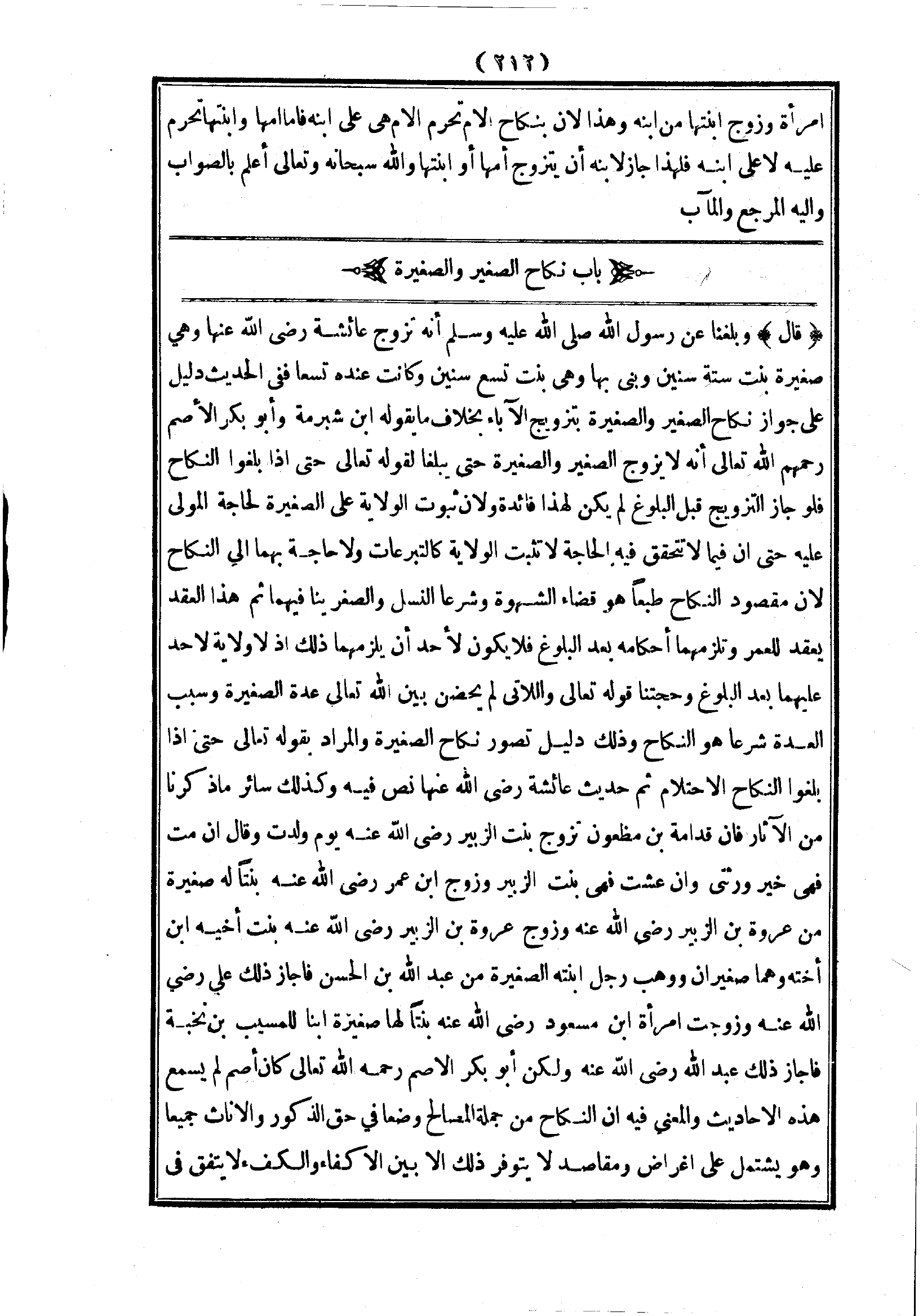
Full page
Translation
Word by word
it has reached us وَبَلَغَنَا* married تَزَوَّجَ* a girl of six بِنْتُ سِتَّةِ سِنِينَ consummated the marriage with her بَنَى بِهَا* in this hadith there is proof فَفِي الْحَدِيثِ دَلِيلٌ* the permissibility of جَوَازِ the marriage of the minor boy and the minor girl نِكَاحِ الصَّغِيرِ وَالصَّغِيرَةِ* by the fathers giving them in marriage بِتَزْوِيجِ الْآبَاءِ*
Interlinear view
- وَبَلَغَنَا: The formula used in fiqh works for transmission without a chain; no line of narrators is given.
- تَزَوَّجَ: Form V of z-w-j: the making of the contract. Consummation is expressed by a separate verb (bana); the text distinguishes them.
- بَنَى بِهَا: From b-n-y, «to pitch (the bridal tent)»; in classical usage the beginning of sexual union.
- فَفِي الْحَدِيثِ دَلِيلٌ: Al-Sarakhsi is not transmitting here but arguing: the sentence is the work's own ruling.
- نِكَاحِ الصَّغِيرِ وَالصَّغِيرَةِ: al-saghir/al-saghira here denotes one who has not reached maturity; this is also the chapter title itself.
- بِتَزْوِيجِ الْآبَاءِ: A Form II verbal noun: the subject who makes the contract is the father, not the one married off.
Source
Context
The passage opens al-Mabsut's chapter 'the marriage of the minor boy and the minor girl' (vol. 4 p. 212); its first sentence does not establish the ruling but its proof. Al-Sarakhsi introduces the report with 'it has reached us' (wa-balaghana), the formula used in fiqh works for transmission without a chain; neither this report nor the practices of the Companions listed after it (Qudama b. Maz'un contracting marriage with al-Zubayr's daughter on the day she was born, Ibn Umar giving his young daughter to Urwa, Urwa marrying his brother's daughter to his sister's son while both were minors, Ali and Ibn Mas'ud approving similar contracts) is given an isnad on this page.
The page's real value is that it records the tradition's own Quran-based objection. Al-Sarakhsi reports the position of Ibn Shubruma and Abu Bakr al-Asamm that minors may not be married off, together with their grounds: 'until they reach [the age of] marriage' (4:6) — 'had marriage before maturity been valid, this phrase would serve no purpose'; further, that guardianship is established only for the need of the one under it, that the natural purpose of marriage is the satisfaction of desire and its legal purpose offspring, both negated by minority, and that the contract binds for life while after maturity no one holds guardianship over them. Al-Sarakhsi's answer runs in three steps: 'and those who have not menstruated' (65:4) fixes the waiting period of the minor girl, the legal cause of a waiting period is marriage, therefore the marriage of a minor is conceivable; 'reaching marriage' in 4:6 means the onset of seminal maturity; and the Aisha report is decisive text on the question. There follows the remark about al-Asamm: 'but Abu Bakr al-Asamm was deaf, he did not hear these hadiths.'
The next page states the practical consequence: when a father marries off his daughter she acquires no option to repudiate the contract on reaching maturity.
End of the previous page
Start of the next page
Positions of the schools
| Hanafi | A father (and grandfather) may marry off a minor boy or girl without seeking their consent; the proof is the report about Aisha and the practice of the Companions. This is the page that is the subject of this entry. |
|---|---|
| Maliki | No one may compel anyone into marriage; the exceptions are enumerated: the father (over his virgin daughter and minor son), the master (over his slave woman and slave) and the guardian (over his orphan ward). The same page records that a father's marrying off his young daughter for less than her fair dower is likewise valid. |
| Shafi'i | The father of a virgin has more right to give her in marriage than she has herself, on the ground that a girl of seven and of nine has no say over herself. No guardian other than a father may give a virgin in marriage until she reaches maturity. |
| Hanbali | A father marries off his young daughter without seeking her consent and she acquires no option on reaching maturity; further, by Ahmad's explicit ruling a girl who has completed nine is handed over for consummation if her husband demands it. |
How the tradition defends this
The tradition's defence runs along these lines. (1) The contract and consummation are distinct: in Hanafi law a minor's marriage is a contract of guardianship; sexual union is tied to a separate threshold (physical capacity), and that distinction is present in the texts themselves. 'Marriage to a child' and 'intercourse with a child' are therefore not the same ruling. (2) Welfare: al-Sarakhsi's own stated reason is that a suitable match is not available at every moment; the guardian secures the child's future and the contract is in the child's interest. (3) The proof from 65:4: the Quran regulates the waiting period of a woman who has not menstruated; the cause of a waiting period is marriage; therefore the Quran presupposes that such a marriage occurs — so the objection is not Quran against tradition but one verse against another. (4) Internal review: the position of Ibn Shubruma and al-Asamm is not an invention; the school's own book records it, so the question was contested inside the tradition and it is wrong to ascribe a single position to Islam. (5) The option at maturity: some Hanafis grant an option to repudiate where a guardian other than father or grandfather contracted the marriage, which is offered as an internal indication that the authority is not unlimited. None of these defences disputes what stands on the page; all of them work to narrow the ruling's scope.
Still held today?
What does the Quran say?
- 4:6 Text states it explicitly
'Test the orphans until they reach [the age of] marriage; then if you discern in them sound judgement, hand over to them their property.' An orphan's property is not transferred until two thresholds are met together — reaching the age of marriage and the discernment of rushd. This is the measure the text itself sets: no transfer before capacity. Ibn Shubruma's proof, transmitted on this very page, is precisely this verse.
- 4:21 Text states it explicitly
'And they have taken from you a solemn covenant.' The party taking the covenant is the women; the verb is assigned to them. A party whose consent is legally never sought cannot, by description, be the party who takes a covenant.
- 2:232 Text states it explicitly
'Do not prevent them from marrying their husbands when they have agreed together in a fitting way.' The verb of marrying (yankihna) is feminine plural and assigned to the women, and the condition is mutual agreement (tarada, Form VI — reciprocal). The guardian's role here is not to obstruct, not to make the contract by himself.
- 4:19 Text states it explicitly
'It is not lawful for you to inherit women against their will.' Placing women into a marital arrangement against their own will is forbidden outright; karhan stands as a circumstantial qualifier of the act itself.
- 30:21 Implied by the text
'He created for you from yourselves spouses, that you may find repose in them, and He set between you affection and mercy.' The purpose the text states for the contract is a repose, an affection and a mercy each party finds in the other. These are not states one party can establish alone; the statement of purpose requires parties capable of entering into such a relation.
- 65:4 Compatible with the text
'And those of your women who have despaired of menstruation, if you are in doubt, their waiting period is three months, and [likewise] those who have not menstruated.' This is al-Sarakhsi's counter-proof on this page. The honest assessment: the phrase states no age. The first member is women whose menses have ceased; the second phrase is coordinated onto it, and what joins them is not age but the unavailability of menstruation as a measure — not menstruating has causes other than childhood. Further, the verse regulates the counting of a waiting period; it does not license the making of a contract. What al-Sarakhsi derives from it is that a minor's marriage is conceivable, not that it is permitted. The traditional reading is not contrary to the text, but neither is it required by it.
This page makes the site's question unusually plain, because it is the tradition itself that transmits the Quran-based objection in its own book. Ibn Shubruma's proof is 4:6, and the verse sets two thresholds before an orphan's property may be handed over: 'until they reach [the age of] marriage' and 'if you discern in them sound judgement'. That is the measure the text itself builds: property is not transferred before capacity exists. That the Quran sets this threshold for a girl's property while the tradition requires no threshold at all for her, is an inconsistency internal to the material, not a criterion brought in from outside.
Al-Sarakhsi's counter-proof is 65:4, and the honest assessment is this: the phrase 'and those who have not menstruated' states no age. The first half of the sentence is 'those who have despaired of menstruation' — women whose menses have ceased; the second phrase is coordinated onto it, and what joins the two is not age but the unavailability of menstruation as a measure. Not menstruating has causes other than childhood. Further, the verse regulates the counting of a waiting period; it does not license the making of a contract. Al-Sarakhsi's own wording gives this away: what he derives from the verse is that the marriage of a minor is conceivable, not that it is permitted. The step from conceivable to permitted is taken by the hadith, not by the verse.
Looking at the structure the Quran builds around marriage, the consent of the parties is not a secondary detail but the description of the contract: the women have taken from you 'a solemn covenant' (4:21) — the party taking the covenant is the woman; 'do not prevent them from marrying their husbands when they have agreed together' (2:232) assigns the verb to the women and makes mutual agreement the condition; 'it is not lawful for you to inherit women against their will' (4:19) forbids compulsion outright; 'that you may find repose in them' (30:21) sets the purpose of the contract as a repose each party finds in the other. A party whose consent is legally never sought cannot, by description, take a covenant, agree mutually, or be a repose.
Where the text is silent should be recorded too: the Quran gives no numeric age for marriage. What it gives is not an age but a measure of capacity (4:6) and a structure of consent. The strongest evidence that can be set against this reading is 65:4, treated above; its traditional reading is not contrary to the text, but neither is it required by the text — it remains at the level of the text-compatible and cannot on its own license a contract. The page's last move shows why all this matters for this entry: the ruling was derived not from the Quran but from a report given without a chain, and that report was used to suspend the threshold the verse had set.