A child born of zina is not legally one's child: marrying the daughter is disliked, but not annulled
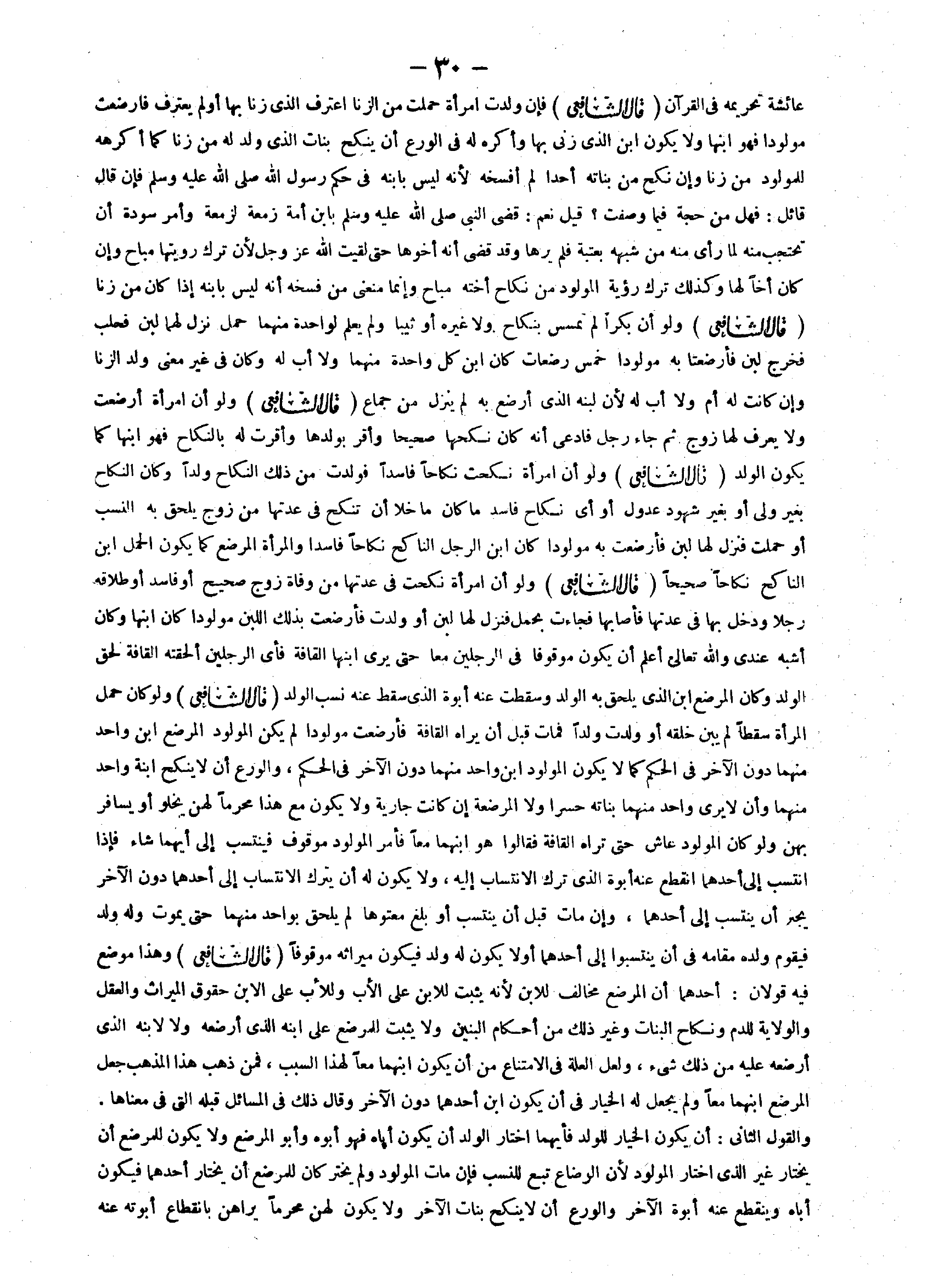
Arabic text
Full page
Translation
Word by word
and-if فَإِنْ she gave birth وَلَدَتْ a woman امْرَأَةٌ she conceived حَمَلَتْ from مِنْ zina الزِّنَا he acknowledged اعْتَرَفَ the one who الَّذِي committed zina زِنَا with her بِهَا or أَوْ did not لَمْ acknowledge يَعْتَرِفْ and-she nursed فَأَرْضَعَتْ an infant مَوْلُودًا then he فَهُوَ is her son ابْنُهَا and-not وَلَا is يَكُونُ the son of ابْنُ the one who الَّذِي committed zina زَنَى with her بِهَا and-I dislike وَأَكْرَهُ* for him لَهُ in فِي scrupulousness الْوَرَعِ that أَنْ he marry يَنْكِحَ the daughters of بَنَاتِ the one who الَّذِي was born وُلِدَ to him لَهُ from مِنْ zina زِنًا just as كَمَا I dislike it أَكْرَهُهُ for the one born لِلْمَوْلُودِ from مِنْ zina زِنًا and-if وَإِنْ he marries نَكَحَ from مِنْ his daughters بَنَاتِهِ one أَحَدًا not لَمْ I annul it أَفْسَخْهُ* because-he لِأَنَّهُ is not لَيْسَ his son بِابْنِهِ in فِي the ruling of حُكْمِ the Messenger of رَسُولِ God اللَّهِ (peace be upon him) ﷺ
Interlinear view
- وَأَكْرَهُ: 1st person singular imperfect, root k-r-h: 'I find it disliked'; not 'I forbid'.
- أَفْسَخْهُ: lam + jussive imperfect + suffixed object pronoun: 'I do not annul it'.
Source
Context
The passage occurs in al-Umm's chapter on milk kinship (rada'); al-Shafi'i applies to the milk bond his principle that a child born of zina is not legally attributed to the man who committed zina. The principle is stated openly in the same volume: 'zina has no ruling that would make the lawful unlawful' (vol. 5 p. 27; Mukhtasar al-Muzani vol. 8 p. 270: 'zina does not make the lawful unlawful'). Whether 'the daughters of the one born to him from zina' means the daughters born of zina directly or the daughters of the child born of zina is grammatically arguable; the ground of the ruling ('he is not his son in the ruling of the Messenger of God') is the same on either reading. The school's settled wording is unambiguous in al-Nawawi's Minhaj: 'the [girl] created from his zina is lawful to him, while a woman's child born of zina is forbidden to her' (p. 210). Ibn Qudama attributes this view to Malik and to the dominant position of al-Shafi'i, and defends prohibition on behalf of 'the generality of jurists' (al-Mughni vol. 9 p. 529). The claim as it circulates ('he ruled that one may marry her') reports al-Shafi'i's own wording incompletely: he says 'disliked' and only 'I would not annul it'; the school's later formula, however, says 'lawful to him'.
End of the previous page
Start of the next page
Positions of the schools
| Hanafi | Forbidden. A child born of zina is 'part' of the man (ba'diyya); kinship is not established, because several men may have come to the woman, but the prohibition is. |
|---|---|
| Maliki | Ibn Qudama attributes the permissive view to Malik ('all of that is permitted, because she is a stranger to him and is not legally attributed to him'). The later dominant Maliki position is prohibition, and contemporary fatwas count the Malikis among the majority. The Maliki primary source has not yet been verified for this entry. |
| Shafi'i | Not forbidden; disliked out of scrupulousness; if contracted, not annulled (this entry). The school's settled formula: 'the [girl] created from his zina is lawful to him' (al-Nawawi, Minhaj p. 210). The principle: 'zina does not make the lawful unlawful' (Mukhtasar al-Muzani vol. 8 p. 270). |
| Hanbali | Forbidden: 'a man is forbidden to marry his daughter from zina, his sister, his son's daughter, his daughter's daughter, his brother's daughter and his sister from zina; this is the view of the generality of jurists.' The ground: 'because she is truly from his seed' (vol. 11 p. 322). |
How the tradition defends this
The tradition's defence runs as follows. (1) Legal kinship is established only by a valid marriage, a defective marriage or a plausible mistake; zina establishes none ('the child belongs to the bed, and the fornicator gets the stone'). (2) Since the daughter born of zina is not attributed to the man, she does not inherit from him, he is not her guardian and owes her no maintenance; by the same logic 'your daughters' in 4:23 does not apply to her, because she is not legally 'his daughter'. (3) Al-Shafi'i does not present this as 'permitted'; he calls it disliked out of scrupulousness and says only 'I would not annul it'; the ruling follows from the absence of any legal cause that would make the lawful unlawful. (4) The view is a minority one within Sunni fiqh; the Hanafi and Hanbali schools, later Malikis and contemporary fatwa bodies adopt prohibition. (5) Within the Shafi'i tradition too it is stressed that the ruling is 'so in law, unthinkable in practice'.
Still held today?
What does the Quran say?
- 4:23 Text states it explicitly
«Forbidden to you are your mothers and your daughters»: the text says 'your daughters', with no qualifier tying daughterhood to a valid contract. The same verse attaches a condition to step-daughters ('from your wives with whom you have consummated'); it attaches none to one's own daughters.
- 58:2 Text states it explicitly
«Their mothers are none but those who gave birth to them»: the Quran defines motherhood by birth, not by a contract.
- 33:4-5 Text states it explicitly
«He has not made your adopted sons your sons … call them by their fathers»: adopted children are not sons; children are attributed to their real fathers. The Quran ties fatherhood, too, to real parentage rather than to a legal construct.
- 4:23 Implied by the text
Result: because 58:2 and 33:4-5 define kinship by birth and real parentage, that a daughter born of zina falls under 'your daughters' in 4:23 is an inference the text compels. The distinction 'a child of zina is not legally one's child' does not exist in the Quran; a verse tying kinship to a contract was searched for and not found (text-silent). The strongest counter-evidence is the tradition's report 'the child belongs to the bed'; that is a hadith, not the text of the Quran.
The issue is not al-Shafi'i's intent but the method. In front of a text that says 'your daughters are forbidden to you', a legal construct tying kinship to a contract was placed, and the text was then narrowed to fit the construct. If the Quran defines kinship by birth and real parentage, defining it by contract is to place law above the text. That the majority of the schools did not reach the same conclusion does not vindicate the method; Ibn Qudama's ground ('she is truly from his seed') is the Quran's measure, not fiqh's, and it had to be defended against fiqh's own consistency.