Al-Shafi'i: any adult man or woman who leaves Islam is called to repent, and is killed if they do not
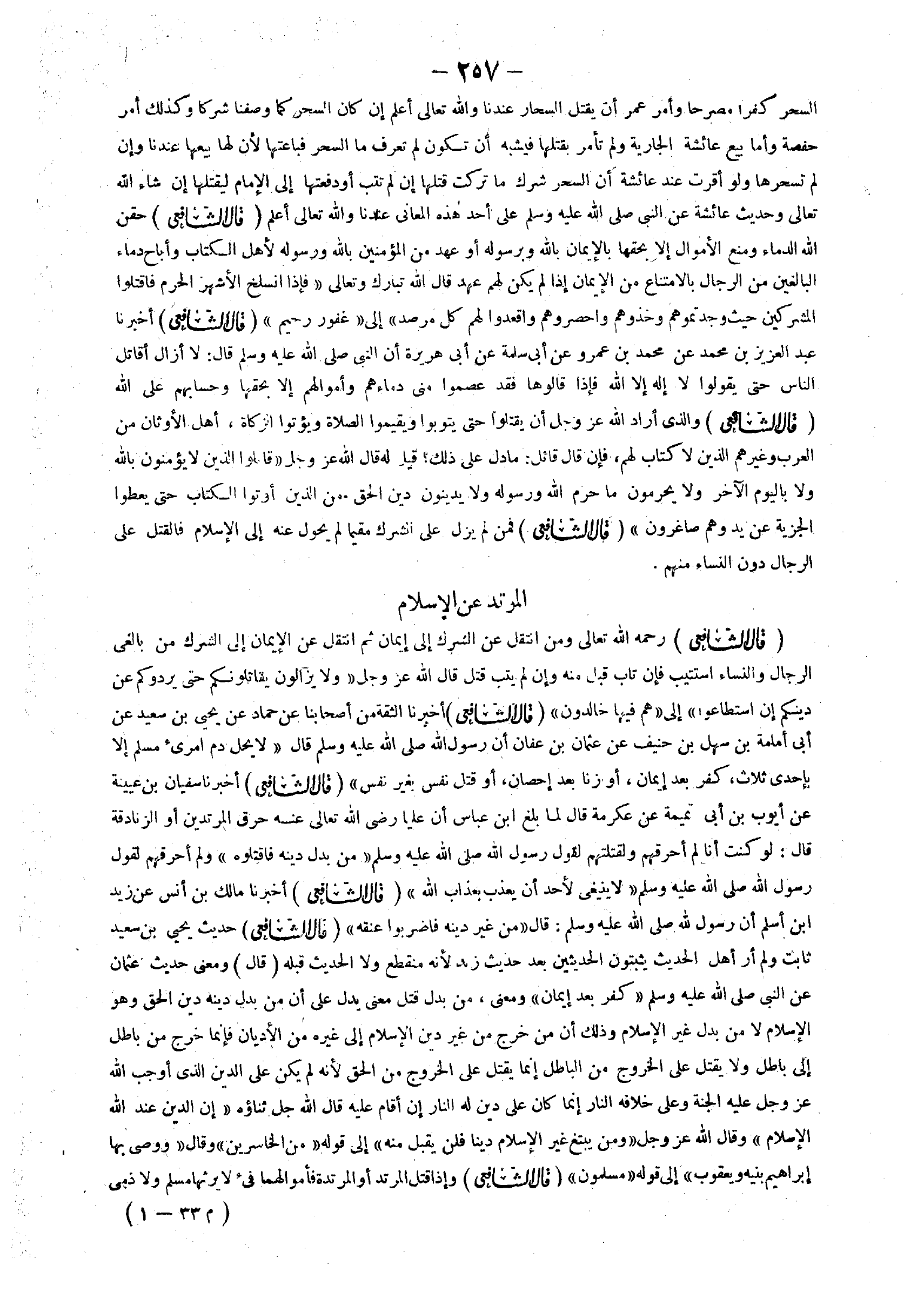
Arabic text
Full page
Translation
Word by word
whether of the adult men or of the women مِنْ بَالِغِي الرِّجَالِ وَالنِّسَاءِ* is called to repent اُسْتُتِيبَ* and if he does not repent he is killed وَإِنْ لَمْ يَتُبْ قُتِلَ* the report of Yahya b. Sa'id is established حَدِيثُ يَحْيَى بْنِ سَعِيدٍ ثَابِتٌ*
Interlinear view
- مِنْ بَالِغِي الرِّجَالِ وَالنِّسَاءِ: The explicit inclusion of women is this page's distinguishing phrase. The sentence immediately before says, of polytheists who never entered Islam, 'killing applies to the men and not the women'; the woman's life is protected in original unbelief and not protected in departure from Islam.
- اُسْتُتِيبَ: Istitaba: form X of t-w-b. The next page records two views on whether it is done at once or over a term (three days), and transmits by way of Malik Umar's rebuke of a summary execution.
- وَإِنْ لَمْ يَتُبْ قُتِلَ: A passive verb; its agent is the court. The verse al-Shafi'i reads immediately afterwards as proof (2:217) describes the same case with an active, intransitive verb: fa-yamut — 'and he dies'.
- حَدِيثُ يَحْيَى بْنِ سَعِيدٍ ثَابِتٌ: Of the page's three reports al-Shafi'i counts only one as established, Uthman's hadith 'unbelief after faith'; Zayd b. Aslam's he calls 'broken'. On the most natural reading of the sentence he says that the people of hadith do not establish the Ikrima–Ibn Abbas report 'whoever changes his religion, kill him' either.
Source
Context
The passage is the subheading 'the apostate from Islam' in the first volume of al-Umm, coming immediately after the discussion of whom to fight and on what ground (Dar al-Fikr vol. 1 p. 294). Al-Umm also has a longer chapter devoted to the apostate ('the great chapter of the apostate', Dar al-Fikr vol. 6 p. 168); this page is the ruling's short, compact statement.
The page proceeds in five moves. (1) Original unbelief: of the polytheists, 'killing applies to the men and not the women'. (2) Apostasy: the adult man and woman who move from faith to polytheism are called to repent and killed if they do not return — this is the quote; 2:217 is read as proof from 'and they will not cease fighting you' to 'they abide in it forever'. (3) Three reports: from Uthman, 'the blood of a Muslim is lawful only for one of three: unbelief after faith, adultery after ihsan, or killing a soul without right'; from Ikrima, Ibn Abbas's words 'whoever changes his religion, kill him' on hearing that Ali had burned apostates; from Malik, Zayd b. Aslam's mursal 'whoever alters his religion, strike his neck'. (4) Assessment: al-Shafi'i counts only Uthman's report as 'established'. (5) Scope: the ruling applies only to one who leaves Islam; one who moves from one false religion to another has gone 'from falsehood to falsehood' and is not killed — the proof being 3:19, 3:85 and 2:132.
The page's continuation (context_after) regulates the apostate's property and children: the property of the executed apostate man and woman is fay'; their children are not enslaved, because 'they bear no sin for their fathers' change of religion' — but the same sentence adds that any of these children who reaches maturity is commanded to Islam and, if he does not become Muslim, is killed.
End of the previous page
Start of the next page
Positions of the schools
| Hanafi | The male apostate is killed; the female apostate is not killed but imprisoned and forced to return to Islam. The same page reports al-Shafi'i's view 'she is killed if she does not become Muslim' as the opposing position. |
|---|---|
| Maliki | An apostate who declares his departure openly is invited to repent and killed if he does not return; the zindiq who conceals his unbelief is killed when found out, without being invited to repent. |
| Shafi'i | The adult man and woman who move from faith to polytheism are called to repent; if they repent it is accepted, if not they are killed. The ruling applies only to one who leaves Islam, not to one who moves between other religions. This is the page that is the subject of this entry. |
| Hanbali | Killing the apostate is obligatory and there is consensus on it; there is no difference between a man and a woman, and they are called to repent for three days under constraint. |
How the tradition defends this
The tradition's defence runs along these lines, and part of it comes from this very page.
(1) Al-Shafi'i narrows the scope. The report's wording, 'whoever changes his religion', is broad enough to cover any changer of religion; al-Shafi'i reduces it to departure from Islam and expressly excludes one who moves from one false religion to another.
(2) Istitaba is required and repentance is accepted. The ruling is not the automatic application of a penalty but a process with a way back; the next page records two views on the length of istitaba and transmits Umar's rebuke of a summary execution.
(3) Equality is a principle of justice. Shafi'is argue that in penalties men and women are treated alike — as in the hadd for adultery, theft and wine — and that exempting the woman would be a discrimination (this argument is reported on al-Shafi'i's behalf by al-Sarakhsi at al-Mabsut vol. 10 p. 109).
(4) Al-Shafi'i sifts his own proofs. The page brings three reports and counts only one as established; it is a methodological rigour that builds hadith criticism into the ruling itself.
(5) Individual responsibility is recognised. The apostate's children are not enslaved, because 'they bear no sin for their fathers' change of religion'.
Still held today?
What does the Quran say?
- 2:217 Text states it explicitly
"And whoever of you turns back from his religion and dies while an unbeliever — their deeds have come to nothing in this world and the next, and they are the companions of the Fire": the verse al-Shafi'i reads immediately after the quote. It envisages the one who turns back from his religion as remaining an unbeliever until he dies: the verb fa-yamut is active and intransitive — 'dies', not 'is killed'. The recompense is twofold and neither part is in a court's hands: the voiding of deeds and the Fire. The page's ruling shrinks the span the verse leaves open, 'until he dies', to the span of istitaba.
- 4:137 Text states it explicitly
"Those who believed, then disbelieved, then believed, then disbelieved, then increased in disbelief — God will not forgive them": the verse describes people who move between faith and unbelief more than once. For the description to mean anything they must have survived the cycle; someone killed at the first turn has no second faith. The recompense is again divine: not being forgiven and not being guided.
- 2:256 Text states it explicitly
"There is no compulsion in religion; right guidance has become distinct from error": the verse rejects compulsion in religion on the ground that the right way and error have become clearly distinct. Istitaba offered as 'repent or be killed' is by definition a demand for a declaration of belief under threat of death.
- 18:29 Text states it explicitly
"So whoever wills, let him believe, and whoever wills, let him disbelieve; We have prepared for the wrongdoers a Fire": the choice between faith and unbelief is left to the person's will and its recompense is tied to the hereafter.
- 10:99 Text states it explicitly
"Would you then compel people until they become believers?": the question is put directly to the Prophet and its answer lies in the verse itself: faith cannot be the result of compulsion.
- 3:85 Compatible with the text
"Whoever seeks a religion other than Islam, it will not be accepted from him, and in the hereafter he will be among the losers": al-Shafi'i reads this verse to bound the ruling's scope: the penalty falls only on one who leaves the religion of truth. The verse is compatible with that use; but the recompense it states itself is non-acceptance and loss in the hereafter, not a worldly sanction.
What puts this page in the register is not that it carries the ruling to kill the apostate — that ruling stands in three of the four schools — but the threshold at which it protects the woman's life and the threshold at which it lifts that protection. The sentence immediately before exempts the polytheist woman who never entered Islam from killing; the quote kills the woman who turns back from faith if she does not repent. On the page, then, what costs the woman her life is not unbelief but having once believed. The penalty attaches not to the person's present belief but to her changing it.
Al-Shafi'i reads the Quran first as proof for this ruling, and the verse he reads does not carry it. 2:217 envisages the one who turns back from his religion as one who 'dies an unbeliever'; the verb is active and intransitive, fa-yamut, and the recompense is the voiding of deeds and the Fire. The person the verse describes lives and dies at his own appointed time; the person the page describes is killed when the term for repentance runs out. 4:137 makes the same point more sharply: it describes a person who moves between faith and unbelief twice, which is possible only for someone who was not killed at the first turn.
The chain of proof shows its limits on its own page as well. Al-Shafi'i counts only one of the three reports as established — Uthman's hadith of 'unbelief after faith' — and declares Zayd b. Aslam's openly broken; on the most natural reading of his sentence he says that the people of hadith do not establish the Ikrima–Ibn Abbas report, found today in al-Bukhari, either. The one proof left says 'a Muslim person' (imri'in muslim) and does not name women separately; the inclusion of women in the ruling is the result not of the report but of al-Shafi'i's analogy of equality. From the same report the Hanafis reach the opposite conclusion and do not kill the woman.
There is also what must be written in the page's favour. Al-Shafi'i narrows the ruling's scope: he excludes, despite the breadth of the wording, one who moves from one false religion to another. He requires istitaba and accepts repentance. He does not enslave the apostate's children, because 'they bear no sin for their fathers' change of religion' — a sentence consonant with the Quran's principle of individual responsibility. But the same sentence limits that principle at once: any of these children who reaches maturity is called to Islam and killed if he refuses. The ruling's logic takes its plainest form here — someone counted 'a Muslim by legal rule' in childhood is deemed to have 'left' a religion he never chose.
What the Quran says on the same subject is this: there is no compulsion in religion, because the right way has become distinct from error (2:256); whoever wills believes and whoever wills disbelieves, and the recompense is in the hereafter (18:29); would you compel people until they become believers (10:99). The text names apostasy by name and more than once; none of the recompenses it attaches to it is placed in a court's hands.