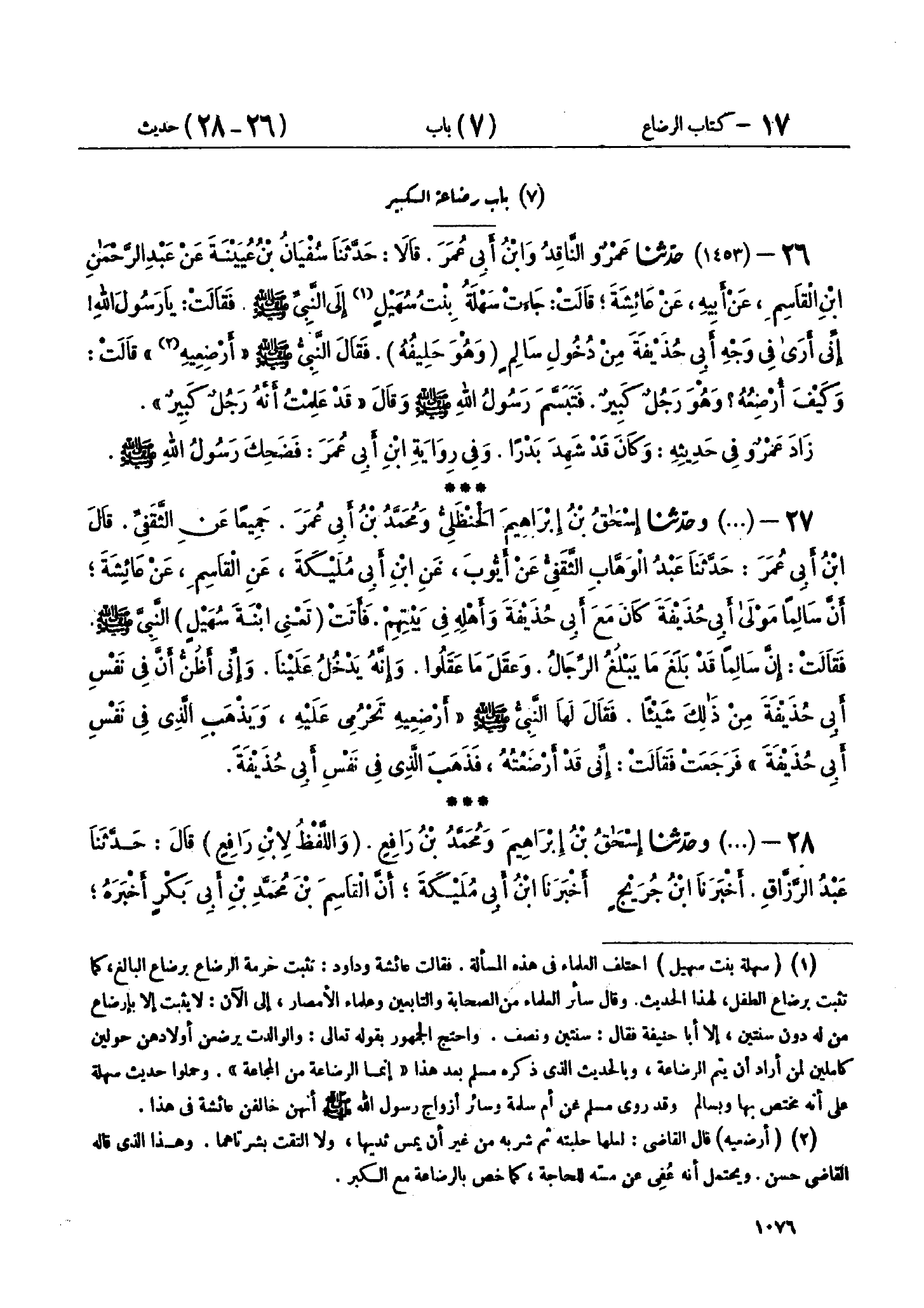
The nursing of a grown man: «Nurse him» — «How can I nurse him, when he is a grown man?»
Arabic text
Full page
Translation
Word by word
and-he said فَقَالَ the Prophet النَّبِيُّ nurse him أَرْضِعِيهِ* she said قَالَتْ and-how وَكَيْفَ can I nurse أُرْضِعُ* when he وَهُوَ is a man رَجُلٌ grown كَبِيرٌ*
Interlinear view
- أَرْضِعِيهِ: Form IV imperative, feminine addressee + object pronoun: 'you (f.) nurse him'. From the root r-d-', denoting the giving of milk.
- أُرْضِعُ: Form IV, first person imperfect; the tone of the question is objection or astonishment.
- كَبِيرٌ: Root k-b-r; here of age: the chapter heading itself reads 'the nursing of the adult'. In the second report the same state is glossed as 'he has reached what men reach'.
Source
Context
The text stands in Sahih Muslim's Book of Suckling, in the seventh chapter, which is headed 'the nursing of the adult' (vol. 2 p. 1076, no. 1453). The situation is this: Salim, the freedman and adopted son of Abu Hudhayfa, counted as unrelated once adoption had been abolished (33:4-5), and his coming and going in the presence of Abu Hudhayfa's wife Sahla bint Suhayl became a problem. The solution given was that Salim be nursed, so that milk kinship would be established. Muslim gives three chains in the same chapter; in the second the rationale is stated openly: 'nurse him, so that you become forbidden to him and what is in Abu Hudhayfa's heart may go.' The chapter goes on to report that the Prophet's other wives did not accept the practice and regarded it as a view particular to Aisha (Muslim 1454) — the disagreement is recorded inside the report itself. The printed footnote on the same page (Abd al-Baqi) summarises the matter: Aisha and Dawud [al-Zahiri] held that prohibition is established by the nursing of an adult; the rest of the scholars among the Companions, the Successors and the scholars of the regions held that it is established only by nursing under the age of two, and the majority grounded this in the Quranic verse 'mothers nurse their children two full years' (2:233).
End of the previous page
Start of the next page
Positions of the schools
| Hanafi | Prohibition is not established by nursing an adult; milk kinship holds only for a child at the age of suckling. Abu Hanifa sets the period at two and a half years (Abd al-Baqi's footnote on the same page). |
|---|---|
| Maliki | Prohibition is established by nursing within two years; the report of Salim is treated by the majority as particular to him. |
| Shafi'i | Prohibition is established by five separate feeds within two years; nursing an adult produces no ruling. |
| Hanbali | With the majority, adopts the two-year qualification; the report of Salim is held to be abrogated or particular. |
How the tradition defends this
The tradition's defence runs in four steps, most of them summarised in the printed footnote on this very page. (1) Specification from the Quran: the majority hold that milk kinship is bounded by 'mothers nurse their children two full years' (2:233), so that nursing an adult produces no ruling — that is, the tradition qualified the generality of this report by the Quran. (2) Reading it as particular: most hold the ruling to be a dispensation specific to Salim and the household of Abu Hudhayfa, their evidence being the disagreement recorded within the report itself (the other wives' refusal, Muslim 1454). (3) Abrogation: one line holds the ruling abrogated by the report of five feeds. (4) The manner of the act: Qadi Iyad's comment, quoted in the footnote on the same page, holds that the milk was expressed and drunk, with no contact. What these defences share is that they neutralise the ruling without rejecting the report; none disputes that the text stands in the Sahih, and the strongest of them appeals directly to the Quran.
Still held today?
What does the Quran say?
- 2:233 Text states it explicitly
«Mothers nurse their children two full years, for whoever wishes to complete the suckling.» The Quran ties suckling to a term, and its object is a child. The majority's own specification rests on precisely this verse.
- 4:23 Text states it explicitly
«And your mothers who nursed you, and your sisters through suckling.» The Quran recognises milk kinship, but 'your mothers who nursed you' refers back to the nursing relation described in 2:233 — a relation formed in infancy.
- 33:4-5 Text states it explicitly
«God has not made for any man two hearts within him … call them by their fathers, that is more equitable with God; and if you do not know their fathers, then they are your brothers in religion and your clients.» The Quran resolves the very problem the report addresses, but differently. Adoption does not create lineage; yet the text goes on to constitute the relation as 'brotherhood in religion and clientage'. In place of the bond it abolishes the Quran puts not a legal device but another, named bond.
- 24:31 Implied by the text
The Quran fixes the circle of mahram relations by enumeration in 24:31 and offers no subsequently performed 'act of nursing' as a way into that list; a route for making an adult a mahram was searched for and not found. That the text is silent here is not a gap but a finding: the Quran does not constitute the circle of mahram relations as an extendable list.
What is striking about this entry is that the tradition itself appealed to the Quran here. The majority did not accept the report's literal ruling and took its ground directly from 2:233: suckling is a relation bounded by two full years, so nursing an adult produces no ruling. The question of the measure — Quran or hadith — was thus opened explicitly, and the majority chose the Quran. The problem is that the choice never became a method: the same tradition sees no difficulty, on other questions, in restricting the Quran's explicit wording by the generality of a hadith (the apostasy entry on this site is an instance). A second point: the problem the report sets out to solve is already resolved in the Quran. Having abolished the bond of adoption, 33:5 constitutes the relation as 'brotherhood in religion and clientage' and proposes no procedure for reproducing mahram status. The solution proposed in the report is to manufacture mahram status by a legal act — the kind of construct 33:4 rejects ('God has not made two hearts in a man's chest'). A third point: the disagreement is recorded inside the report itself, since the Prophet's other wives did not accept the practice. The text says in its own words that it was contested in the first generation.