Malik: zindiqs, when they are found out, are killed without being invited to repent
Arabic text
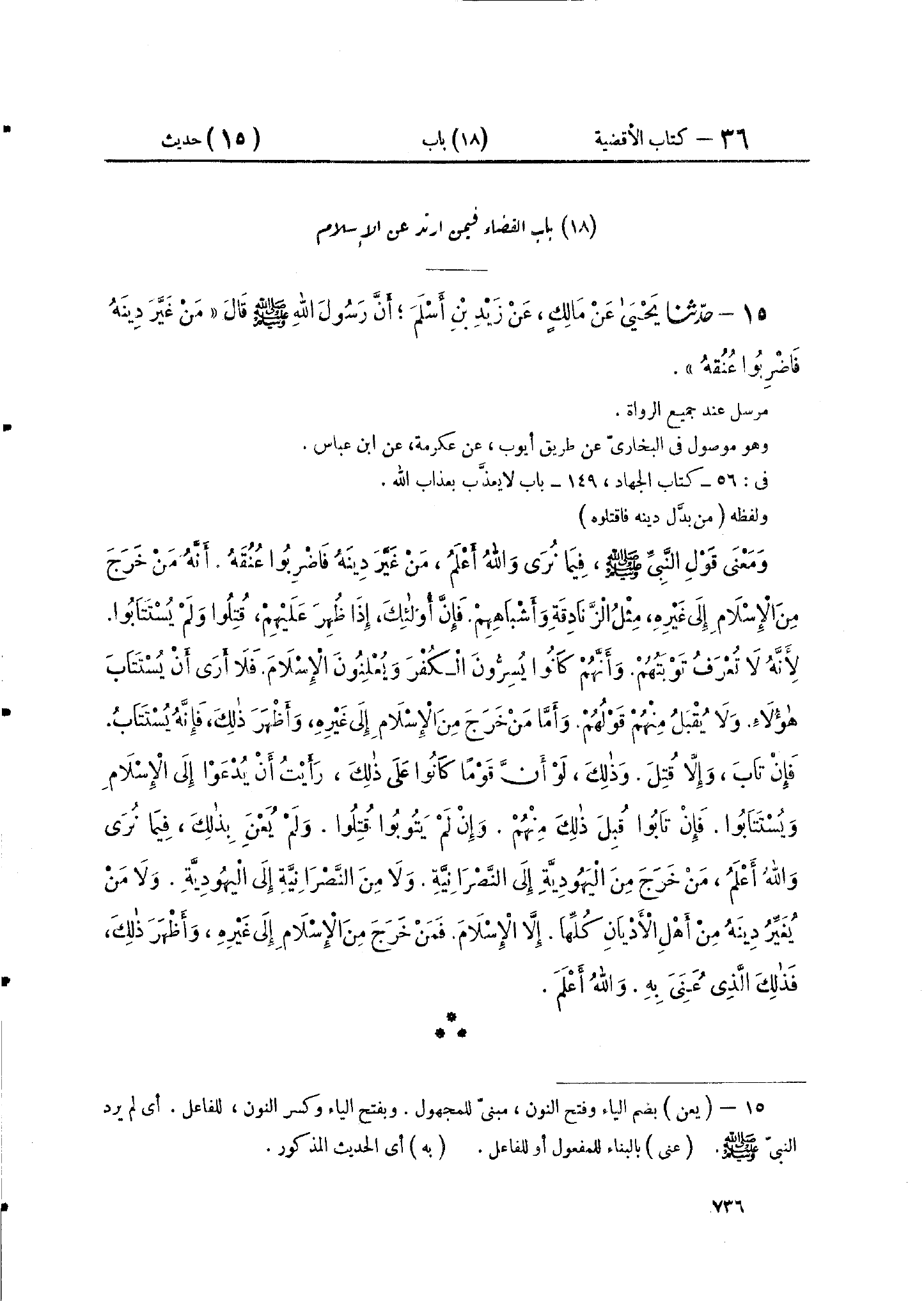
Full page
Translation
Word by word
such as the zindiqs and their like مِثْلُ الزَّنَادِقَةِ وَأَشْبَاهِهِمْ* when they are found out إِذَا ظُهِرَ عَلَيْهِمْ* and they are not invited to repent وَلَمْ يُسْتَتَابُوا* because their repentance cannot be known لِأَنَّهُ لَا تُعْرَفُ تَوْبَتُهُمْ* as we see it — and God knows best فِيمَا نُرَى - وَاللَّهُ أَعْلَمُ*
Interlinear view
- مِثْلُ الزَّنَادِقَةِ وَأَشْبَاهِهِمْ: Zindiq is a term of Persian origin and does not occur in the Quran. The page's own description: one who leaves Islam for something else but **conceals** it. The Quran's word for precisely this set is munafiq.
- إِذَا ظُهِرَ عَلَيْهِمْ: A passive verb. What triggers the ruling is not an act of the subject but others' **coming to know** his concealed state.
- وَلَمْ يُسْتَتَابُوا: Istitaba: form X of t-w-b, 'to call to repentance'. Further down the same page istitaba is required for one who declares his unbelief **openly**; it is withdrawn here because the qualifier is concealment.
- لِأَنَّهُ لَا تُعْرَفُ تَوْبَتُهُمْ: The ground of the ruling is not a claim of knowledge but a claim of **ignorance**: because the interior cannot be known, the possibility of repentance is closed in advance. The Quran draws the opposite conclusion from the same unknowability (9:101).
- فِيمَا نُرَى - وَاللَّهُ أَعْلَمُ: Malik marks the gloss expressly as his own opinion; the page does not present the ruling as transmitted.
Source
Context
The passage stands on the opening page of al-Muwatta's chapter '(18) The chapter of judgment concerning one who apostatises from Islam' (vol. 2 p. 736) and is Malik's own gloss, following immediately on hadith no. 15, the chapter's first report.
The page moves in three steps. (1) The report: 'whoever changes his religion, strike his neck' — from Yahya, from Malik, from Zayd b. Aslam, direct to the Prophet. (2) A narrowing: Malik qualifies the report's generality — 'by this was not meant one who moves from Judaism to Christianity, nor from Christianity to Judaism, nor anyone of all the religions who changes his religion; only Islam [was meant]'. Where the hadith's wording is wide enough to cover any changer of religion, Malik reduces its scope to departure from Islam alone. (3) A division in two: one who conceals his departure (the zindiq) is separated from one who declares it. The declarer is invited to repent and killed if he does not return. The concealer 'is killed when found out and is not invited to repent' — that is this entry's quote.
The rationale stands in the page's own sentence and has two parts: 'their repentance cannot be known' and 'they were concealing unbelief and proclaiming Islam'. What generates the ruling is therefore not a committed act but the unauditable interior of the subject. Malik presents this not as transmission but as his own view: 'as we see it — and God knows best'.
The page's own surroundings bound the ruling on both sides. The preceding page (vol. 2 p. 735) is on an unrelated subject — the destruction of livestock and foodstuffs. The following page (vol. 2 p. 737) carries the chapter's second report and touches this ruling directly: when Abu Musa's man says they seized someone who had disbelieved after his Islam and struck his neck on the spot, Umar rounds on him — 'Could you not have held him three days, fed him a loaf each day, and called him to repent? Perhaps he would have repented and returned to God's command' — and then says, 'O God, I was not present, I did not command it, and I was not content when it reached me.' The record withdrawing istitaba thus stands in tension with the second report of the tradition's own chapter.
The printed copy carries one further record that the digital text does not. Beneath the hadith Abd al-Baqi places his own takhrij: the report is mursal in all the transmissions of the Muwatta (Zayd b. Aslam direct to the Prophet, with no Companion in between); it is connected only in al-Bukhari, by way of Ayyub from Ikrima from Ibn Abbas, with the wording 'whoever changes his religion, kill him'. None of this apparatus is present in Shamela's digital text (see the scan note).
End of the previous page
Start of the next page
Positions of the schools
| Hanafi | The male apostate is killed; calling him to repent is recommended, not obligatory. The female apostate is not killed but imprisoned and coerced until she returns to Islam. |
|---|---|
| Maliki | An apostate who declares his departure openly is invited to repent and killed if he does not return; one who conceals his unbelief while proclaiming Islam (the zindiq) is killed when found out, without being invited to repent, because his repentance cannot be known. This is the page that is the subject of this entry. |
| Shafi'i | Both the male and the female apostate are killed; the ruling for the woman is the same as for the man. |
| Hanbali | The apostate is invited to repent for three days and pressed; if he does not return he is killed. There is no difference between man and woman; Ibn Qudama reports a consensus on it. |
How the tradition defends this
The tradition's defence runs along these lines, and part of it comes from this very page.
(1) Malik narrows the hadith; he does not widen it. The report's wording, 'whoever changes his religion', is broad enough to cover any changer of religion; Malik expressly rejects that and reduces the scope to departure from Islam alone. The page is a text that bounds a penalty, not one that extends it.
(2) Istitaba is the rule and its withdrawal the exception. The same page requires that the apostate who declares his departure be called to repent, and says that even where a whole group is concerned 'let them be called to Islam and invited to repent'. The exception hangs on a single qualifier: concealment.
(3) The zindiq is not a person who changed his mind. In classical usage zandaqa names not a private change of conviction but an organised and concealed subversion (its use for Manichaean networks under the Abbasids is the standard instance). On this defence what is punished is not belief but systematic deception sustained inside a polity — something nearer to what modern law files under espionage or treason.
(4) The rationale is procedural, not ontological. Malik does not say the zindiq's repentance will be rejected by God; he says a court cannot verify it. Istitaba is a procedure for granting an opportunity, and in the face of systematic dissimulation the procedure cannot function. Maliki jurisprudence separately debates whether the repentance of a zindiq who repents of his own accord before being seized is accepted — so the door is not shut altogether.
(5) The tradition's own brakes are on the record. The chapter's second report is Umar rebuking a summary execution and insisting on a three-day term. It is the very book that issues the ruling that records this; the tradition carries its own note of restraint.
(6) The chain is weak for the defenders too, and this is known. That the report is mursal in the Muwatta is written beneath it on the page by the book's own editor. Since Maliki legal theory treats the mursal and the practice of the people of Madina as probative, this is not a defect within the school but an accepted category of proof.
Still held today?
What does the Quran say?
- 9:101 Text states it explicitly
"And among those around you of the bedouin are hypocrites, and among the people of Madina — they have persisted in hypocrisy. You do not know them; We know them. We will punish them twice; then they will be returned to a great punishment." The verse's premise is the page's premise: the interior cannot be known. The conclusion is the opposite. The verse states the unknowability to the Prophet himself ("you do not know them") and assigns the sentence to God ("We know them... We will punish them"). In precisely this category, the Quran turns unknowability not into a ground for execution but into a limit on human jurisdiction.
- 63:1-3 Text states it explicitly
"They have taken their oaths as a shield... That is because they believed, then disbelieved, so their hearts were sealed." Malik's description — "they were concealing unbelief and proclaiming Islam" — is almost word for word this sura's description: a set who take their oaths as a shield and are characterised as having "believed, then disbelieved". The Quran identifies this set, describes it across a whole sura, states that their hearts are sealed — and issues no sentence of execution over them. The instruction it does give is at 9:84, that the funeral prayer not be performed over them: a posture after their death, not an execution during their life.
- 4:137 Text states it explicitly
"Those who believed, then disbelieved, then believed, then disbelieved, then increased in disbelief — God will not forgive them nor guide them to a way." The person the verse describes has moved between belief and unbelief more than once. For that description to be possible he must have remained alive and at liberty throughout the cycle: someone executed at the first turn has no second and third turn. The Quran describes this person and announces only the closing of forgiveness and guidance — it names no worldly penalty.
- 3:86-90 Text states it explicitly
This passage is the strongest text that can be read in the tradition's favour, and it must be read in full. 3:90 ends: "their repentance will never be accepted, and it is they who are the astray." On the surface it resembles Malik's sentence. But the passage's own sequence separates two things. (a) Whose penalty: 3:87 names the recompense — "upon them is the curse of God, of the angels and of all people"; what is named is a curse, not an execution, and its agent is not a court. (b) Is the door shut: the immediately preceding verse, 3:89, states the exception — "except those who repent after that and make amends; for God is forgiving, merciful." The door of repentance stands open and closes only for those who "increased in disbelief", and the one who closes it is God. The difference between page and text is exact here: the Quran makes the acceptance of repentance God's, while Malik removes the asking for repentance from the court.
- 2:256 Text states it explicitly
"There is no compulsion in religion; right has been made distinct from error." The sentence is unqualified, and its ground stands in the text itself: since guidance has been made distinct from error, compulsion is unnecessary. A religious affiliation maintained under threat of death is the heaviest form of the very ikrah the verse negates. The ground also states why the arrangement built on this page cannot work: compulsion multiplies not the belief that is declared but the belief that is hidden.
- 4:94 Text states it explicitly
"And do not say to one who offers you peace, 'You are not a believer.'" Even in the most strained situation — on campaign — the verse forbids ascribing an interior state contrary to the other party's outward declaration, and twice commands tabayyanu, "investigate thoroughly". The logic of the zindiq ruling is the reverse: the outward declaration (the proclamation of Islam) is rejected and a presumed interior is put in its place. The verse's own ground deserves notice too — "you were like that before."
- 5:54 Implied by the text
"Whoever of you turns back from his religion, God will bring a people whom He loves and who love Him." Where the Quran uses the verb of apostasy of a community, the response it gives is not a penalty but a replacement: a beloved people is brought in place of those who leave. The apodosis of the conditional carries no sanction at the place one would be expected.
What puts this page in the register is not the penalty it imposes but the way it grounds it. Malik does not tie the killing of the zindiq to a committed act; he ties it to unknowability: "because their repentance cannot be known." What generates the ruling is not what the court knows but what it cannot know. In a legal order ignorance normally narrows sanction; here it has become the ground that widens it.
The Quran sets out the same premise about the same set and reaches the opposite conclusion. Speaking of the hypocrites, 9:101 tells the Prophet directly, "you do not know them; We know them," and assigns the punishment to God, sa-nuʿadhdhibuhum. 63:1-3 describes the same set as those who "have taken their oaths as a shield" and who "believed, then disbelieved" — almost the same phrase as Malik's "they were concealing unbelief and proclaiming Islam". The Quran identifies these people, describes them, states that their hearts are sealed; the one concrete instruction it gives about them is at 9:84, that the funeral prayer not be performed over them. There is no sentence of execution. In the text unknowability works as a limit on jurisdiction; on the page it has become jurisdiction's warrant.
The structure of 4:137 leads to the same place. The verse describes a person who moves between belief and unbelief more than once. For that description to mean anything, the person must have survived the cycle; someone whose neck is struck at the first turn has no second. The Quran describes this person and yet names no worldly penalty for him.
The tradition's strongest text against this reading is 3:90: "their repentance will never be accepted." On the surface it stands close to Malik's sentence, and honesty requires setting it down unsoftened. But the passage's own sequence forces two distinctions. First, the preceding verse, 3:89, holds the door open — "except those who repent after that and make amends" — and the closure falls only on those who "increased in disbelief". Second, 3:87, naming the recompense, speaks of a curse and not an execution, and its agent is not a court. The Quran leaves the acceptance of repentance to God; the page removes the asking for repentance from the court. These are not the same act: one is a divine verdict, the other a procedural decision.
There is also what must be written in the page's favour, and it is not slight. Malik narrows the report's generality: where the wording could cover any changer of religion, he reduces its scope to departure from Islam and expressly excludes the one who moves from Judaism to Christianity. He keeps the open apostate within istitaba, and says that even where a group is concerned "let them be called to Islam and invited to repent". And the chapter's second report — on the following page — is Umar rounding on a summary execution and demanding a three-day term. The withdrawal of istitaba is not an unopposed record even inside the tradition's own chapter.
The chain of proof is worth noting as well. The report the ruling is built on is, as the book's own editor writes at the foot of the page, mursal in all the transmissions of the Muwatta; its connected form is found only in al-Bukhari. And the gloss Malik builds on it is not transmission — it is marked as his own view by the words "as we see it". The issue is not that Malik exercised ijtihad; ijtihad is legitimate. The issue is that a judgement about an unauditable interior became a sentence of death that removes the possibility of repentance in advance. What the Quran says about that same judgement is: you do not know them.