The prohibition of compulsion in marriage and its enumerated exceptions: father, master, guardian
Arabic text
Full page
Translation
Word by word
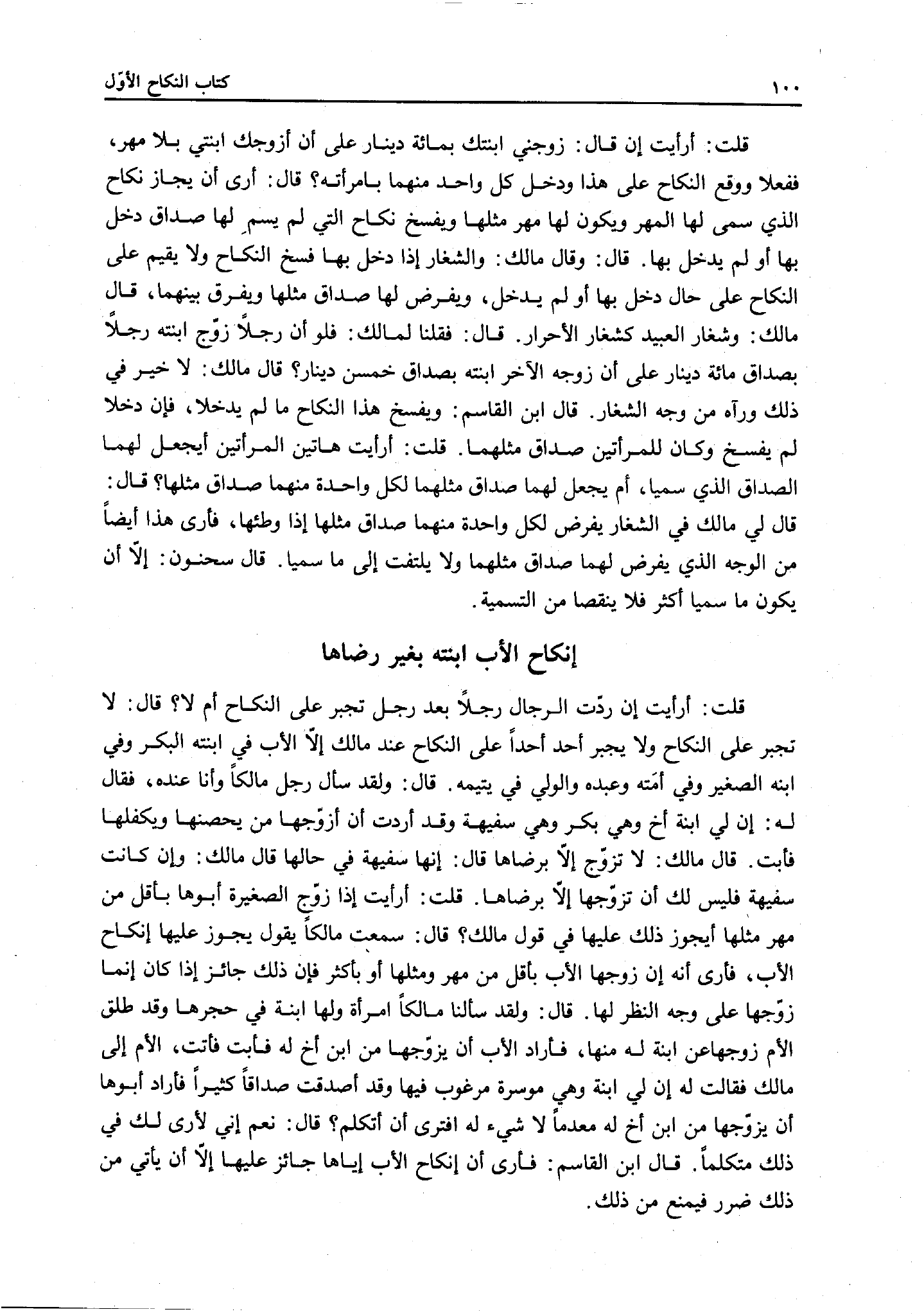
she is not compelled لَا تُجْبَرُ* no one may compel anyone وَلَا يُجْبِرُ أَحَدٌ أَحَدًا* except إلَّا* the father, over his virgin daughter الْأَبُ فِي ابْنَتِهِ الْبِكْرِ* and over his minor son وَفِي ابْنِهِ الصَّغِيرِ* over his slave woman and his slave وَفِي أَمَتِهِ وَعَبْدِهِ and the guardian over his orphan ward وَالْوَلِيُّ فِي يَتِيمِهِ
Interlinear view
- لَا تُجْبَرُ: Form IV passive of j-b-r: to be forced into something against one's will. The sentence is cast as a negative and a general rule.
- وَلَا يُجْبِرُ أَحَدٌ أَحَدًا: An indefinite subject with an indefinite object, conveying full generality; the rule is unqualified before the exception arrives.
- إلَّا: The particle of exception: what follows is the enumeration of what is removed from the rule's scope.
- الْأَبُ فِي ابْنَتِهِ الْبِكْرِ: The qualifier is virginity, not minority; in the Maliki school an adult virgin also falls under this.
- وَفِي ابْنِهِ الصَّغِيرِ: For the son the qualifier is minority — a father may not compel an adult son; no such qualifier is placed on the daughter.
Source
Context
The passage stands under al-Mudawwana's heading 'the father giving his daughter in marriage without her consent' (vol. 2 p. 100); it is in question-and-answer form (Sahnun to Ibn al-Qasim) and transmits directly from Malik.
The same page records three things together, and all three belong to this entry. (1) The general rule: there is no compulsion in marriage — stated without qualification, as a general proposition. (2) The enumerated exceptions: the father (over his virgin daughter and his minor son), the master (over his slave woman and slave), the guardian (over his orphan ward). The absence of the qualifier 'minor' for the daughter is not accidental: in the Maliki school the father's power of compulsion extends to the adult virgin, while for the son it lapses at maturity. (3) A limit: immediately afterwards a man tells Malik he wishes to marry off his virgin niece, who is of poor judgement (safiha); twice Malik answers 'she may not be married except with her consent' — the exception belongs to the father, not to every guardian.
The last section of the page takes up the dower: if a father marries off his young daughter for less than her fair dower the contract holds; Ibn al-Qasim adds the qualifier 'provided he married her off looking to her interest' and the gloss that if harm results he is prevented.
End of the previous page
Start of the next page
Positions of the schools
| Hanafi | A father (and grandfather) may marry off a minor boy or girl without seeking their consent; an adult woman, however, contracts her own marriage — in the Hanafi school there is no compulsion over an adult virgin. |
|---|---|
| Maliki | There is no compulsion in marriage; the exceptions are the father (over his virgin daughter and minor son), the master (over his slave woman and slave) and the guardian (over his orphan ward). Because the qualifier is virginity, the power of compulsion reaches the adult daughter as well; it is not granted to any guardian other than the father. This is the page that is the subject of this entry. |
| Shafi'i | The father of a virgin has more right to give her in marriage than she has herself; no guardian other than a father may give a virgin in marriage until she reaches maturity. |
| Hanbali | A father marries off his young daughter without seeking her consent, and she acquires no option on reaching maturity. |
How the tradition defends this
The tradition's defence runs along these lines. (1) The rule is the prohibition of compulsion: the page itself opens with 'no one may compel anyone'; the exception is narrow and enumerated, not the rule. (2) Compulsion is a duty, not a licence: Ibn al-Qasim's qualifier 'looking to her interest' and his gloss that harm bars it show the power to be reviewable; Maliki jurisprudence discusses annulling a marriage a father contracted in bad faith or to an unsuitable husband. (3) The scope is bounded: on this same page Malik refuses to let a guardian other than a father marry off even a virgin niece of poor judgement without her consent — the exception is not a door that widens. (4) The reason for the virginity qualifier: the classical rationale is the virgin's reticence to speak on the matter and her inexperience; the guardian is a conduit, not an obstacle. (5) A social argument: marriage is a contract between two families, and the guardian protects the woman from an unsuitable match. None of these defences disputes what stands on the page; all of them discuss the exception's rationale and its bounds.
Still held today?
What does the Quran say?
- 2:232 Text states it explicitly
'Do not prevent them from marrying their husbands when they have agreed together in a fitting way.' The verse addresses the guardian directly and gives him not an authority but a prohibition: obstruction. The verb of marrying (yankihna) is feminine plural and assigned to the women; the condition is mutual agreement. The Mudawwana page begins with the same proposition ('there is no compulsion') and then enumerates exceptions; the Quran at this point enumerates none.
- 4:19 Text states it explicitly
'It is not lawful for you to inherit women against their will, nor to prevent them.' Two verbs stand side by side forbidding disposal over women against their will: bringing them into a marital arrangement karhan, and obstructing them by ʿaḍl. The text applies the same measure in both directions: the woman's own will.
- 4:21 Text states it explicitly
'And they have taken from you a solemn covenant.' The party who takes the covenant is the women. In an arrangement where the contracting party is described as her father, her master or her guardian, the text's description of the woman as the one who takes the covenant loses its place.
- 24:32 Implied by the text
'And marry off the spouseless among you, and the righteous among your male and female slaves.' Where the Quran urges marriage its addressee is the community and its subject is 'the spouseless among you'. To extract a power of compulsion from this is to convert an imperative to facilitate into a law of guardianship; the verse commands that marriage be made easier, not that consent be set aside. That the page's list of exceptions also includes the master over his slave woman should be read alongside this verse: here too the Quran urges marriage, not compulsion.
- 4:6 Text states it explicitly
'Test the orphans until they reach [the age of] marriage; then if you discern in them sound judgement, hand over to them their property.' The page's list of exceptions includes 'the guardian, over his orphan ward'. The only explicit instruction of guardianship the Quran gives regarding an orphan concerns property, and that guardianship ends when two thresholds are met (the age of marriage and rushd). The text does not give the guardian authority to marry the orphan off; it places on him the obligation to hand over the orphan's property when the time comes.
The value of this page is that it frames the ruling in the same form as the Quran's own sentence and then departs from it. The Mudawwana says 'there is no compulsion in marriage'; the Quran too, at 2:232, lays on the guardian not compulsion but non-obstruction, and at 4:19 forbids disposal karhan. The difference lies in what follows: after that rule the Mudawwana enumerates three exceptions, and the Quran enumerates none.
The qualifiers attached to the exceptions matter as well. For the son the qualifier is minority — it lapses at maturity; for the daughter it is virginity — it does not. The same page therefore accepts that a child's will becomes legally recognised at maturity in the case of a boy, and denies it in the case of a girl. Search the text for a ground for that distinction and none is found: at 4:21 the party taking the covenant is the woman, with no qualifier of virginity or widowhood; at 2:232 the verb of marrying is feminine plural and assigned to the women.
The third item on the list — the guardian over his orphan ward — meets the Quran's only explicit instruction of guardianship over an orphan head on. 4:6 describes the moment guardianship ends, and its subject is property; no authority to marry the ward off is granted. What the Quran says about orphans (4:2, 4:5, 4:6, 4:10) is from beginning to end an obligation of protection and of handing over.
The strongest text that can be urged against this reading is 24:32: the imperative 'marry off the spouseless among you' assigns the act of marrying off to the community and can be read as the basis of a law of guardianship. But the verse's subject is 'the spouseless', and the verb looks to facilitation; the removal of consent does not follow from it — and if it did, it would collide with the prohibition of obstruction at 2:232 and the prohibition of karhan at 4:19. A reading that takes 24:32 as proof of compulsion is therefore not compatible with the text.
Finally, honesty requires recording what on this page tells the other way: Malik refuses to let a guardian other than a father marry off even a virgin niece of poor judgement without her consent, and he says so twice. The consent that is the text's measure has not disappeared entirely inside the tradition; it has been suspended for one person only — the father.