Ibn Taymiyya: the caliphs ordered the demolition of the churches that ought to be demolished, such as all the churches in the land of Egypt; whether demolishing them is obligatory is subject to two views
Arabic text
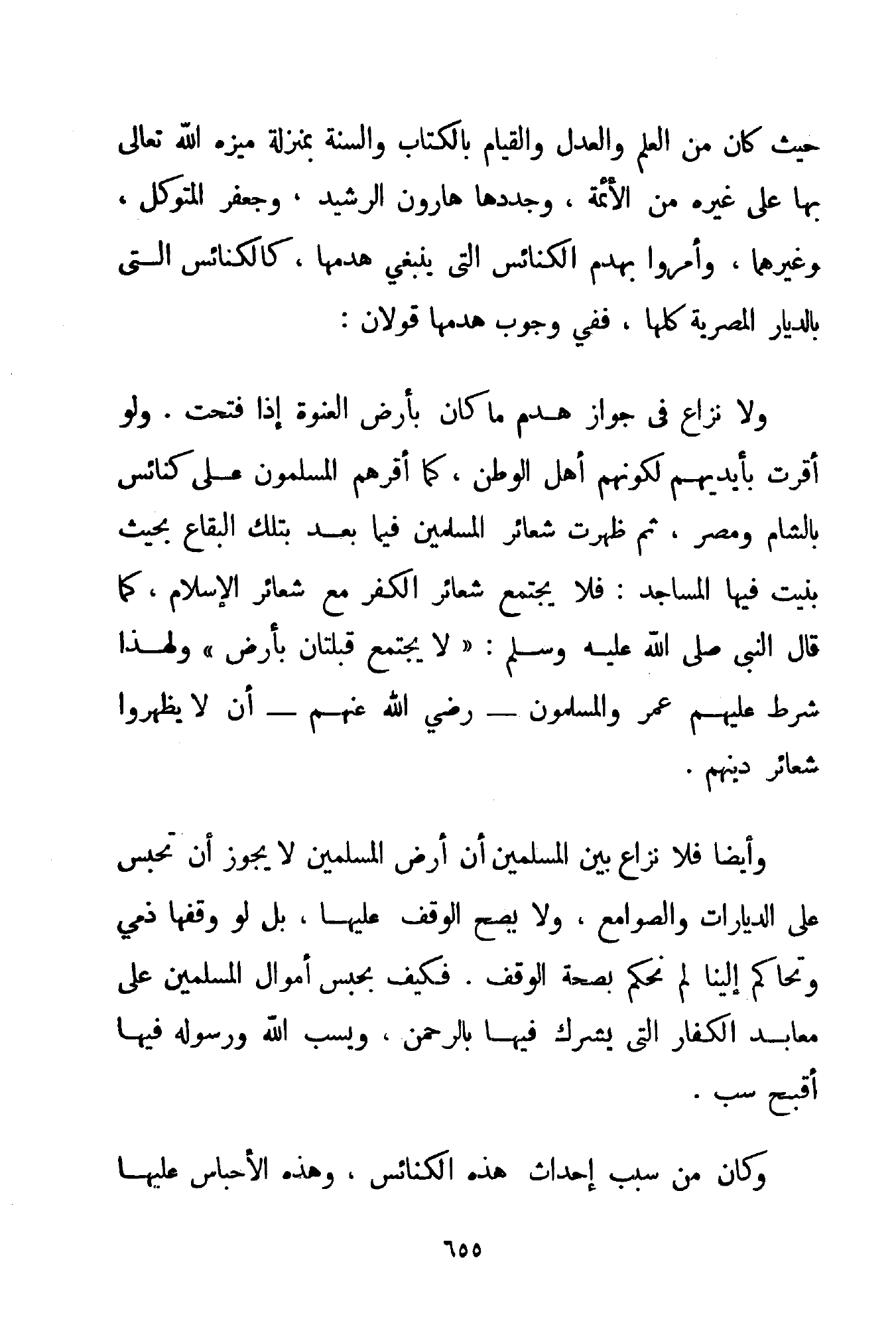
Full page
Translation
Word by word
they ordered وَأَمَرُوا* the demolition of بِهَدْمِ* that ought to be demolished الَّتِي يَنْبَغِي هَدْمُهَا* such as the churches in the land of Egypt, all of them كَالْكَنَائِسِ الَّتِي بِالدِّيَارِ الْمِصْرِيَّةِ كُلِّهَا* on whether demolishing them is obligatory there are two views فَفِي وُجُوبِ هَدْمِهَا قَوْلَانِ*
Interlinear view
- وَأَمَرُوا: The subject is in the preceding sentence: Harun al-Rashid, Ja'far al-Mutawakkil 'and others', who renewed the Pact of Umar. The previous page attributes the same renewal to Umar b. Abd al-Aziz and calls those who did it 'those of the rulers of the Muslims whom God granted success' (28/654). The event is reported with approval.
- بِهَدْمِ: The root h-d-m. The Quran uses it **once**: at 22:40 the demolition of monasteries, churches (biya'), synagogues and mosques is named as what God's repelling of people by one another prevents.
- الَّتِي يَنْبَغِي هَدْمُهَا: It reads like a qualifier, but the example given immediately after makes the set unlimited: those in Egypt, 'all of them'.
- كَالْكَنَائِسِ الَّتِي بِالدِّيَارِ الْمِصْرِيَّةِ كُلِّهَا: The reasoning is at the start of the fatwa (28/634): Egypt is land taken by force ('anwa); Cairo was founded more than three hundred years after Umar, so its churches count as 'built later'.
- فَفِي وُجُوبِ هَدْمِهَا قَوْلَانِ: The dispute is over obligation, not permissibility. The very next sentence: 'there is no dispute that demolishing what is in land taken by force is permissible.'
Source
Context
The passage is the last page of a long fatwa on the churches of Cairo in the jihad volume of *Majmu' al-Fatawa* (vol. 28 pp. 632–656). The question (28/632–633): churches in Cairo have been closed by order of the rulers of the day; the dhimmis claim the closure was unjust and that the churches date from the time of Umar b. al-Khattab, and they are pressing the demand through envoys from the abode of war; should the churches be reopened?
Ibn Taymiyya's answer (28/634) gives the ruling at the outset: the four schools and the early generations 'agree' that if the imam demolished every church in land taken by force — 'such as Egypt, the Sawad of Iraq and Syria' — this would not be injustice; obeying and assisting him is obligatory; if the dhimmis resist the ruling they have broken the covenant, and 'their blood and their property become lawful'. That Cairo was founded more than three hundred years after Umar is recorded as 'mass-transmitted knowledge'.
The quoted page (28/655) reports that the Pact of Umar was renewed by Umar b. Abd al-Aziz, Harun al-Rashid and Ja'far al-Mutawakkil, and that these caliphs ordered all the churches in Egypt demolished; it then states the dispute over obligation and says permissibility in land taken by force is undisputed. The page argues that even where churches were left standing, once mosques are built and the rites of Islam appear there, 'the rites of unbelief do not gather with the rites of Islam', citing the report 'two qiblas do not gather in one land', and adds that no endowment may be made for churches.
The fatwa closes on the next page (28/656) by tracing the multiplication of churches to the Fatimids ('Banu Ubayd al-Qaddah') with their Jewish and Christian viziers, and to the abuse of Muslim funds by Christian scribes.
End of the previous page
Start of the next page
How the tradition defends this
The tradition's defence runs along these lines.
(1) The fatwa is concrete and political. It is not a general ruling on churches but an answer to a demand to reopen buildings the rulers had closed. The question records that the demand was being pressed through foreign envoys and that reopening would cause strife among Muslims (28/632–633).
(2) Force and treaty are distinguished. In Ibn Taymiyya's own wording the ruling is tied to land taken by force and to cities the Muslims founded (28/634, 28/655). Houses of worship in land taken by treaty are not this page's subject.
(3) The Pact of Umar is presented as a covenant. In the tradition the dhimmis' undertaking not to build new houses of worship is told as a clause of a mutual agreement; the charge of injustice is rejected on the strength of that covenant.
(4) The ruling is recorded as disputed. Ibn Taymiyya does not say demolition is obligatory; he says there are two views on whether it is.
(5) The issue is abuse of state power. 28/656 traces the multiplication of churches to Fatimid viziers and to scribes' abuse of the treasury; in Ibn Taymiyya's eyes the target is not a religion but an order of power.
Still held today?
What does the Quran say?
- 22:40 Text states it explicitly
﴿وَلَوۡلَا دَفۡعُ ٱللَّهِ ٱلنَّاسَ بَعۡضَهُم بِبَعۡضٖ لَّهُدِّمَتۡ صَوَٰمِعُ وَبِيَعٞ وَصَلَوَٰتٞ وَمَسَٰجِدُ يُذۡكَرُ فِيهَا ٱسۡمُ ٱللَّهِ كَثِيرٗاۗ﴾: the only occurrence of the root h-d-m in the Quran. The previous verse grants permission to fight 'because they have been wronged' (22:39); this verse sets the ground of that permission as preventing the demolition of churches, synagogues, monasteries and mosques. The label attaches to the verse's counting of that demolition as something to be prevented. Whether the qualifier 'in which God's name is much mentioned' refers to all four or only to mosques is grammatically open; the argument does not depend on it.
- 2:148 Text states it explicitly
﴿وَلِكُلّٖ وِجۡهَةٌ هُوَ مُوَلِّيهَاۖ فَٱسۡتَبِقُواْ ٱلۡخَيۡرَٰتِۚ﴾: the previous verse records the plurality of qiblas as a fact: ﴿وَمَا بَعۡضُهُم بِتَابِعٖ قِبۡلَةَ بَعۡضٖۚ﴾. The Quran's answer to that plurality is a race, not removal. The page's principle 'two qiblas do not gather in one land' is not found in the Quran; it rests on a report.
- 5:48 Text states it explicitly
﴿لِكُلّٖ جَعَلۡنَا مِنكُمۡ شِرۡعَةٗ وَمِنۡهَاجٗاۚ وَلَوۡ شَآءَ ٱللَّهُ لَجَعَلَكُمۡ أُمَّةٗ وَٰحِدَةٗ﴾: the plurality of laws and ways is tied to the divine will and defined as a test; the verse ends by saying it is God who will inform them of what they differed over.
- 60:8 Compatible with the text
﴿لَّا يَنۡهَىٰكُمُ ٱللَّهُ عَنِ ٱلَّذِينَ لَمۡ يُقَٰتِلُوكُمۡ فِي ٱلدِّينِ وَلَمۡ يُخۡرِجُوكُم مِّن دِيَٰرِكُمۡ أَن تَبَرُّوهُمۡ وَتُقۡسِطُوٓاْ إِلَيۡهِمۡۚ إِنَّ ٱللَّهَ يُحِبُّ ٱلۡمُقۡسِطِينَ﴾: God does not forbid kindness and justice towards those who have not fought over religion or expelled. In the fatwa the Christians of Cairo are not described as a fighting party; the ground of demolition is the status of the land. Applying the verse to this case is an inference, hence the label text-compatible.
- 9:29 Text is silent
﴿قَٰتِلُواْ ٱلَّذِينَ لَا يُؤۡمِنُونَ بِٱللَّهِ وَلَا بِٱلۡيَوۡمِ ٱلۡأٓخِرِ وَلَا يُحَرِّمُونَ مَا حَرَّمَ ٱللَّهُ وَرَسُولُهُۥ وَلَا يَدِينُونَ دِينَ ٱلۡحَقِّ مِنَ ٱلَّذِينَ أُوتُواْ ٱلۡكِتَٰبَ حَتَّىٰ يُعۡطُواْ ٱلۡجِزۡيَةَ عَن يَدٖ وَهُمۡ صَٰغِرُونَ﴾: The falsification attempt: the strongest verse that could support demolishing churches was sought, and this is it. The verse regulates war and the jizya; it is silent on houses of worship. The page itself cites not this verse but the Pact of Umar and a report.
What puts this page in the register is not that a ruler closed buildings during a political crisis, but that a mufti declared it a matter of consensus that the imam may demolish every church in land taken by force, that obeying him is obligatory, and that the blood and property of a resisting dhimmi become lawful (28/634). The quoted page cites the same demolition — of 'all' the churches in Egypt — as an example of rulers whom God granted success.
The Quran uses the root h-d-m only once, and that one use says the opposite of this page. 22:39 grants permission to fight 'because they have been wronged'; 22:40 explains the ground of that permission: had God not repelled people by one another, monasteries, churches, synagogues and mosques would have been demolished (la-huddimat). The verse lists churches and synagogues before mosques and names their demolition as the evil the permission to fight exists to prevent. The page makes the same act, with the same root, a policy of state.
The page's principle — 'two qiblas do not gather in one land' — is a report. The Quran records the plurality of qiblas as a fact (2:145) and answers it with 'each has a direction to which he turns; so race to good deeds' (2:148); 5:48 ties the plurality of laws and ways to the divine will and to a test, and leaves judgement to God, who will inform them of what they differed over. Nowhere does the Quran say that two qiblas cannot exist in one land.
The falsification attempt: the Quranic basis of the tradition's dhimma framework is 9:29. The verse commands fighting until the jizya is paid and is silent on houses of worship; no power to demolish or close churches follows from it. The page does not cite it either, but the Pact of Umar and a report. 60:8, for its part, does not forbid kindness and justice towards those who have not fought or expelled; in the fatwa the ground of demolition is not any act of the Christians of Cairo but the legal status of the land.