Ibn Taymiyya: a woman is not married off without her permission and is not compelled if she is averse — except the minor virgin: her father marries her off and she has no permission
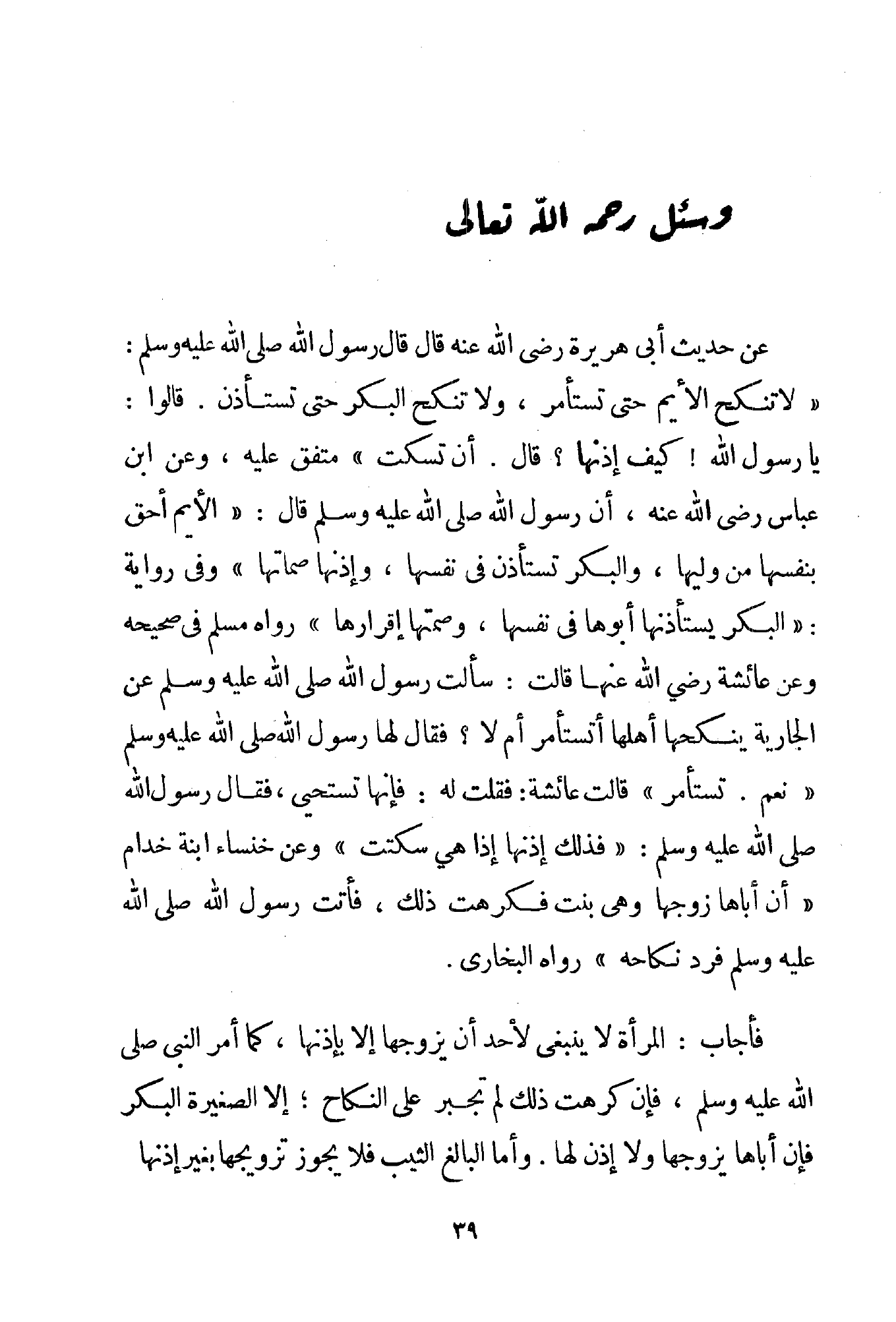
Arabic text
Full page
Translation
Word by word
except إلَّا* the minor virgin الصَّغِيرَةُ الْبِكْرُ* her father marries her off فَإِنَّ أَبَاهَا يُزَوِّجُهَا* she has no permission وَلَا إذْنَ لَهَا*
Interlinear view
- إلَّا: The particle of exception. The preceding sentence is the general principle: 'no one should marry a woman off except with her permission… if she is averse she is not compelled into marriage.' The rule is the woman's consent; the exception is the minor girl.
- الصَّغِيرَةُ الْبِكْرُ: Two attributes together: minority and virginity. The page gives no age limit.
- فَإِنَّ أَبَاهَا يُزَوِّجُهَا: The power is given to the father alone. The continuation (32/40) records as consensus that no one but the father and grandfather may marry off a grown virgin without her permission, and says that for the father and grandfather too asking her permission is 'obligatory on the correct view'.
- وَلَا إذْنَ لَهَا: Not that her permission is not sought, but that her permission **does not exist** in law. All five reports cited in the question tie marriage to permission or consent; the page gives no proof for this exception.
Source
Context
The passage is the answer to a fatwa (vol. 32 p. 39). The question lists five reports and asks for the ruling: from Abu Hurayra, 'the previously married woman is not married until she is consulted, nor the virgin until her permission is sought — her permission is her silence'; from Ibn Abbas, 'the previously married woman has more right over herself than her guardian, and the virgin's permission is sought concerning herself'; Muslim's report 'her father seeks the virgin's permission'; Aisha's question whether a girl married off by her family is consulted; and from al-Bukhari, Khansa' bint Khidham: her father married her off, she was averse, and the Prophet rejected the marriage.
The answer opens with the general principle: 'No one should marry a woman off except with her permission, as the Prophet commanded; if she is averse she is not compelled into marriage.' The quoted exception follows immediately; the page continues: 'as for the grown woman previously married, it is not permitted to marry her off without her permission.'
The next page (32/40) takes up the grown virgin: no one but the father and grandfather may marry her off without her permission (consensus); the father and grandfather should seek it, and in the dispute over whether that is obligatory or recommended 'the correct view is that it is obligatory'. The guardian marries her off 'for her benefit, not his own': he may not give her to a deficient husband, in exchange for another man's ward (a kind of shighar), for an alliance of interests, or for a bribe. The page's ground is that the guardian's disposal over her person is like his disposal over her property.
End of the previous page
Start of the next page
Positions of the schools
| Hanafi | A father (and grandfather) may marry off a minor boy or girl without seeking their consent; the proof is the report about Aisha and the practice of the Companions. The same page records the dissent of Ibn Shubruma and Abu Bakr al-Asamm. |
|---|---|
| Maliki | No one may compel anyone into marriage; the exceptions are enumerated: the father (over his virgin daughter and minor son), the master and the guardian. |
| Shafi'i | The father of a virgin has more right to give her in marriage than she has herself, on the ground that a girl of seven and of nine has no say over herself. |
| Hanbali | A father marries off his minor virgin daughter to an equal even if she is averse and resists; Ibn Qudama says there is no disagreement on this and reports consensus from Ibn al-Mundhir. On the grown virgin there are two narrations from Ahmad. |
How the tradition defends this
The tradition's defence runs along these lines.
(1) This page is one of the strongest defences of consent. Ibn Taymiyya sets the rule as the woman's permission, says the previously married woman cannot be compelled, and on the next page holds that even the father must seek the grown virgin's permission. Against the Hanbali school's other narration, which grants the father a power to compel, this is a choice and a correction.
(2) Guardianship is a trust. The guardian marries her off for her benefit; a deficient husband, a shighar-like exchange, an alliance of interests and a bribe are expressly forbidden (32/40).
(3) A minor's permission has no legal effect. The ground of the exception is that, as in her financial dealings, a minor's will produces no legal effect in marriage; the power goes to the person presumed most compassionate, the father.
(4) The report about Aisha. The tradition grounds a father's marrying off of his minor daughter in the Prophet's marriage to Aisha; this page does not mention the report, but the exception rests on the framework that report built in the school.
Still held today?
What does the Quran say?
- 4:19 Text states it explicitly
﴿لَا يَحِلُّ لَكُمۡ أَن تَرِثُواْ ٱلنِّسَآءَ كَرۡهٗاۖ﴾: the Quran bounds disposal over women with the root k-r-h. The page's answer opens with the same root — 'if she is averse she is not compelled into marriage' — and then removes the minor girl from that protection. The verse contains no exception by age.
- 2:232 Text states it explicitly
﴿فَلَا تَعۡضُلُوهُنَّ أَن يَنكِحۡنَ أَزۡوَٰجَهُنَّ إِذَا تَرَٰضَوۡاْ بَيۡنَهُم بِٱلۡمَعۡرُوفِۗ﴾: the verse gives the guardian not a power but a prohibition: not to obstruct. The verb of marrying is predicated of the women and the condition is mutual consent (taradaw). 'She has no permission' turns a contract that requires consent into a one-sided act of the guardian.
- 4:21 Text states it explicitly
﴿وَأَخَذۡنَ مِنكُم مِّيثَٰقًا غَلِيظٗا﴾: the party that takes the covenant is the women; the verb is predicated of them. A party whose permission is held not to exist cannot, by definition, be the one who takes a covenant.
- 4:6 Implied by the text
﴿وَٱبۡتَلُواْ ٱلۡيَتَٰمَىٰ حَتَّىٰٓ إِذَا بَلَغُواْ ٱلنِّكَاحَ فَإِنۡ ءَانَسۡتُم مِّنۡهُمۡ رُشۡدٗا﴾: the Quran ties marriage to an age and names that age together with the testing of sound judgement. The page's continuation (32/40) likens the guardian's disposal over the girl to his disposal over her property; in the Quran the handing over of property is tied to the age of marriage and to sound judgement. What the verse says is explicit; that a minor therefore cannot be married is an inference, hence the label text-implied.
This page carries one of Ibn Taymiyya's strongest statements on consent and breaks it with a single exception. The question lists five reports; all five tie marriage to the woman's permission or consent, and in the fifth the marriage of a girl whose father married her to someone she did not want is rejected. The answer adopts the principle, then says 'except the minor virgin'. The page gives no proof for the exception; none of the reports in the question contains it.
The Quran sets no exception. 4:19 bounds disposal over women with the root k-r-h; Ibn Taymiyya's answer begins by using the same root in the same direction — 'if she is averse she is not compelled' — and then removes the minor girl from that protection. 2:232 gives the guardian not a power but a prohibition on obstructing, and ties marriage to mutual consent. 4:21 says the women are the party that takes the covenant; someone whose permission is held not to exist cannot be the one who takes a covenant.
The page's own ground is on the next page: the guardian's disposal over the girl is like his disposal over her property. The Quran bounds the guardian's disposal over property too, and ties its handing over to 'reaching marriage' and the perception of sound judgement (4:6). Carried to the Quran, the analogy stops being a power the guardian exercises over a minor and remains the name of the threshold at which minority ends.
Ibn Taymiyya's refusal to compel the grown virgin is a correction made from within the tradition; the register records it in the defence section. But the correction stops where consent is least possible: the girl who cannot speak for herself.