Ibn Taymiyya: most of the early generations order the killing of the one who calls to innovation and misleads people — whether or not they called him a disbeliever
Arabic text
Full page
Translation
Word by word
for this reason وَلِهَذَا* most of the early generations أَكْثَرُ السَّلَفِ* the one who calls to innovation and misleads people الدَّاعِي إلَى الْبِدْعَةِ الَّذِي يُضِلُّ النَّاسَ* on account of the corruption he causes in religion لِأَجْلِ إفْسَادِهِ فِي الدِّينِ* whether they said 'he is a disbeliever' or 'he is not a disbeliever' سَوَاءً قَالُوا: هُوَ كَافِرٌ أَوْ لَيْسَ بِكَافِرِ*
Interlinear view
- وَلِهَذَا: The sentence hangs on the one before: worldly punishment does not entail otherworldly punishment, nor the reverse. Killing is placed here as the answer not to an otherworldly verdict but to a worldly harm.
- أَكْثَرُ السَّلَفِ: No names or sources are given. The claim is not consensus but a majority.
- الدَّاعِي إلَى الْبِدْعَةِ الَّذِي يُضِلُّ النَّاسَ: The target is not the holder of an innovation but its propagator; the defining verb is yudillu (d-l-l). With the same root the Quran says it is God who knows best who has strayed from His path (16:125).
- لِأَجْلِ إفْسَادِهِ فِي الدِّينِ: The root f-s-d occurs in 47 verses of the Quran: in 31 with 'the earth', in none with 'religion'. One of the two grounds on which the Quran excepts the taking of life is 'corruption in the earth' (5:32), and 5:33 defines it.
- سَوَاءً قَالُوا: هُوَ كَافِرٌ أَوْ لَيْسَ بِكَافِرِ: The penalty is detached from declaring disbelief. The same page immediately ties declaring a specific person a disbeliever to the establishing of proof; it sets no such condition on killing.
Source
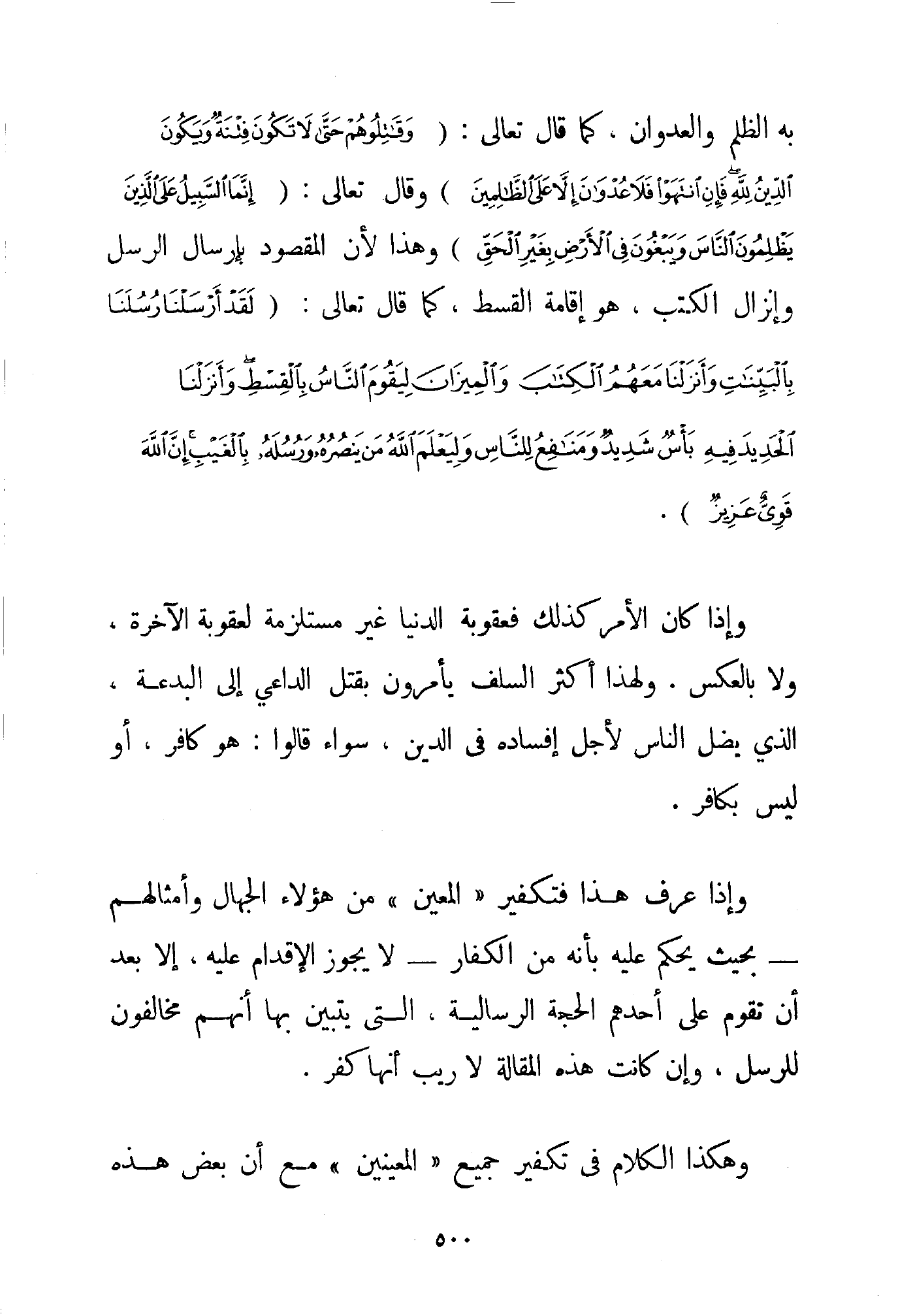
Context
The passage belongs to a section in vol. 12 of *Majmu' al-Fatawa* that opens at 12/484: 'Once these premises are clear — on the names believer, disbeliever and sinner within the community, on the ruling of promise and threat, and on the difference between the general and the specific…'. Its subject is the distinction between a general verdict of disbelief and declaring a specific person a disbeliever.
The previous page (12/499) establishes with examples that worldly and otherworldly punishment are not tied to each other: the agreement of Umar and Ali concerning those who held wine lawful on the strength of 5:93 — flogging if they acknowledged its prohibition, killing if they persisted in holding it lawful; dhimmis and hypocrites, by contrast, are not punished in this world yet are disbelievers in the next. It argues from 2:193, 42:42 and 57:25 that punishment in this world is legislated only to repel harm.
The quote is the conclusion of that argument: the propagator is killed whether or not he is counted a disbeliever. The page then turns immediately to caution about declaring disbelief: declaring a specific person among these ignorant ones a disbeliever is not permitted until the proof of the message has been established showing him to be in opposition to the prophets. The section closes on the next page (12/501): no Muslim, even one who errs, may be declared a disbeliever until the proof is established and the way made clear to him.
End of the previous page
Start of the next page
How the tradition defends this
The tradition's defence runs along these lines.
(1) A penalty independent of takfir is a brake. In Ibn Taymiyya's framework killing answers a worldly harm, not an otherworldly verdict; this means no one may be killed for belief alone. The target is not the holder of an innovation but the propagator who misleads others.
(2) The same page restricts takfir. A specific person may not be declared a disbeliever until the proof is established and his opposition becomes evident; 12/501 extends this to all Muslims: no one may be declared a disbeliever 'even if he errs'. Ibn Taymiyya's caution on takfir is often cited against later generations.
(3) The measure is Companion practice. The previous page cites the agreement of Umar and Ali concerning those who held wine lawful; Ibn Taymiyya says he derives his principle from that practice.
(4) The proof is drawn from the Quran. The page grounds the ruling in the fitna of 2:193, the 'way' against wrongdoers of 42:42 and the 'iron with mighty force' of 57:25: the purpose of sending the prophets is to establish justice, and harm that defeats that purpose is repelled by force.
Still held today?
What does the Quran say?
- 5:33 Text states it explicitly
﴿إِنَّمَا جَزَٰٓؤُاْ ٱلَّذِينَ يُحَارِبُونَ ٱللَّهَ وَرَسُولَهُۥ وَيَسۡعَوۡنَ فِي ٱلۡأَرۡضِ فَسَادًا أَن يُقَتَّلُوٓاْ أَوۡ يُصَلَّبُوٓاْ أَوۡ تُقَطَّعَ أَيۡدِيهِمۡ وَأَرۡجُلُهُم مِّنۡ خِلَٰفٍ أَوۡ يُنفَوۡاْ﴾: 5:32 excepts the killing of a soul only for a soul or ﴿أَوۡ فَسَادٖ فِي ٱلۡأَرۡضِ﴾; 5:33 defines that corruption as waging war on God and His messenger and striving to spread corruption in the earth. The page moves the ground to 'corruption in religion'; none of the root's 47 occurrences is paired with 'religion'.
- 2:193 Text states it explicitly
﴿وَقَٰتِلُوهُمۡ حَتَّىٰ لَا تَكُونَ فِتۡنَةٞ وَيَكُونَ ٱلدِّينُ لِلَّهِۖ فَإِنِ ٱنتَهَوۡاْ فَلَا عُدۡوَٰنَ إِلَّا عَلَى ٱلظَّٰلِمِينَ﴾: the page's own proof. The sequence opens at 2:190 with ﴿وَقَٰتِلُواْ فِي سَبِيلِ ٱللَّهِ ٱلَّذِينَ يُقَٰتِلُونَكُمۡ وَلَا تَعۡتَدُوٓاْۚ﴾; at 2:191 fitna is what the aggressors did: ﴿وَأَخۡرِجُوهُم مِّنۡ حَيۡثُ أَخۡرَجُوكُمۡۚ وَٱلۡفِتۡنَةُ أَشَدُّ مِنَ ٱلۡقَتۡلِۚ﴾. The verse targets the one who fights and wrongs; the propagator of a teaching does not appear in the sequence.
- 42:42 Text states it explicitly
﴿إِنَّمَا ٱلسَّبِيلُ عَلَى ٱلَّذِينَ يَظۡلِمُونَ ٱلنَّاسَ وَيَبۡغُونَ فِي ٱلۡأَرۡضِ بِغَيۡرِ ٱلۡحَقِّۚ﴾: the page's own proof. 'The way' — of blame and penalty — is reserved for those who wrong people and transgress in the earth without right. The measure is wrong done to people, not doctrinal error.
- 4:140 Text states it explicitly
﴿وَقَدۡ نَزَّلَ عَلَيۡكُمۡ فِي ٱلۡكِتَٰبِ أَنۡ إِذَا سَمِعۡتُمۡ ءَايَٰتِ ٱللَّهِ يُكۡفَرُ بِهَا وَيُسۡتَهۡزَأُ بِهَا فَلَا تَقۡعُدُواْ مَعَهُمۡ حَتَّىٰ يَخُوضُواْ فِي حَدِيثٍ غَيۡرِهِۦٓ﴾: when God's verses are denied and mocked, the Quran's ruling for believers is to leave the gathering; 6:68 repeats it: ﴿وَإِذَا رَأَيۡتَ ٱلَّذِينَ يَخُوضُونَ فِيٓ ءَايَٰتِنَا فَأَعۡرِضۡ عَنۡهُمۡ حَتَّىٰ يَخُوضُواْ فِي حَدِيثٍ غَيۡرِهِۦۚ﴾.
- 16:125 Text states it explicitly
﴿ٱدۡعُ إِلَىٰ سَبِيلِ رَبِّكَ بِٱلۡحِكۡمَةِ وَٱلۡمَوۡعِظَةِ ٱلۡحَسَنَةِۖ وَجَٰدِلۡهُم بِٱلَّتِي هِيَ أَحۡسَنُۚ إِنَّ رَبَّكَ هُوَ أَعۡلَمُ بِمَن ضَلَّ عَن سَبِيلِهِۦ وَهُوَ أَعۡلَمُ بِٱلۡمُهۡتَدِينَ﴾: calling is with wisdom and good counsel, argument in the best way; knowledge of straying belongs to God (dalla, the same root as the page's yudillu). Cf. 10:40, the same expression with the root f-s-d: ﴿وَرَبُّكَ أَعۡلَمُ بِٱلۡمُفۡسِدِينَ﴾.
- 16:88 Text states it explicitly
﴿ٱلَّذِينَ كَفَرُواْ وَصَدُّواْ عَن سَبِيلِ ٱللَّهِ زِدۡنَٰهُمۡ عَذَابٗا فَوۡقَ ٱلۡعَذَابِ بِمَا كَانُواْ يُفۡسِدُونَ﴾: the strongest counter-example the falsification attempt found: corruption is named together with barring from God's path (cf. 7:86). The verse stands in a scene of the Day of Judgement (from 16:84) and the subject of the punishment is God (zidnahum). The Quran attaches no penalty of killing by human hands to this act.
What is striking about the page is that it deliberately detaches the penalty from the verdict of disbelief. Ibn Taymiyya ties declaring a specific person a disbeliever to the establishing of proof — but he does not tie killing to that condition: most of the early generations kill the propagator 'whether or not they called him a disbeliever'. The caution applied to takfir is lifted for the penalty; a person may be killed while counted a Muslim.
The Quran excepts the taking of life on two grounds: a life for a life, and 'corruption in the earth' (5:32); and it defines the second: those who wage war on God and His messenger and strive to spread corruption in the earth (5:33). The page moves the ground to 'corruption in religion'. None of the 47 occurrences of the root f-s-d in the Quran carries that collocation.
The page's own verses do not describe its target either. 2:193 closes a sequence: 'fight those who fight you and do not transgress' (2:190), 'expel them from where they expelled you' (2:191); the verse ends 'if they desist, there is no hostility except against the wrongdoers'. 42:42 reserves 'the way' for those who wrong people and transgress in the earth without right. 57:25 names iron so that people may uphold justice. In all three the measure is wrong done to people; propagating a teaching does not appear in them.
The Quran's ruling for believers facing those who deny God's verses and mock them is not to sit with them until they turn to other talk (4:140, 6:68). Its ruling on calling others is to argue in the best way, and knowledge of who has strayed belongs to God (16:125) — the same root as yudillu, the verb by which the page defines the propagator.
The falsification attempt found a counter-example, and it is recorded here: the Quran does name corruption together with barring from God's path — ﴿ٱلَّذِينَ كَفَرُواْ وَصَدُّواْ عَن سَبِيلِ ٱللَّهِ زِدۡنَٰهُمۡ عَذَابٗا فَوۡقَ ٱلۡعَذَابِ بِمَا كَانُواْ يُفۡسِدُونَ﴾ (cf. 7:86). This is the closest Quranic expression to the page's 'corruption in religion'. But the verse stands in a scene of the Day of Judgement (from 16:84) and the subject of the punishment is God: 'We shall add punishment upon punishment'. The Quran recognises the act; it attaches no penalty of killing by human hands to it.