Ibn Qudama: the people of knowledge are agreed that killing the apostate is obligatory
Arabic text
Full page
Translation
Word by word
have agreed وأجْمَعَ* the people of knowledge أهلُ العلمِ* on the obligatoriness of على وُجوبِ* the killing of قَتْلِ the apostates المُرْتَدِّين*
Interlinear view
- وأجْمَعَ: Form IV of j-m-ʿ. In legal theory ijmaʿ counts as an independent proof; here it is not a transmission but a claim of proof.
- أهلُ العلمِ: The set named as the subject of the consensus; the page gives no boundary for that set.
- على وُجوبِ: From w-j-b: not permission or licence but an obligation whose omission is sinful.
- المُرْتَدِّين: The page's own definition: 'the apostate is one who returns from the religion of Islam to unbelief' — the qualifier is a change of belief, not an act.
Source
Context
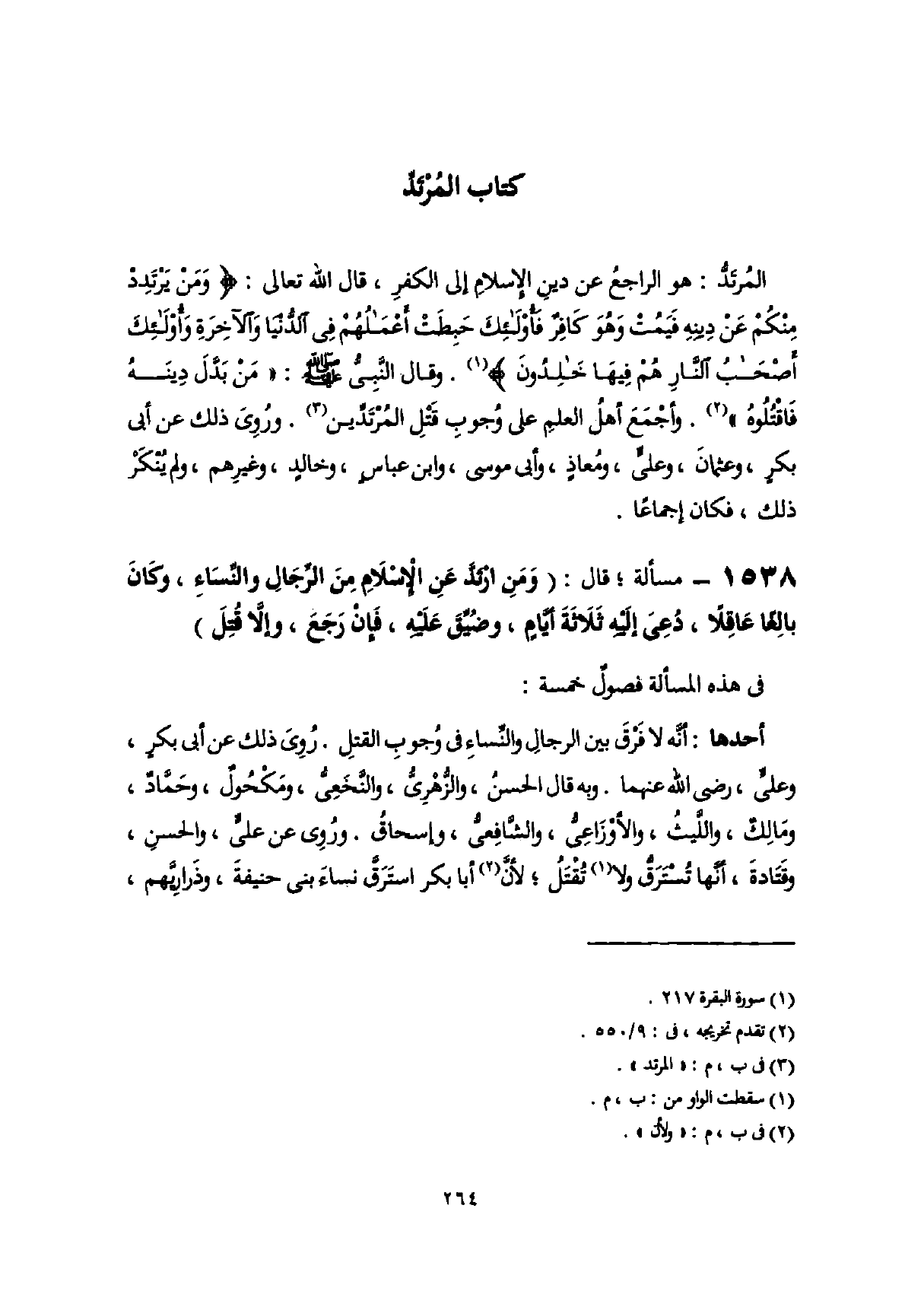
The sentence stands on the opening page of al-Mughni's 'Book of the Apostate' (vol. 12 p. 264) and is the third link in that chapter's chain of proofs. Ibn Qudama first defines the apostate — 'one who returns from the religion of Islam to unbelief' — and then brings three things in order: (1) a verse: 2:217, 'and whoever of you turns back from his religion and dies a disbeliever, their deeds have come to nothing in this world and the next'; (2) a hadith: 'whoever changes his religion, kill him'; (3) consensus: the quotation of this entry.
How the consensus is constructed is stated on the page in so many words: 'That is transmitted from Abu Bakr, Uthman, Ali, Muʿadh, Abu Musa, Ibn Abbas, Khalid and others; it was not objected to, and so it was consensus.' The consensus is thus not a record but an inference: reports from seven names, plus the absence of any record of objection.
The same page carries the record that weakens that inference. Question 1538 states that there is no difference between a male and a female apostate as to the obligation of killing, and ascribes this to Abu Bakr and Ali, and to al-Hasan al-Basri, al-Zuhri, al-Nakhaʿi, Makhul, Hammad, Malik, al-Layth, al-Awzaʿi, al-Shafiʿi and Ishaq — and then immediately adds: 'and it is transmitted from Ali, al-Hasan and Qatada that she is enslaved and not killed.' The next page records that Abu Hanifa too did not kill her but compelled her to Islam by imprisonment and beating. The scope of the consensus is thus broken, on the page's own record, at no fewer than two points — the female apostate, and Ali himself.
End of the previous page
Start of the next page
Positions of the schools
| Hanafi | The male apostate is killed; calling him to repent is recommended. The female apostate is not killed but imprisoned and coerced until she returns to Islam — al-Mughni transmits this position from Abu Hanifa on the following page and records that he grounds it in the report 'do not kill a woman'. |
|---|---|
| Maliki | The apostate is called to repent for three days and, if he does not return, his neck is struck; the zindiq is killed without being asked to repent. |
| Shafi'i | Both the adult male and the female apostate are called to repent; if they do not repent they are killed. |
| Hanbali | Killing the apostate is obligatory and there is consensus on it; there is no difference between a man and a woman, and they are called to repent for three days under constraint. This is the page that is the subject of this entry. |
How the tradition defends this
The tradition's defence runs along these lines. (1) Apostasy as political treason: in the classical setting turning from the religion is not a change of opinion but a break with the polity and a passage to the enemy's side; the penalty attaches to treason, not to belief. That the Companions' precedents enumerated on Ibn Qudama's page all occur in a setting of war is adduced in support. (2) Consensus is a proof of legal theory: Ibn Qudama here transmits not his own opinion but a record of law above the schools; a claim of consensus is not a personal preference and must be answered at the level of legal theory. (3) The condition of istitaba: the ruling itself contains a three-day period for repentance, so the penalty is not a reflex applied to whoever changes belief. (4) The narrowing is internal: the disagreement over the female apostate and Abu Hanifa's position show that the literal generality of the ruling was not taken absolutely even inside the tradition. (5) Present practice: many contemporary scholars in the Hanbali tradition tie the apostasy penalty to state authority and a state of war; the classical text is a record of history. None of these defences disputes what stands on the page; all of them discuss the ruling's ground and its scope.
Still held today?
What does the Quran say?
- 2:217 Text states it explicitly
'And whoever of you turns back from his religion and dies a disbeliever — their deeds have come to nothing in this world and the next, and they are the companions of the Fire.' This is the verse Ibn Qudama adduces on the page. It takes up apostasy and states its consequence explicitly: works come to nothing, and the penalty is in the hereafter. Further, the sentence's condition is 'and dies a disbeliever' — the text presupposes a span running until the apostate dies of his own end. For someone put to death that condition has no work to do.
- 5:54 Text states it explicitly
'O you who believe, whoever of you turns back from his religion — God will bring a people whom He loves and who love Him.' The second place where the Quran directly takes up apostasy. The consequence set out is not that those who turn back are killed but that God will bring another people in their place. This is the most natural place for the text to impose a penal sanction, and it does not.
- 3:89 Text states it explicitly
'Except those who repent after that and put things right — God is forgiving, merciful.' 3:86-90 takes up those who disbelieve after their belief and leaves the door of repentance open to them. Repentance is possible 'after that' — the text presupposes an order in which the one who turned back goes on living. The tradition's three-day period of istitaba puts a calendar on the span the verse presupposes; the text sets no such limit.
- 4:137 Implied by the text
'Those who believed, then disbelieved, then believed, then disbelieved, then increased in disbelief.' The verse describes a group that turns repeatedly. In an order where a single turning met with death, a second turning would be impossible; the world the text presupposes is one in which turning back is not answered with killing.
- 2:256 Text states it explicitly
'There is no compulsion in religion; right has become distinct from error.' An unqualified negation, given together with its reason. The ruling on the page provides death for one who changes belief, and (on some views) imprisonment and beating for the female apostate; both fall under the definition of compulsion.
The chain of proof this page presents can be read on its own terms. Ibn Qudama brings three grounds, and the first is a verse: 2:217. The verse takes up exactly this subject — turning back from religion — and states its consequence; the consequence it states is that works come to nothing and that the penalty is in the hereafter. It contains no worldly penalty. Further, the verse's conditional clause 'and dies a disbeliever' presupposes a span: the ruling hangs until the person dies in that state. Execution empties that condition of work; whether a person will die a disbeliever is no longer a question in an order that kills him after three days.
The Quran takes up apostasy directly a second time at 5:54, and there too the consequence is not killing but that God will bring another people in place of that one. 3:86-90 treats the same subject and keeps repentance open 'after that'; 4:137, by describing a person who turns repeatedly, implies an order in which killing is not applied. The text takes up this question in four separate places and in none of them imposes a worldly sanction. That is not a silence but taking up the subject and giving a different consequence — the two are not the same, and the second is the stronger fact.
What remains is the claim of consensus itself. The page states openly how it is built: reports from seven Companions, and 'it was not objected to'. That is by definition an argument from silence; the absence of a record of objection is not proof that none was made. But there is a simpler problem: the claim does not hold on the page's own record. The same page transmits from Ali, al-Hasan and Qatada that the female apostate is enslaved and not killed; the next page records that Abu Hanifa too did not kill her. One of the seven names counted as evidence of the consensus (Ali) appears on the same page as the source of the report that breaks its scope.
The methodological point is this: consensus reports how widely a position was held; it does not report what the text says. On a reading that takes the Quran as the measure, the agreement of scholars cannot alter the consequence a verse states. And that is exactly what changed here: the consequence the text defers to the hereafter in four places was drawn into this world by a report given without its chain and a record of agreement inferred from it.
Honesty requires recording the strongest objection to this reading as well: 5:33 (muharaba) is where the Quran does provide a death penalty, and the tradition's defence that 'apostasy is treason' amounts to accepting precisely that distinction. But the moment that defence is accepted, the penalty attaches to an act rather than to belief — and then the definition Ibn Qudama gives on this page ('the apostate is one who returns from the religion of Islam to unbelief') ceases to be the subject of the ruling. The defence works only by narrowing the very ruling it defends.