Al-Sarakhsi: the apostate woman is not killed; she is imprisoned and forced back into Islam
Arabic text
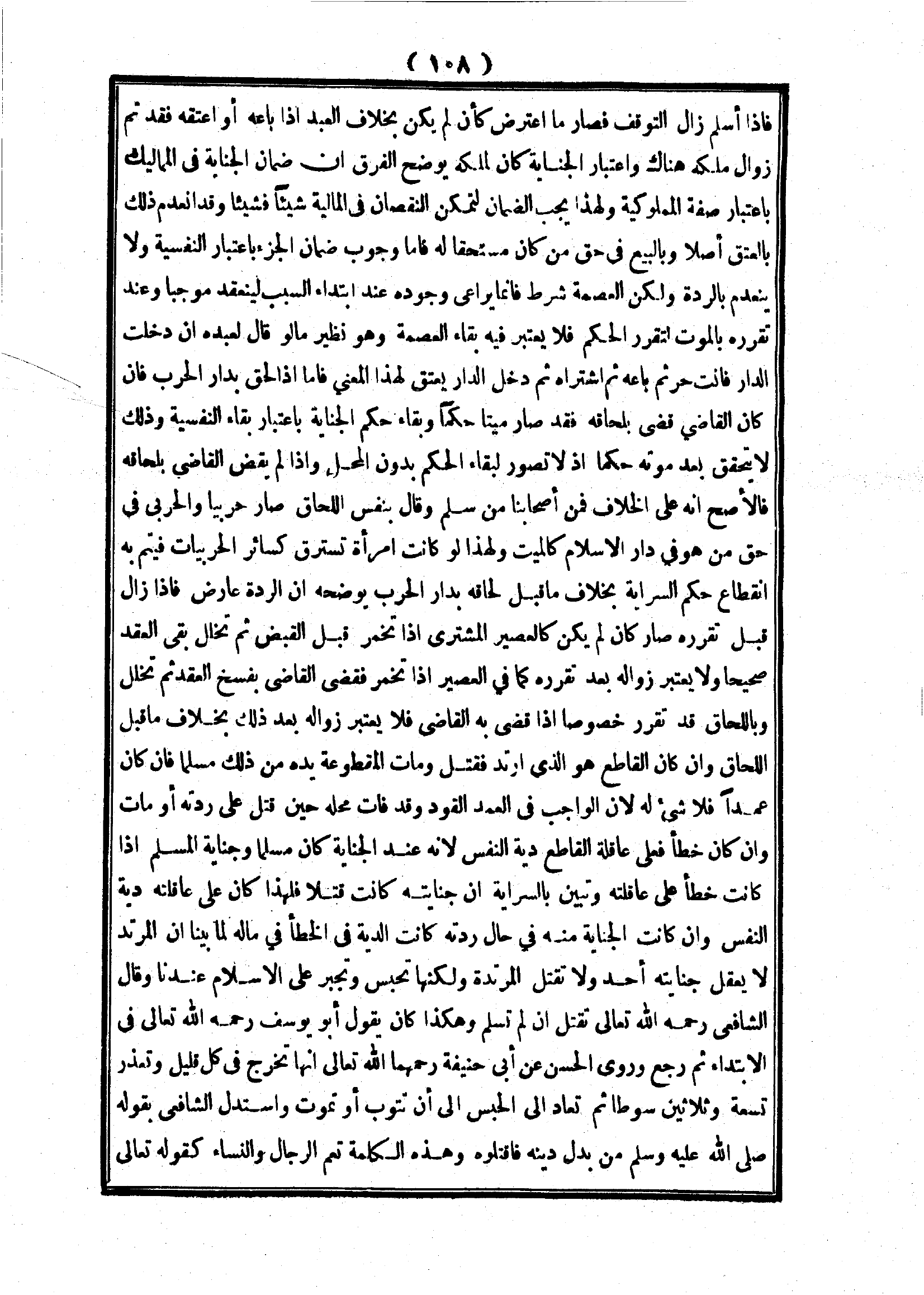
Full page
Translation
Word by word
the apostate woman is not killed وَلَا تُقْتَلُ الْمُرْتَدَّةُ* she is imprisoned تُحْبَسُ* and she is compelled to Islam وَتُجْبَرُ عَلَى الْإِسْلَامِ* in our view عِنْدَنَا* she is killed if she does not become Muslim تُقْتَلُ إنْ لَمْ تُسْلِمْ*
Interlinear view
- وَلَا تُقْتَلُ الْمُرْتَدَّةُ: This is the only view among the four schools that protects the apostate woman's life. The ground is given on the next page: killing is tied to the cause of fighting, and women do not fight.
- تُحْبَسُ: The term is stated on the page: by al-Hasan's report from Abu Hanifa she is taken out from time to time and given thirty-nine lashes, then returned to prison — 'until she repents or dies' (ila an tatuba aw tamut).
- وَتُجْبَرُ عَلَى الْإِسْلَامِ: Ijbar: form IV of j-b-r. The Quran uses the same root of the Prophet in the negative: 'and you are not over them a jabbar' — 'one who compels' (50:45).
- عِنْدَنَا: Al-Sarakhsi speaks for the school: the ruling is the Hanafi school's view, not a personal preference.
- تُقْتَلُ إنْ لَمْ تُسْلِمْ: Al-Shafi'i's view, consistent with his own words at al-Umm vol. 1 p. 294 (see the entry 'Al-Shafi'i: any adult man or woman who leaves Islam is called to repent'). By the page's continuation Abu Yusuf too held this view at first, then retracted.
Source
Context
The passage stands in the chapter on the apostate in the book of siyar of al-Mabsut (vol. 10 p. 108). The page moves from the rulings on wounding committed by or against an apostate to the ruling on the apostate woman; the quote is the first sentence of that transition.
The page sets three views side by side. (1) Hanafi: the woman is not killed, but imprisoned and compelled to Islam. (2) Al-Shafi'i: she is killed if she does not become Muslim; Abu Yusuf too said so at first, then retracted. (3) Al-Hasan b. Ziyad's report from Abu Hanifa: the woman is taken out of prison from time to time, given thirty-nine lashes and returned to prison 'until she repents or dies'. The page closes as it begins to set out al-Shafi'i's proof — that 'whoever changes his religion, kill him' covers women as well.
The debate continues over the next two pages. On al-Shafi'i's behalf: the reports that the Prophet had an apostate woman called Umm Marwan killed and Abu Bakr one called Umm Qirfa, and the equality of men and women in penalties. The Hanafi proof ('and our argument'): the Prophet's prohibition of killing women — his words on seeing a woman killed in battle, 'this one was not fighting' — so the cause of killing is fighting, and women do not fight; the apostate women who were killed were women who fought or incited to fighting. And in al-Sarakhsi's own words (p. 110): killing is not the recompense for apostasy but the consequence of persisting in unbelief; 'changing religion and unbelief itself are among the greatest crimes, but they are between the servant and his Lord; their recompense is deferred to the abode of recompense'.
End of the previous page
Start of the next page
Positions of the schools
| Hanafi | The male apostate is killed; the female apostate is not killed but imprisoned and compelled to Islam. By al-Hasan's report from Abu Hanifa she is taken out from time to time, given thirty-nine lashes and held in prison until she repents or dies. This is the page that is the subject of this entry. |
|---|---|
| Maliki | An apostate who declares his departure openly is invited to repent and killed if he does not return; the zindiq who conceals his unbelief is killed when found out, without being invited to repent. |
| Shafi'i | The adult man and woman who move from faith to polytheism are called to repent; if they do not repent they are killed. |
| Hanbali | Killing the apostate is obligatory and there is consensus on it; there is no difference between a man and a woman, and they are called to repent for three days under constraint. |
How the tradition defends this
The tradition's defence runs along these lines.
(1) The Hanafis protect the woman's life. Where three of the four schools kill the apostate woman, the Hanafi school does not; this is the most merciful view within the tradition itself, and it rests on the Prophet's prohibition of killing women.
(2) The cause of killing is not belief but fighting. The Hanafi proof ties killing to the cause of fighting and leaves the one who does not fight outside it; it says the apostate women who were killed were women who fought or incited to fighting. This is the most developed argument built within the tradition against killing for belief.
(3) Al-Sarakhsi leaves the recompense of apostasy to the hereafter. On the following page he says openly that changing religion lies between the servant and his Lord and that its recompense is deferred to the abode of recompense; within that frame the prison is defended not as a penalty but as a measure that gives an opportunity to return.
(4) The debate within the school is on the record. Abu Yusuf's retraction from al-Shafi'i's view shows that the school made a deliberate choice against killing the woman.
Still held today?
What does the Quran say?
- 2:256 Text states it explicitly
"There is no compulsion in religion; right guidance has become distinct from error": the page's sentence 'she is compelled to Islam' is a word-for-word description of what the verse rejects: being brought into a religion by prison and beating. The verse's ground runs against the ruling as well — because the right way has become distinct from error, compulsion has neither need nor place.
- 10:99 Text states it explicitly
"Would you then compel people until they become believers?": the question is put to the Prophet and ties a compulsion to a goal: 'until they become believers'. Al-Hasan's report from Abu Hanifa carries the same structure — 'until she repents or dies'. The structure the verse rejects is the structure the page builds.
- 16:106 Text states it explicitly
"Whoever disbelieves in God after his faith — except one who is compelled while his heart is at rest in faith — but whoever opens his breast to unbelief, upon them is wrath from God": the verse takes the apostate precisely as its subject and says two things. First: speech extracted by compulsion does not show the state of the heart and is void. Second: the recompense of one who returns to unbelief willingly is God's wrath and a great punishment — its agent is not a court. The declaration of Islam the page aims to obtain by prison and lashes is, by the Quran's own measure, exactly a compelled utterance that does not reflect the heart.
- 18:29 Text states it explicitly
"So whoever wills, let him believe, and whoever wills, let him disbelieve": the choice between faith and unbelief is left to the person's will; the recompense is tied to the hereafter. Al-Sarakhsi's sentence on the next page, 'their recompense is deferred to the abode of recompense', repeats this verse's logic — the page's ruling does not apply it.
- 4:15 Compatible with the text
"Then confine them to their houses until death takes them or God makes a way for them": honesty requires recording it: the Quran does know the holding of women in houses 'until death takes them', and this is the Quranic case nearest to the page's imprisonment 'until she dies'. But the verse's subject is an act of indecency and it requires proof by four witnesses; it does not take a belief or a change of belief as its subject, and it is not applied to extract a declaration of faith.
What puts this page in the register is not that it spares the apostate woman — that is the most merciful view within the four schools and must be recorded as such — but what it puts in death's place. The page protects the woman's life and builds in its stead an open-ended regime of compulsion: prison, thirty-nine lashes from time to time, and prison again, 'until she repents or dies'. The death penalty is lifted; a prison that ends in death remains.
The Quran names each part of this regime and rejects it. 2:256 rejects compulsion in religion; the page's verb, tujbaru 'ala al-islam, is the exact description of compulsion. 10:99 asks the Prophet 'would you compel people until they become believers'; the 'until she repents or dies' of al-Hasan's report builds the same structure. And 16:106, the very verse that takes the apostate as its subject, declares that speech extracted by compulsion does not show the heart and is void. What the page aims at — a declaration of Islam spoken under the lash in prison — is by the Quran's measure a compelled utterance that does not reflect the heart; the regime is built to produce a result the Quran counts as worthless.
The sharpest counter-argument, though, comes before the Quran from al-Sarakhsi's own pen. Two pages later, defending the Hanafi thesis, he writes: killing is not the recompense for apostasy; 'changing religion and unbelief itself are among the greatest crimes, but they are between the servant and his Lord; their recompense is deferred to the abode of recompense'. That sentence is the Quran's principle (18:29, 16:106). But the page's ruling contradicts it: for a crime whose recompense is deferred to the hereafter, prison and lashes are applied in this world. The ground al-Sarakhsi builds to reject killing is enough to reject the prison as well.
There is also what must be written in the page's favour, and it is not slight. The Hanafi proof, by tying killing to the cause of fighting, offers the most developed argument built within the tradition against killing for belief; Abu Yusuf changed his view in that direction. And it must be recorded honestly that the Quran too knows the holding of women in houses 'until death takes them' (4:15). But that verse takes as its subject an act of indecency proven by four witnesses, not a belief. The prison the Quran knows answers to an act; the prison the page builds is for obtaining a declaration of faith.
It should also be noted that on this page the digital text corrupts al-Hasan's report: the print's 'and al-Hasan reported' has become 'that he al-Hasan' in Shamela (see the scan note). The ruling of thirty-nine lashes is a report the reader cannot make out from the digital text but which the printed page states plainly.