Al-Sarakhsi: in Abu Hanifa's view there is no hadd on a man who hires a woman for zina and commits it, nor on her
Arabic text
Full page
Translation
Word by word
he hired اسْتَأْجَرَ* there is no hadd on either of them فَلَا حَدَّ عَلَيْهِمَا* in the view of Abu Hanifa فِي قَوْلِ أَبِي حَنِيفَةَ* this is a dower هَذَا مَهْرٌ* it is not zina linguistically لَيْسَ بِزِنًا لُغَةً*
Interlinear view
- اسْتَأْجَرَ: Form X of the root '-j-r: the contract of ijara, acquiring a benefit for a fee. The page's whole argument rests on the legal character of this word: because ijara is a lawful contract, it produces a **doubt** even when its object is zina.
- فَلَا حَدَّ عَلَيْهِمَا: A dual pronoun: the ruling covers both the man who hires and the woman who is hired. The page does not declare the act lawful; its ruling is limited to the falling away of the hadd.
- فِي قَوْلِ أَبِي حَنِيفَةَ: The ruling is assigned to the school's founder; the continuation of the same sentence records that Abu Yusuf, Muhammad and al-Shafi'i say 'the hadd is on both'. The school's two great imams oppose the founder.
- هَذَا مَهْرٌ: The words attributed to Umar and the page's real premise: money given for zina has the status of a dower. Al-Sarakhsi widens this to 'dower and fee are close to each other' and grounds it in the phrase 'their ujur' of 4:24.
- لَيْسَ بِزِنًا لُغَةً: Al-Sarakhsi's second proof: the people of the language do not call intercourse based on a contract zina and do not distinguish hire from marriage, since the difference between them is a legal one. The Quran has its own word for intercourse for payment: bigha' (24:33).
Source
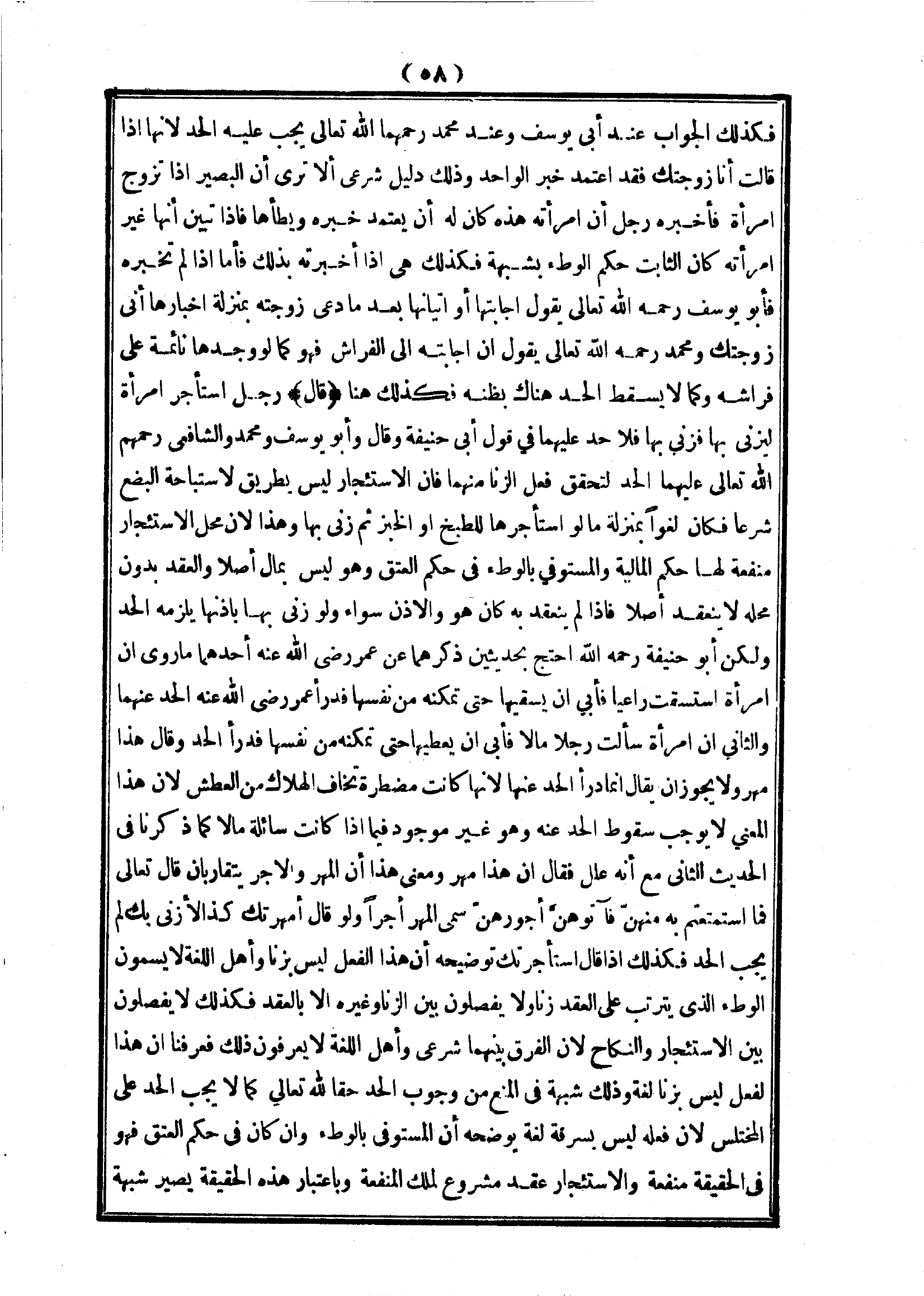
Context
The passage stands in the book of hudud of al-Mabsut (vol. 9 p. 58), within a series of cases in which the hadd falls away by doubt. The case immediately before is that of the blind man who lies with a stranger who came in place of the wife he called to his bed; the one immediately after is the man compelled to zina.
The page sets the question out on both sides. The opponents — Abu Yusuf, Muhammad and al-Shafi'i — say the hadd is due on both: the act of zina has occurred and hiring is no way of making intercourse lawful; as with hiring the woman to cook or bake and then committing zina with her, the contract is void. Abu Hanifa's proof is two reports attributed to Umar: a woman asked a shepherd for water and he refused unless she yielded herself, and Umar dropped the hadd from both; a woman asked a man for money and he set the same condition, and Umar dropped the hadd saying 'this is a dower'. Al-Sarakhsi expressly rejects explaining the first report by necessity: necessity does not drop the hadd from the man, and in the second report there is no necessity.
Al-Sarakhsi adds three grounds. (1) Dower and fee are close to each other; 4:24 calls the dower 'ujur'; had he said 'I give you such a dower to commit zina with you' no hadd would be due, and none is due when he says 'I have hired you'. (2) The people of the language do not call intercourse based on a contract zina; so the act is not zina linguistically, and this is a doubt — as the hadd for theft is not applied to the snatcher. (3) What is obtained by intercourse is in reality a benefit, and ijara is a lawful contract for acquiring a benefit; this reality, too, produces a doubt.
End of the previous page
Start of the next page
Positions of the schools
| Hanafi | According to Abu Hanifa there is no hadd on a man who commits zina with a woman hired for it, nor on her, because the fee resembles a dower and the contract of ijara produces a doubt. Abu Yusuf and Muhammad say the hadd is due on both. This is the page that is the subject of this entry. |
|---|---|
| Shafi'i | The hadd is due on both: the act of zina has occurred and hiring is no way of making intercourse lawful. (As reported by al-Sarakhsi on the same page.) |
| Hanbali | On a man who hires a woman for zina and does it, and on her, the hadd is due; Ibn Qudama gives this as the view of most of the people of knowledge and records Abu Hanifa's dissent, on the ground that owning the benefit counts as a doubt that drops the hadd. |
How the tradition defends this
The tradition's defence runs along these lines.
(1) Hudud fall away by doubts. This is a principle common to the schools; al-Mughni says in the same context that 'there is no disagreement that the hadd is averted by doubts'. Abu Hanifa's ruling is not a permission but an application of this general principle: because the hadd is the gravest penalty, it is not applied at the slightest uncertainty.
(2) No hadd does not mean lawful. The page does not treat the act as legitimate; the dispute concerns only whether the hadd is applied. The hiring contract is, on the page's own terms, void — the doubt arises from the contract's existence, not its validity.
(3) The ground is a Companion's practice. The ruling rests on two reports attributed to Umar, and Umar's 'this is a dower' builds the closeness of fee and dower from the Quran's own language (the ujur of 4:24).
(4) The school does not defend this ruling with one voice. On the same page Abu Yusuf and Muhammad oppose the founder; according to al-Mughni so do most of the people of knowledge. The tradition debated this ijtihad within itself and left it in the minority.
Still held today?
What does the Quran say?
- 4:24 Text states it explicitly
"That you seek [them] with your wealth, in wedlock and not in fornication (muhsinina ghayra musafihin); so for whatever you enjoy of them, give them their ujur as an obligation": the verse al-Sarakhsi reads to equate dower and fee; he takes only its second half, 'their ujur'. Yet the same sentence sets the condition of that payment just before: that you seek with your wealth in wedlock and not in fornication. The verse in which the Quran calls the dower a 'fee' is precisely the verse that separates marriage made with money from zina done for money.
- 4:25 Text states it explicitly
"So marry them with the permission of their people and give them their ujur in a fair manner, as chaste women, not fornicating (ghayra musafihat) nor taking lovers": the same distinction is drawn a second time from the woman's side: ujur are given only in marriage, in a chaste bond and 'not as fornicators'. In the Quran the payment does not determine the character of the relation; the character of the relation determines the name of the payment.
- 24:33 Text states it explicitly
"And do not compel your slave girls to prostitution (bigha') when they desire chastity, seeking the goods of this worldly life": the Quran has its own word for intercourse in exchange for worldly gain: bigha'. Al-Sarakhsi's argument that 'the people of the language do not call intercourse based on a contract zina' meets the fact that the Quran names this act not as a kind of contract but as the opposite of chastity (the contrary of tahassun). The verse also forgives the women who are compelled ('after their compulsion, God is forgiving, merciful') — the Quran, that is, recognises the ground of necessity and compulsion; the page expressly rejects the necessity-based reading of the first Umar report and makes the fee the ground instead.
- 24:2 Text states it explicitly
"The woman and the man who commit zina — flog each of them a hundred lashes, and let no tenderness for them seize you in the religion of God": the verse names the woman and the man who commit zina together, binds both to the same ruling and admits no exception for payment. The same verse separately forbids suspending the ruling out of 'tenderness in the religion of God' towards the two. The point here is not the penalty itself but the way the Quran defines the act: zina is zina whatever passes between the parties.
What puts this page in the register is not the averting of the hadd by doubt — that is a principle every school accepts — but the source of the doubt. Here the doubt arises not from a mistake, a compulsion or an irregular marriage; it arises from a payment contract whose object is the act of zina itself. In the page's logic, putting a price on zina takes it partly out of being zina: the more commercial the relation, the more uncertain the legal character of the act.
Al-Sarakhsi's Quranic proof, 4:24, does not carry this logic. He takes only the verse's second half — 'give them their ujur'; the first half sets the condition of payment: 'in wedlock and not in fornication'. 4:25 repeats the same distinction from the woman's side. In the Quran money does not give the relation its name; the relation's name gives the money its name. What is given in marriage is called ujur; what is given in zina has no name in the Quran, because that relation is not recognised in the Quran as a contract.
The linguistic argument meets the Quran's own vocabulary as well. Al-Sarakhsi says the people of the language do not call intercourse based on a contract zina and do not distinguish hire from marriage. The Quran, however, names intercourse for payment with a separate word — bigha' (24:33) — and defines it as the opposite of chastity; baghiyy, from the same root, names the exact contrary of chastity at 19:20 and 19:28. The Quran's language recognises this act not as a kind of marriage but as something standing outside marriage.
There is also what must be written in the page's favour, and it is not slight. The ruling is a minority one within the tradition: in the same sentence the school's two great imams, Abu Yusuf and Muhammad, oppose the founder; al-Mughni counts most of the people of knowledge on the other side too. The page does not declare the act lawful; it only drops the hadd. And the first Umar report — the woman compelled for water — can readily be explained by the ground of compulsion the Quran recognises at 24:33; the Quran forgives the woman who is compelled.
That is exactly where the problem lies: the page sees this explanation and rejects it. By saying that necessity would not drop the hadd from the man and that there is no necessity in the second report, al-Sarakhsi moves the ground from compulsion to the fee. The mitigating cause the Quran recognises is the situation of the compelled woman; the mitigating cause the page constructs is the fee itself. The first protects the one wronged; the second, the one who pays.