«I have not seen anyone more depriving a resolute man of his reason than one of you, deficient in intellect and religion»
Arabic text
Full page
Translation
Word by word
I have not seen مَا رَأَيْتُ among مِنْ those deficient (fem. pl.) نَاقِصَاتِ* intellect عَقْلٍ and-religion وَدِينٍ more carrying off أَذْهَبَ* of the reason لِلُبِّ* of the man الرَّجُلِ resolute, prudent الْحَازِمِ than مِنْ one of you (f.) إِحْدَاكُنَّ
Interlinear view
- نَاقِصَاتِ: Active participle of n-q-s in the sound feminine plural; in construct: 'women deficient in intellect and religion'. The attribute is predicated of women as a class, not of individuals.
- أَذْهَبَ: An elative (af'al pattern): 'more apt to make go away', expressing comparison.
- لِلُبِّ: lubb: the core of the intellect, sound sense; in the Quran it appears in the laudatory phrase ulu al-albab.
Source
Context
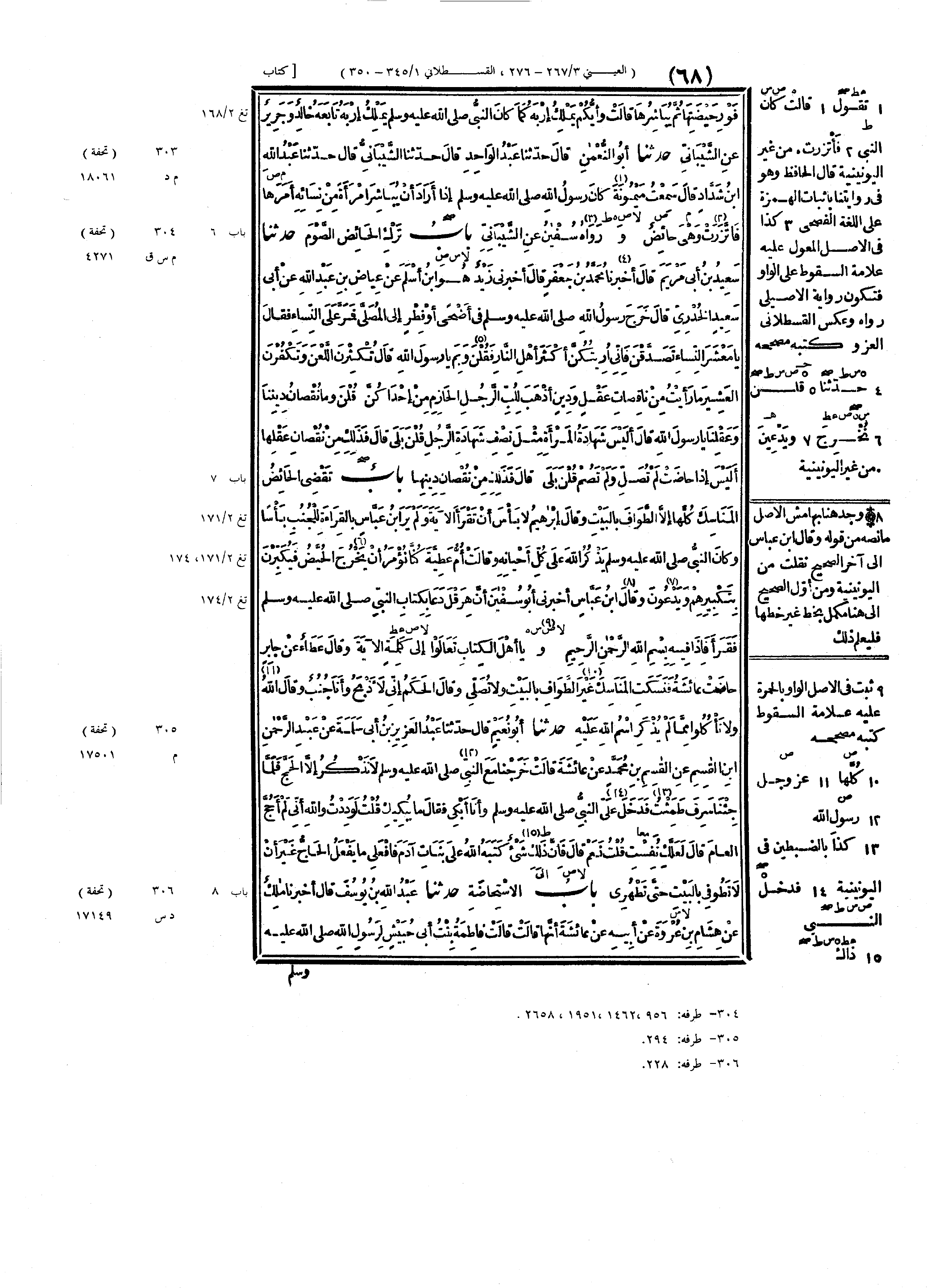
The report stands in the Sahih's Book of Menstruation, in the chapter 'the menstruating woman's leaving of the fast' (vol. 1 p. 68, no. 304); the second locus is in the Book of Zakat (vol. 2 p. 120, no. 1462), and Muslim also transmits it (no. 79). The text comes inside the scene of an eid prayer and carries three separate statements: (a) that women form the majority of the people of the Fire, (b) that the cause is their frequent cursing and their 'ingratitude to the husband', and (c) a definition of deficiency in intellect and religion. The third is defined inside the report itself, and the definition is legal: deficiency of intellect is tied to the ratio in testimony, deficiency of religion to the lapse of prayer and fasting during menstruation. This matters for the text's own logic — 'deficiency' is presented not as a moral fault but as a conclusion drawn from two legal situations; yet the conclusion is still predicated of women as a class and joined to the sentence about carrying off a resolute man's reason. This entry records the text and its place in the Sahih; the report's grade is not disputed within the tradition.
End of the previous page
Start of the next page
How the tradition defends this
The tradition's defence runs along these lines. (1) The definition is inside the text: 'deficiency' is defined in the report itself and tied to two legal situations (the ratio in testimony; the lapse of prayer and fasting in menstruation), so it is a technical observation, not a moral disparagement. Deficiency in religion is not a sin — the menstruating woman is commanded not to pray; commentators read this as a dispensation, not a defect. (2) The context of the address: the sentence is spoken not as a rebuke but in the setting of an exhortation to give alms, and the women answer back; commentators take the tone to be one of gentle banter. (3) 'Carrying off the reason' is praise: al-Nawawi and others read a woman's capacity to sway a resolute man as an indication of power rather than of weakness, with the sentence addressed to men, not to women. (4) 'The majority' is not a statistic: the report functions as a warning and is followed at once by a remedy (almsgiving). None of these defences disputes the report's authenticity; each reconstitutes the sentence's scope and tone.
Still held today?
What does the Quran say?
- 33:35 Text states it explicitly
«Indeed the submitting men and the submitting women … God has prepared for them forgiveness and a great reward.» The verse enumerates ten qualities separately for men and for women and states the reward for both in a single clause. This is the balance the Quran itself sets: the reward attaches to the qualities enumerated, not to sex.
- 4:124 Text states it explicitly
«Whoever does righteous deeds, male or female, and is a believer — those will enter the Garden and will not be wronged a speck.» Entry into the Garden is explicitly levelled with the qualifier 'male or female', and it is said that they will not be wronged in the least.
- 16:97 Text states it explicitly
«Whoever does righteousness, male or female, while being a believer — We will surely cause him to live a good life.» The same levelling is repeated for the reward in this world.
- 2:282 Implied by the text
The report's definition of 'deficiency of intellect' is grounded in the provision of two women witnesses in 2:282. The verse supplies its own rationale: 'so that if one of them errs, the other may remind her'. The rationale is reminding, not intellectual capacity; the provision is moreover specific to one kind of transaction (recording a deferred debt), and the Quran sets no such ratio elsewhere in testimony (in 24:6-9, for instance, a woman's testimony in li'an carries exactly the same weight as a man's). To infer from this particular provision that a woman's intellect is half is an inference beyond the text's own stated rationale.
- 2:222 Implied by the text
The report's definition of 'deficiency of religion' rests on the lapse of prayer and fasting during menstruation. The Quran mentions menstruation in 2:222 as a discomfort and lays down a restriction only as to intercourse; a statement that a menstruating woman does not pray, or that this constitutes a deficiency in religion, was searched for in the text and not found. The second leg of the definition therefore has no basis in the Quran (text-silent); deriving a religious deficiency from the absence of an obligation has no support in the text.
The most striking feature of this report is that it defines its own claim of 'deficiency' and grounds the definition in two legal situations. That makes the claim testable. The first leg (2:282) goes beyond the verse's own rationale: the text states the reason plainly — 'so that if one errs the other may remind her' — the provision is specific to one kind of transaction, and in another context of testimony (24:6-9) the Quran holds a woman's word exactly equal to a man's. The second leg has no basis in the Quran at all: the ruling that a menstruating woman does not pray is not in the text, so deriving a 'deficiency of religion' from it rests on fiqh, not on the text. The Quran, by contrast, expressly places sex outside the measure wherever reward and rank are at issue (33:35, 4:124, 16:97), and adds in 4:124 that they 'will not be wronged a speck'. The conclusion is this: the report declares women deficient as a class and infers it from two legal details, while the Quran ties worth and reward to faith and deeds alone. The number of softenings the tradition brings to this report — reading the tone as banter, insisting that the deficiency is no fault, taking the sentence to be addressed to men — is the record of its own discomfort with the text's weight.