«Ill omen lies in three: the horse, the woman and the house»
Arabic text
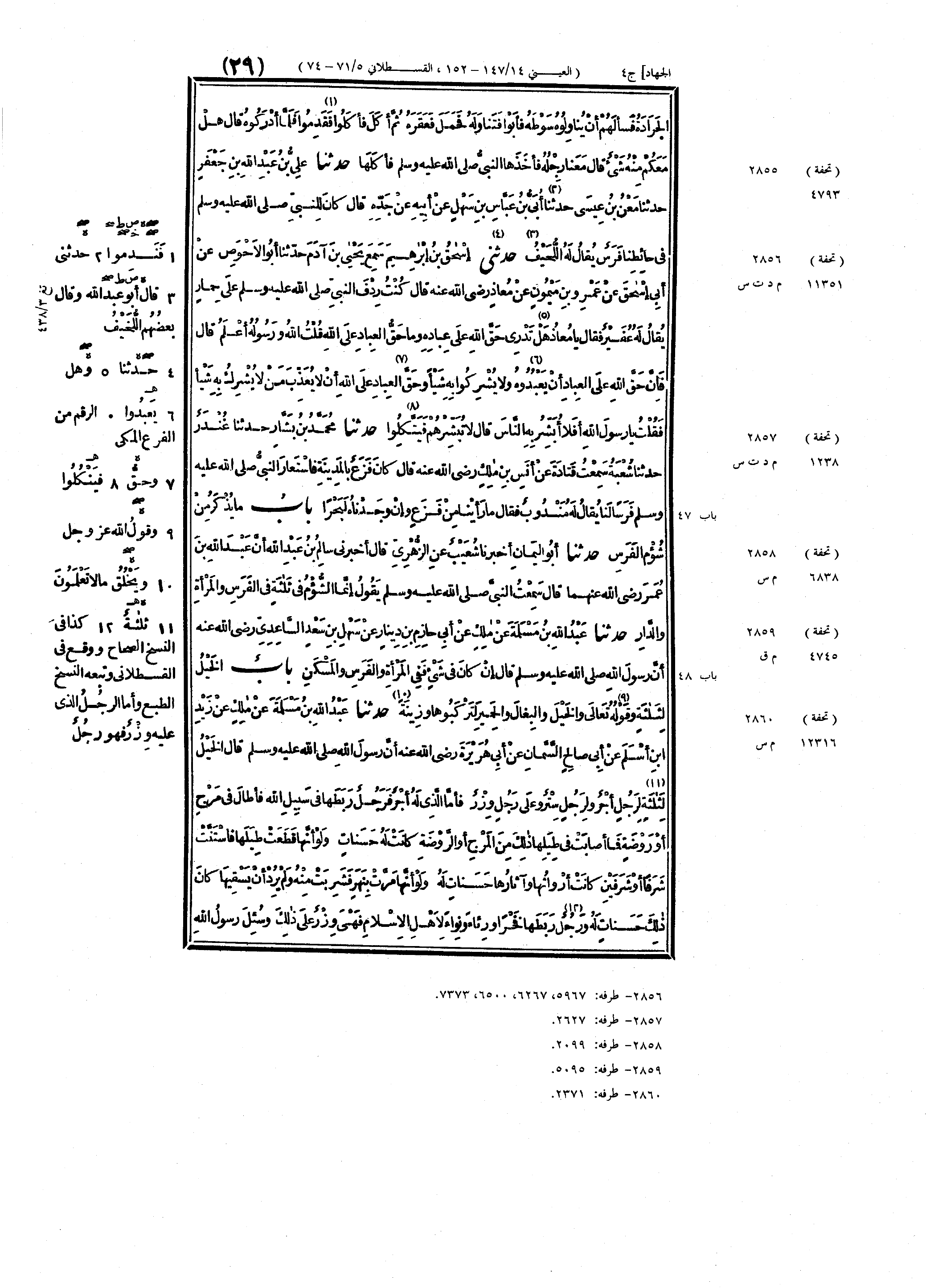
Full page
Translation
Word by word
only إِنَّمَا* the ill omen الشُّؤْمُ* in فِي three ثَلَاثَةٍ in فِي the horse الْفَرَسِ and-the woman وَالْمَرْأَةِ and-the house وَالدَّارِ
Interlinear view
- إِنَّمَا: inna + kaffa ma: a restrictive particle confining the ruling to what follows ('only in these').
- الشُّؤْمُ: root sh-'-m; with the definite article, a generic noun: 'ill omen as such'. Same semantic field as the Quran's ta'ir / tatayyur.
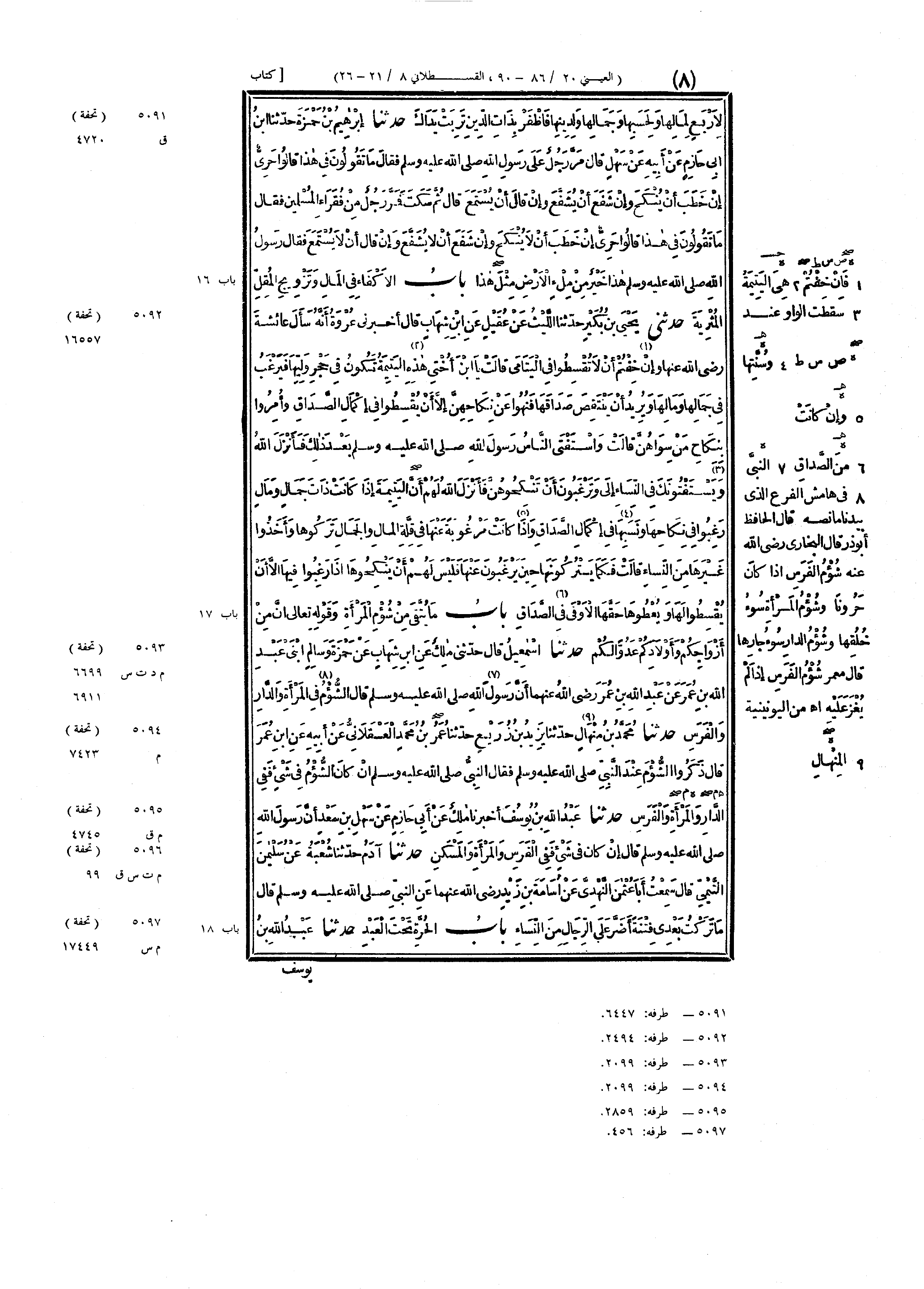
Source
Context
The report appears in two different books of the Sahih: Kitab al-Jihad, the chapter 'on what is mentioned of the ill omen of the horse' (vol. 4 p. 29, no. 2858) and Kitab al-Nikah (vol. 7 p. 8, no. 5093). In both the isnad goes back to Ibn Umar, and both chains meet at al-Zuhri. On the same page, the report of Sahl b. Sa'd that immediately follows (no. 2859) puts the matter conditionally: 'if it were in anything, it would be in the woman, the horse and the dwelling.' al-Bukhari places the two forms side by side. In a third place in the same work (vol. 7 p. 135, no. 5753) the report is transmitted together with 'there is no contagion and no ill omen' — so the Sahih itself contains both a text confining ill omen to three things and a text rejecting ill omen altogether. Aisha's objection to this report is not in the Sahihayn but in the Musnad and Sunan literature; its substance is that the Prophet was reporting a saying of the people of the Jahiliyya, not stating it as his own ruling. This entry records the text and its place in the Sahih; the report's grade is not in dispute — it is a text al-Bukhari and Muslim agree on.
End of the previous page
Start of the next page
How the tradition defends this
The tradition's defence runs along four lines. (1) The conditional reading: the report of Sahl b. Sa'd that al-Bukhari places immediately after ('if it were in anything') frames the matter as a hypothetical concession rather than an absolute attribution; Ibn Hajar treats this form as the interpretation of no. 2858. (2) 'Shu'm' as burden, not bad luck: many commentators read shu'm here not as 'ill fortune' but as 'a state that weighs on a person' — a difficult horse, an incompatible wife, a cramped house; that is, a concrete hardship rather than a divine ill omen. (3) Reading it as a report of others' speech: the line that takes Aisha's objection (in the Musnad and Sunan) as decisive holds that the Prophet was relaying what the Jahiliyya used to say, with an elided 'they used to say' at the head of the sentence. (4) The balance inside the Sahih: the same work contains the unqualified 'there is no ill omen'; by a standard usuli rule an unqualified negation restricts the particular text. None of these defences disputes the report's authenticity; all of them interpret the text away — and that is itself the record of the tradition's own discomfort with it.
Still held today?
What does the Quran say?
- 27:47 Text states it explicitly
«They said: we have taken you and those with you as an ill omen. He said: your omen is with God.» The Quran directly rejects assigning ill omen to a person or an object and refers causation to God.
- 36:19 Text states it explicitly
«Your omen is with you — is it because you were reminded?» The omen lies not in an external object but in the person's own stance.
- 7:131 Text states it explicitly
«If evil befell them, they took Moses and those with him as an ill omen»: Pharaoh's people assigned ill omen to Moses; the Quran narrates this as their failing.
- 17:13 Implied by the text
«We have fastened every person's ta'ir to his own neck.» The Quran deliberately turns the Jahiliyya's word for omen (ta'ir) into a person's own deeds: destiny lies in what one does, not in an external object.
- 4:19 Compatible with the text
«Live with them in kindness; if you dislike them, it may be that you dislike a thing in which God has placed much good.» The Quran frames a wife as a possible source of good even where there is aversion, not as a bearer of ill omen. The verse does not address this report directly (hence the 'compatible' label), but it shows the text's stance.
What the Quran says about ill omen is neither indirect nor implicit: assigning ill omen to a person or an object is a behaviour the text rejects in three separate places, and each time the ones rejecting it are prophets and the ones assigning it are their opponents (27:47, 36:19, 7:131). 17:13 goes one step further and turns the Jahiliyya's word for omen into a person's own deeds. The report, by contrast, confines ill omen to three concrete objects — one of which is a human being. The sheer number of interpretations the tradition brings to it (the conditional reading, the 'hardship' reading, the 'reporting Jahili speech' reading) shows that the difficulty is not a modern invention: the text troubled readers in the earliest centuries, and Aisha's objection is the earliest record of that trouble. The point to notice is this: it is not the report's authenticity that is disputed but its meaning — that is, the tradition finds itself obliged to interpret a text it holds to be sound in order to reconcile it with an explicit Quranic ruling. For a reading that takes the Quran as the measure, no such reconciliation is needed: 36:19 has already said 'your omen is with you'.