"He went out many times to cast himself from the mountain tops"
Arabic text
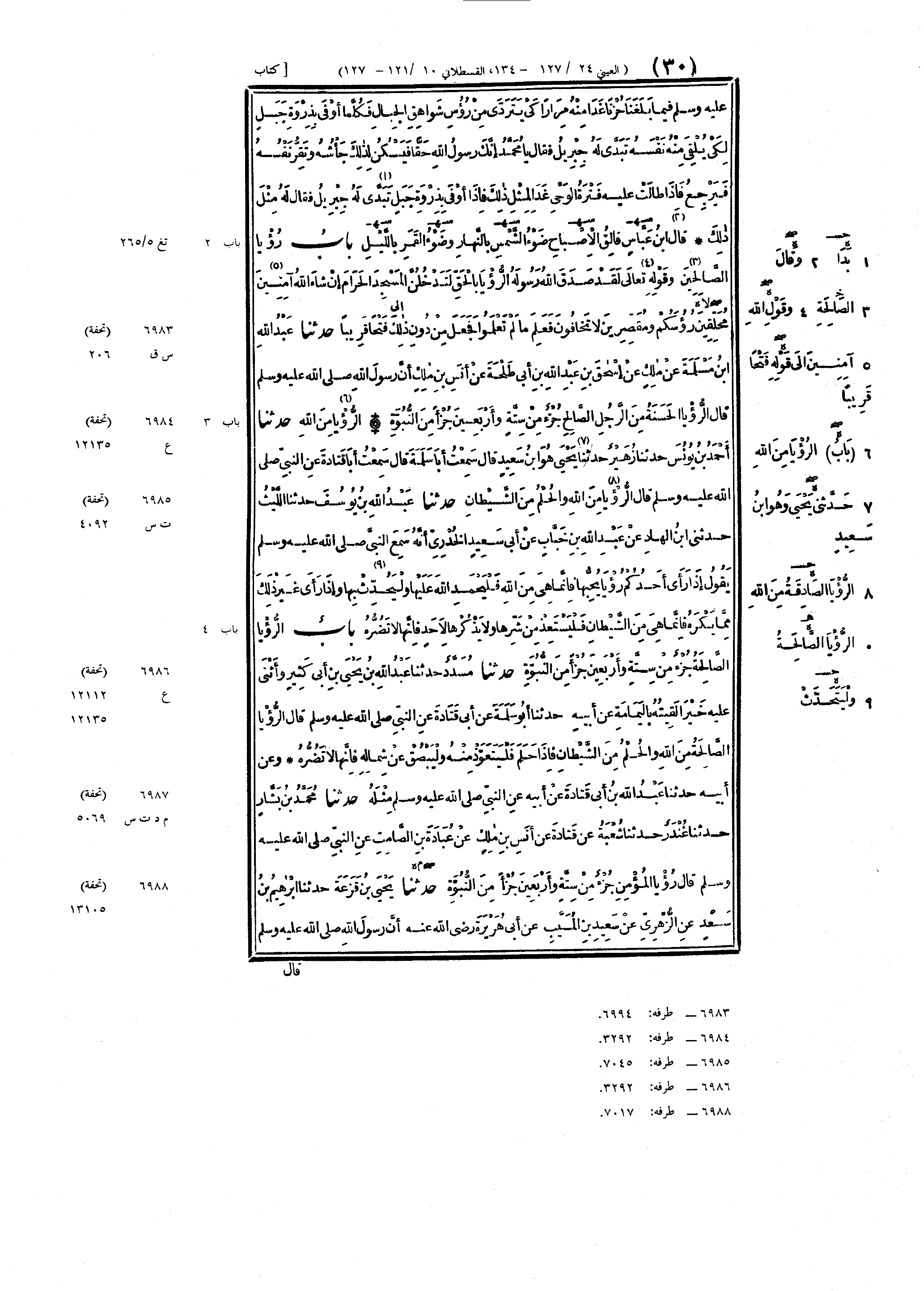
Full page
Translation
Word by word
as has reached us فِيمَا بَلَغَنَا* he went out many times because of it غَدَا مِنْهُ مِرَارًا* in order to throw himself down كَيْ يَتَرَدَّى* Gabriel appeared to him تَبَدَّى لَهُ جِبْرِيلُ*
Interlinear view
- فِيمَا بَلَغَنَا: The four most critical words in the text. This is al-Zuhri's own note, saying that what follows comes not from Aisha but from a report that reached him without a named source — the type called balagh. This is where the chain breaks.
- غَدَا مِنْهُ مِرَارًا: Miraran: it states repetition. The weight of the narrative comes not from a single moment but from the recurrence.
- كَيْ يَتَرَدَّى: Form V of r-d-y, to fall or plunge from a height. The particle kay states the **intention** expressly — what is described is purpose, not outcome.
- تَبَدَّى لَهُ جِبْرِيلُ: The narrative's resolution: each time an angel appears and says, 'You are truly the Messenger of God.' The text frames the attempt not as a collapse but as a recurrence closed by divine consolation.
Source
Context
The report stands in the Sahih's "Book of the Interpretation of Dreams", under the heading "the first of revelation with which the Messenger of God was begun was the true dream", as no. 6982. The text is a longer version of the Sahih's first hadith (the beginning of revelation): Hira, "Recite", Khadija, Waraqa b. Nawfal — all of it is here.
The narrative ends with Waraqa's death, and continues at exactly that point: "Then Waraqa was not long in dying, and revelation paused for a time, until the Prophet grieved — as has reached us — with a grief such that he went out many times to cast himself from the tops of the high mountains..."
The axis of this entry is those four words: fima balaghana, "as has reached us". They are not Aisha's words; they are al-Zuhri's own interjected note, announcing that the chain stops here. In the science of hadith this type is called a balagh: a report the transmitter relates without naming the one he took it from. The first part of the page therefore comes with a chain connected up to Aisha, and the second with a balagh that halts at al-Zuhri; the two stand side by side inside a single text, with no separating device.
The narrative itself says this: during the pause in revelation the Prophet grieved; in that grief he went out many times to the tops of high mountains to throw himself off; each time he reached a summit Gabriel appeared and said, "Muhammad, you are truly the Messenger of God"; at that his agitation subsided and his soul was set at rest and he returned; and when the pause lengthened he went out for the same purpose again, and the same thing happened again.
The page closes with a saying of Ibn Abbas on "the cleaver of daybreak", and the chapter "the dreams of the righteous" opens immediately after.
End of the previous page
Start of the next page
How the tradition defends this
Unlike the other two Bukhari entries, the tradition's defence here rests on the report's own text, and it is strong.
(1) This portion is not the Sahih's connected text. It is al-Zuhri himself who inserts "as has reached us"; the page marks with its own hand where the chain breaks. Ibn Hajar classes it as a balagh. The same defence is repeated today by islamqa (152611) and islamweb (92386): these sentences do not count "as part of the Sahih", because Bukhari's criterion applies to chained text.
(2) Bukhari does not adduce this portion as proof. The chapter's subject is the beginning of revelation and the true dream; the balagh runs as a connecting sentence that completes the chronology. It is the practice of the hadith scholars to include such linking material within a chapter, and it is not treated as probative.
(3) The text can be read as a description of grief rather than an attempt at suicide. The phrase "in order to throw himself down" states an intention, but the close of the narrative is, each time, a divine consolation and a return. In the text's own construction what is related is not a collapse but a repeated scene of consolation; its emphasis falls not on the Prophet's weakness but on God's holding him each time.
(4) Human anguish is not foreign to the Quran. The Quran records the prophets' severe distress, even their approach to despair: Jonah in the belly of the fish (21:87), Jacob's eyes turning white (12:84), Moses's fear (20:67-68, 26:12-13), and the address to the Prophet, "you may well destroy yourself" (18:6, 26:3). Depth of grief is not by itself contrary to the Quran.
(5) The fact of the pause is itself in the Quran. Sura 93 presupposes an interruption and the consolation that follows it: "Your Lord has not forsaken you, nor is He displeased." The report's frame — the halt of revelation, and consolation — sits with the text; the dispute is not over the frame but over the act placed inside it.
Still held today?
What does the Quran say?
- 93:3 Text states it explicitly
"Your Lord has not forsaken you, nor is He displeased." This is the Quran's own sentence about the pause, and it is a negation: you were not abandoned, you were not resented. The rest of the sura moves in the same direction — "the hereafter is better for you than this world", "your Lord will give to you and you will be satisfied", "did He not find you an orphan and shelter you?" The Quran treats the pause as an occasion for consolation, and the content of that consolation is a reminder of past protection. There is in the text neither a narrative of collapse nor an interposed angelic scene; the verse itself carries the consolation.
- 94:1-6 Implied by the text
"Did We not expand your breast for you... For with hardship comes ease." The sura that follows immediately on 93 asks the same addressee, "did We not expand your breast", and twice repeats that ease accompanies hardship. The picture the Quran draws for this period is not a constriction of the breast but its expansion.
- 4:29 Text states it explicitly
"And do not kill yourselves; indeed God is merciful to you." The ground of the prohibition is not a threat of punishment but an attribute: God's mercy toward you. This is not where the entry lodges a claim of contradiction — the verse is a prohibition, while the report speaks of an intention never carried out, and the pause preceded this address. The verse is set here to show how the Quran regards self-killing: the act is tied to a failure to know the divine mercy.
- 53:2-4 Implied by the text
"Your companion has not strayed, nor has he erred; nor does he speak from desire; it is only a revelation revealed." These verses sharpen the entry's real methodological question: about the source of revelation the Quran speaks decisively. The balagh in the report constructs a scene implying that the Prophet doubted his own messengership (Gabriel's saying each time, "you are truly the Messenger of God", answers a hesitation and nothing else). The Quran keeps no record of such a hesitation; sura 93 rests its consolation on wholly different ground — the favour already shown.
- 33:21 Implied by the text
"In the Messenger of God you have a good example." The Prophet's life is set up in the Quran as an exemplar. This is not a denial of anguish; it fixes the form the narrative takes in the Quran. Where the Quran records the Prophet's distress (18:6, 26:3, 15:97) it brings a direction immediately after — "do not grieve", "be patient", "glorify your Lord with praise". The anguish is recorded and closed with an act; no scene of letting go is constructed.
This entry's subject is not what most take it to be. The issue is not "Bukhari says the Prophet attempted suicide"; the issue is that a report with no chain stands, without any separating device, inside the text of a book defined by the criterion of chains.
The page confesses as much itself. Fima balaghana — as has reached us. Those four words are al-Zuhri's, not Aisha's, and they say precisely this: from here on I am not naming my source. The science of hadith calls this a balagh and does not equate it with connected transmission. Ibn Hajar identifies it as such; today's defence (islamqa 152611) starts from the same point and says "this portion does not count as part of the Sahih". That defence is correct, and it is recorded as such in this entry.
But the defence, by its own admission, opens a problem. If these sentences do not meet the Sahih's criterion, what are they doing inside the Sahih? And by what mark is the reader to separate them? On the printed page there is no bracket, no change of type, no warning — the sentence emerges from within a narrative carried by Aisha's chain, in the same flow of prose. The consequence is this: for fourteen centuries anyone reading this text could learn which part fell under which criterion only from a commentary at the level of *Fath al-Bari*. How much of what the label "sahih" covers is this entry's real question.
As to content, honesty is required. The Quran does not conceal the prophets' severe distress: Jonah calls out from the darknesses, Jacob's eyes turn white, Moses is afraid, and the Prophet is twice told, "you may well destroy yourself" (18:6, 26:3). Deep grief is not foreign to the Quran, and rejecting this report because it "does not befit a prophet" draws not on the Quran but on a surplus of immunity built up later.
The distinction lies elsewhere. Everywhere the Quran records the Prophet's distress it closes it with a direction: "do not grieve", "be patient", "glorify your Lord with praise" (15:97-98). And in the one place it speaks of the pause itself — sura 93 — the content of the consolation is not an interposed angel but a reminder of past protection: did He not find you an orphan and shelter you, find you lost and guide you, find you poor and enrich you. The scene the balagh constructs says something else: the Prophet is unsure of his own messengership, and on every summit an angel has to tell him, "you are truly the Messenger of God." The Quran's own consolation rests not on answering such a hesitation but, without touching it at all, on the favour already given.
The verdict of this entry is therefore twofold, and both halves must be written plainly. (a) The content of the balagh does not sit with the Quran's own account of the pause; sura 93 builds a different consolation. (b) But this balagh is also not a connected report by Bukhari's own criterion — so rejecting it does not require standing against the Sahih; reading the Sahih's own note is enough. What enters the register is less the content of the sentence than the fact that this note stayed invisible inside the text for fourteen centuries.