"The Prophet was bewitched, so that he imagined doing a thing he had not done"
Arabic text
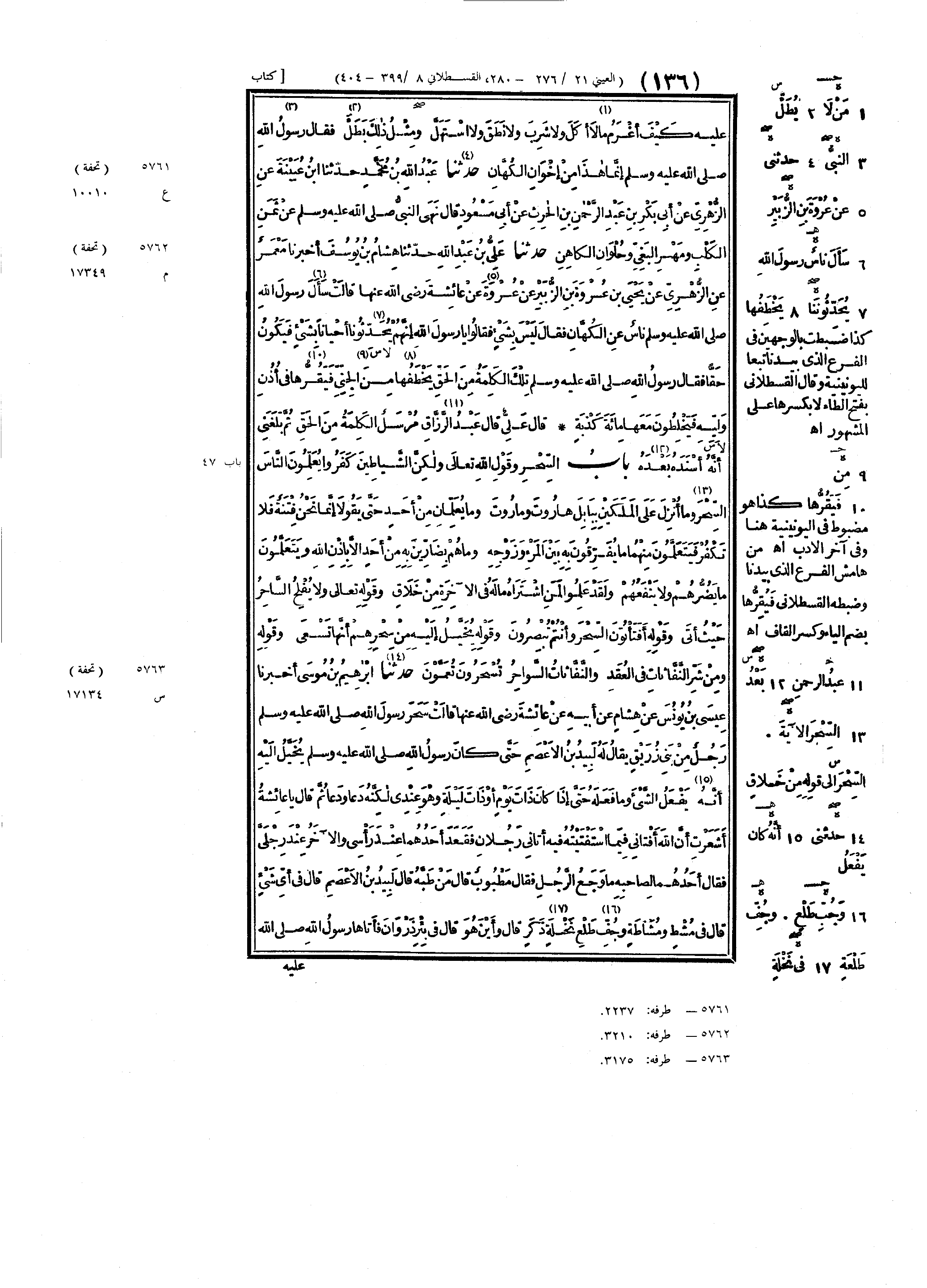
Full page
Translation
Word by word
bewitched سَحَرَ* it was made to appear to him يُخَيَّلُ إِلَيْهِ* that he did a thing when he had not done it أَنَّهُ يَفْعَلُ الشَّيْءَ وَمَا فَعَلَهُ* he has been bewitched مَطْبُوبٌ*
Interlinear view
- سَحَرَ: Root s-h-r. The agent is a man and the object the Prophet — the direction of the verb is the same as that of the accusation the Quran puts in the disbelievers' mouths at 25:8 and 17:47.
- يُخَيَّلُ إِلَيْهِ: Passive, form II of kh-y-l. It is the very verb the Quran uses in describing sorcery (20:66, of the ropes of Pharaoh's magicians). Bukhari cites that verse in the chapter heading itself.
- أَنَّهُ يَفْعَلُ الشَّيْءَ وَمَا فَعَلَهُ: The core of the claim: what is affected is the link between perception and fact. 'A thing' is left indefinite; the page does not say which act.
- مَطْبُوبٌ: A euphemism from t-b-b: the form meaning 'treated' is used for 'bewitched'. It comes on the page from the mouths of two angels.
Source
Context
The report stands in the Sahih's "Book of Medicine", under the heading "the chapter of sorcery", as no. 5763 (vol. 7 p. 136). The chapter heading itself sets this entry's frame: Bukhari opens the chapter of sorcery with five Quranic passages — 2:102 (Harut and Marut), 20:69 ("the sorcerer does not prosper wherever he goes"), 10:77 ("do you come to sorcery with your eyes open?"), 20:66 ("it was made to appear to him from their sorcery that they were moving") and 113:4 ("those who blow on knots"). The hadith's key verb, yukhayyalu, thus comes from the chapter's own list of verses.
The isnad: Ibrahim b. Musa, from Isa b. Yunus, from Hisham [b. Urwa], from his father [Urwa], from Aisha. At the foot of the same page Bukhari lists three corroborations (Abu Usama, Abu Damra, Ibn Abi al-Zinad — all from Hisham) and records a variant: al-Layth and Ibn Uyayna transmit from Hisham "a comb and flax-combings"; Bukhari then glosses the two words lexically. The report is therefore not a singular gharib inside the Sahih but a multiply transmitted text; the same hadith is in Muslim (2189) and appears at a second place in Bukhari (vol. 4 p. 122, no. 3268).
The full text runs thus: Labid b. al-Aʿsam bewitches the Prophet; the Prophet begins to imagine he has done a thing; he prays; two men come to him, one sitting at his head and one at his feet, and they speak to each other — "what ails the man?" "He is bewitched." "Who bewitched him?" "Labid b. al-Aʿsam." "In what?" "In a comb, comb-waste and the sheath of a male date-palm's spathe." "And where is it?" "In the well of Dharwan." The Prophet goes to the well and tells Aisha "its water is like an infusion of henna, and the tops of its palms like the heads of devils". Aisha asks, "shall I not take it out?"; he answers, "God has already granted me well-being, and I disliked stirring up evil among the people over it", and orders the well filled in.
Two details deserve particular notice. First: the page does not describe what the sorcery took effect upon — "a thing" is left indefinite; that indeterminacy is the gap later commentary would fill. Second: the text's own resolution is a divine intervention ("God has granted me well-being"), and the Prophet, though he knows the culprit, declines to punish him.
End of the previous page
Start of the next page
How the tradition defends this
The tradition's defence runs along four lines, some of them strong.
(1) This is exactly the Quran's account of sorcery. 7:116 says the magicians "bewitched the eyes of the people", and 20:66 that the ropes "were made to appear to him, from their sorcery, to be moving". For the Quran, then, sorcery is not a transformation of reality but an illusion of perception — and the report says the same thing with the same word (yukhayyalu). Bukhari cites that very verse in opening the chapter. Moses is a prophet, and the verse says plainly that the illusion reached him.
(2) What is affected is the body, not prophethood. On this defence (the line of the classical commentaries and of Ibn Hajar, repeated today at islamqa 68814) the sorcery touched the Prophet's worldly affairs — which wife he went to, and the like — not the delivery of the message. The preservation of revelation is a separate plane; the page contains not one word about sorcery reaching revelation.
(3) Prophets are not exempt from bodily affliction. They fall ill, are wounded, are poisoned (at Khaybar), and forget. If sorcery is counted a member of that class, then demanding exemption from it rests not on the Quran's own picture of a human prophet but on a surplus of immunity added to it later.
(4) The text's own outcome shows the Prophet victorious, not helpless. The sorcery does not persist: he prays, God informs him, God grants him well-being, and he declines to punish the culprit though he knows him. The direction of the narrative is deliverance, not defeat.
To this may be added a methodological argument: the report stands in both Sahihs, comes from Hisham b. Urwa by at least four routes, and rejecting it means rejecting on grounds of content a text that satisfies every criterion of authentication the science of hadith recognises — a move that itself requires a separate warrant in legal theory.
Still held today?
What does the Quran say?
- 25:8 Text states it explicitly
"And the wrongdoers say, 'You follow only a man bewitched.'" The word mashur is applied to the Prophet in the Quran twice, and on both occasions as an accusation, quoted from "the wrongdoers". The text neither confirms it nor partly concedes it; it closes the matter with the verdict that follows — "see how they strike comparisons for you, and so go astray" (25:9). The report records the same epithet as a fact.
- 17:47 Text states it explicitly
"When the wrongdoers say, 'You follow only a man bewitched.'" The second occurrence gives the setting of the accusation as well: it is what the opponents say whispering among themselves while they listen to him. The Quran says it knows the whisper, and rejects it. The shared structure of the two verses is this: the epithet mashur is an instrument for breaking the credibility of the revelation.
- 20:66 Compatible with the text
"And behold, their ropes and staffs were made to appear to him, from their sorcery, to be moving." This verse can be read in favour of the report, and honesty requires stopping here: the effect of sorcery upon a prophet is described once in the Quran, with exactly this verb, and the one addressed is Moses. Bukhari opens the chapter with it. But what follows shows the difference: Moses is told not to fear, and what is in his hand "swallows what they have contrived" (20:69). The illusion is a stage of the narrative and is closed at once by revelation; at no point does it touch the prophet's knowledge of his own acts.
- 5:67 Text states it explicitly
"And God will protect you from the people." The subject of the sentence is God, its object the Prophet, and its source "the people" — with no restriction to a particular kind of harm. In the report the agent of harm is a human being (Labid b. al-Aʿsam) and the harm takes effect. The defence can resolve the tension by confining the protection to the delivery of the message; but no such restriction stands in the verse's wording — it is supplied by interpretation.
- 16:99 Implied by the text
"He has no authority over those who believe and put their trust in their Lord" (16:99), and "over My servants you have no authority" (15:42). Both verses deny Satan any authority over the believers, and every Quranic mention of sorcery ties it to a satanic teaching (2:102). The conclusion is this: for sorcery to take hold of a believer, still more of a prophet, an exception to the verse's general rule is required — and the text grants none.
- 68:2 Text states it explicitly
"By your Lord's grace, you are not possessed." The Quran repeatedly and directly rejects accusations against the Prophet's soundness of mind and perception (also 34:8, 52:29, 81:22, 53:2), and grounds the rejection in "your Lord's grace". The state the report describes is not madness — the distinction must be kept — but it touches the same measure: the Prophet's knowledge of his own acts.
This report is among the entries in the register that must be handled most carefully, because part of what is urged against it rests not on the Quran but on a conception of prophetic immunity built up later. The question has to be framed in the text's own words.
The word mashur is applied to the Prophet twice in the Quran (25:8, 17:47), and on both occasions as an accusation attributed to "the wrongdoers". The Quran does not argue with the charge; it places it among slanders and says, "see how they strike comparisons for you, and so go astray." The report records the same attribute as a fact. Is that enough for a claim of contradiction? Not by itself — because the sense of the accusation and the sense of the report need not be the same: what the idolaters meant was "a man struck by jinn, out of his mind", while what the report means is a temporary and bounded illusion. The distinction is real and the defence is entitled to it.
But once the distinction is granted, the substance remains: the report describes what is affected as "imagining he had done a thing when he had not done it". The field affected is knowledge of whether an act took place. If a person's knowledge of his own acts can be disturbed, what criterion tells us which part of that knowledge was not disturbed? The page supplies no criterion; "a thing" is left indefinite. The criterion the defence supplies — "it touched worldly affairs and not revelation" — is the commentary's contribution, not the text's, and does not follow from the report itself.
The Quranic verses describing sorcery (7:116, 20:66) are a genuine support for the defence and are labelled as such in this entry. But the structure of 20:66 also deserves notice: the illusion reaches Moses, revelation follows immediately ("Do not fear; you are the higher"), and the illusion ends within the same scene. The Quran's one instance of sorcery touching a prophet is a moment closed by a verse. In the report the condition persists for a time, and the resolution is again a divine communication — a parallel that strengthens the defence. The report's real tension with the Quran lies elsewhere: in the unqualified sentence of 5:67, "God will protect you from the people." Nothing in the text narrows the field of that protection.
Two further things must be said. First: there is a line within the tradition that rejects this report, and it is not a modern line — al-Jassas, Abu Bakr al-Asamm, and later Muhammad Abduh and Rashid Rida rejected it on precisely the ground of 25:8. The issue is not "tradition versus moderns". Second: the report stands in both Sahihs and comes from Hisham b. Urwa by several routes; it cannot be dismissed for weakness of chain. The real question is therefore this: when a text meets every criterion of chain-authentication and yet does not sit with a plain sentence of the Quran, which is the measure? This site's answer is to set the page's own record and the Quran's own sentence side by side, and to leave the reader facing that question.