«Whoever changes his religion, kill him»
Arabic text
Full page
Translation
Word by word
whoever مَنْ* changed بَدَّلَ* his religion دِينَهُ then kill him فَاقْتُلُوهُ*
Interlinear view
- مَنْ: A conditional noun conveying generality — unqualified, of anyone.
- بَدَّلَ: Form II of b-d-l: 'to exchange one thing for another'. The text contains no qualifier of war, rebellion or treason; the verb states a change of belief as such.
- فَاقْتُلُوهُ: The fa of the apodosis + imperative + object pronoun: the answer to the condition. The addressee is plural (the community/authority).
Source
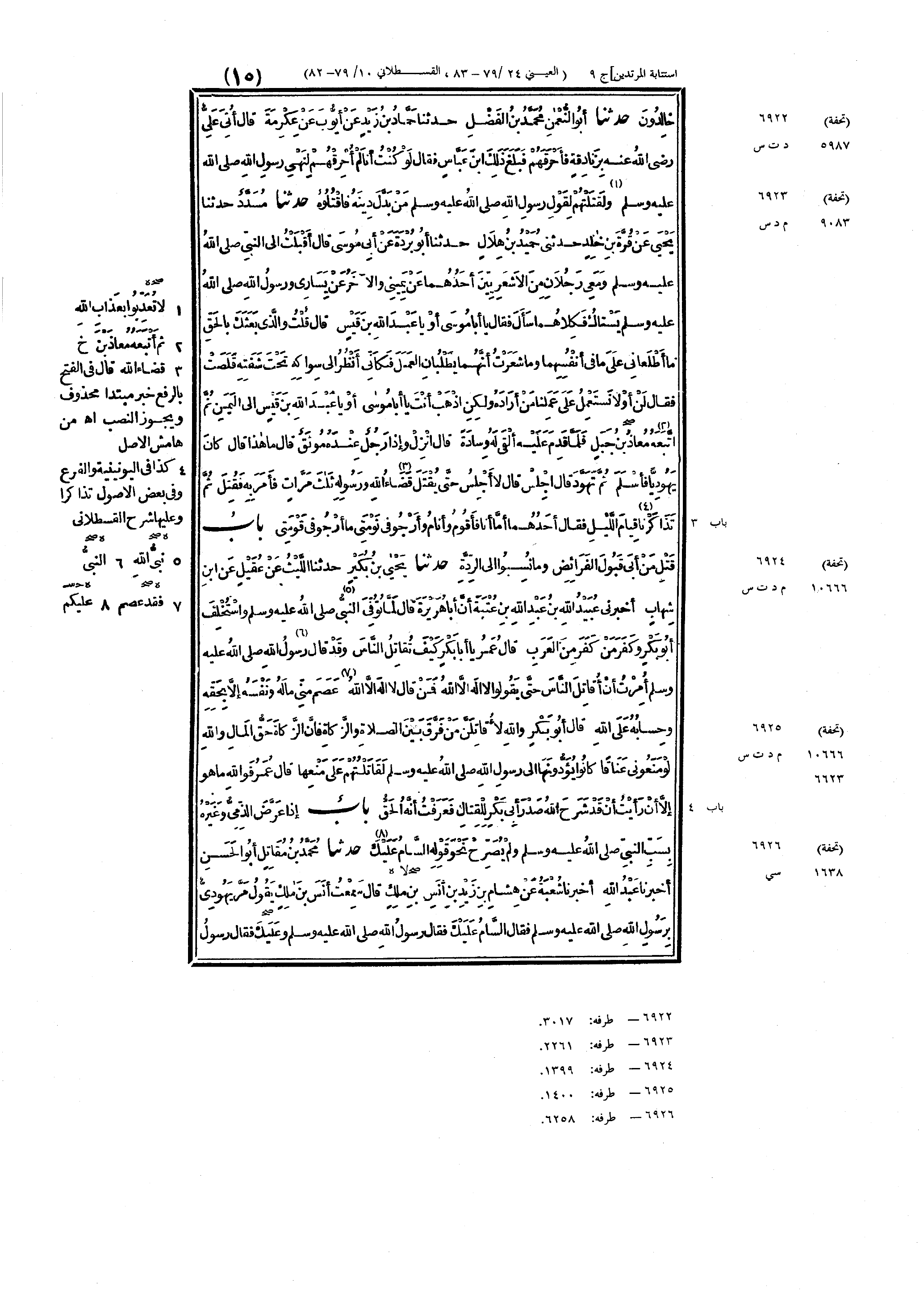
Context
The report appears in the Sahih's chapter 'the ruling on the male and female apostate and calling them to repent' (Kitab Istitabat al-Murtaddin, vol. 9 p. 15, no. 6922); the second locus is in Kitab al-Jihad (vol. 4 p. 61, no. 3017). Its carrier is Ibn Abbas and it comes inside a narrative: zindiqs were brought to Ali, who burned them; Ibn Abbas objects on two counts — he rejects burning ('had it been me I would not have burned them, because the Messenger of God forbade that') but affirms killing ('and I would have killed them, because the Messenger of God said "whoever changes his religion, kill him"'). The sentence is thus transmitted in the Sahih not as a pronouncement of law but as Ibn Abbas's own justification. The tabi'i link in the isnad is Ikrima, about whom the rijal works record an accusation of lying and an attribution of sectarian affiliation; those records are not the subject of this entry and are treated as a separate branch. For the ruling as settled in fiqh see the schools' column: all four agree on killing the male apostate, and differ on the period allowed for repentance and on the female apostate.
End of the previous page
Start of the next page
Positions of the schools
| Hanafi | The male apostate is killed; calling him to repent is recommended, not obligatory. The female apostate is not killed but imprisoned and coerced until she returns to Islam. |
|---|---|
| Maliki | The zindiq is killed without being asked to repent (Muwatta, the chapter on judgment concerning the apostate); the apostate is called to repent for three days, and if he does not return his neck is struck. |
| Shafi'i | Both the male and the female apostate are killed; the ruling for the woman is the same as for the man. |
| Hanbali | The female apostate is also killed; Ahmad b. Hanbal grounds this in the generality of 'whoever changes his religion, kill him'. |
How the tradition defends this
The tradition's defence runs along these lines. (1) Ridda as political treason: in the classical setting apostasy is not a change of religious opinion but a break with the polity and a passage to the enemy's side; the penalty attaches to treason, not to belief. Modern defenders adduce the ridda wars and the reports about the 'reconciled hearts' in support. (2) The generality has been specified: the Hanafi exemption of women shows that even within the tradition the literal generality of the text was not taken absolutely; the ruling is therefore one that other evidence can restrict. (3) The condition of istitaba: the majority make calling to repentance a condition or a recommendation before killing, which is offered as an indication that the penalty is not a reflex applied to whoever changes belief. (4) The chain of transmission: the sentence appears in the Sahih not as a free-standing marfu' ruling but as Ibn Abbas's justification for his reaction to an incident; this context is urged against reading the wording on its own as a statute. What all these defences share is that they try to narrow the scope of the wording; none disputes that the text stands in the Sahih.
Still held today?
What does the Quran say?
- 2:256 Text states it explicitly
«There is no compulsion in religion; right has become distinct from error.» An unqualified negation: the text not only forbids compulsion but gives the reason for it (right and error are already distinct).
- 4:137 Text states it explicitly
The verse describes a group that believes and disbelieves repeatedly, and defers the penalty to the hereafter. In an order where a single change of religion met with death, repeated change would not be possible; the world the text presupposes is one in which such a change is not answered with killing.
- 3:90 Text states it explicitly
«Those who disbelieve after their belief and then increase in disbelief — their repentance will not be accepted»: the consequence set out for turning from belief is the non-acceptance of repentance, not an execution in this world.
- 10:99 Text states it explicitly
«Will you then compel people until they become believers?» The address is to the Prophet himself, and the question is a negation.
- 18:29 Text states it explicitly
«Let whoever wishes believe, and whoever wishes disbelieve.» A statement of freedom cast in the imperative; the consequence that follows it is in the hereafter.
- 5:33 Implied by the text
Where the Quran provides a death penalty it is for 'those who war against God and His messenger and spread corruption in the land' (muharaba); the penalty attaches to an act, not to belief. The tradition's 'apostasy is treason' defence amounts to accepting exactly this distinction — but then the penalty must attach to the act, and a change of belief on its own must fall outside it. A verse criminalising a change of belief on its own was searched for and not found.
This entry does not dispute the report's authenticity; it records that it stands in the Sahih and how it passed into fiqh. The methodological question is this: the Quran takes up turning away from belief in six separate places (2:256, 3:90, 4:137, 10:99, 18:29 and what follows) and in none of them provides a worldly penalty; 4:137, by describing a person who turns repeatedly, implies an order in which killing is not applied. When a single hadith sentence is set against so wide and so repeated a statement of the text, the tradition took the hadith rather than the text as its ground and restricted the Quran's explicit wording by the hadith's generality. The tension within the tradition itself is visible too: the Hanafis break the generality of the wording by exempting women, and the majority delay execution by requiring a call to repentance — the ruling was never applied as absolutely as the wording demands. As for the 'apostasy is treason' defence, the moment it is accepted it requires a return to the measure of 5:33: the penalty attaches to an act, not to belief. On a reading that takes the Quran as the measure the conclusion is plain: the Quran defers the consequence for one who changes belief to the hereafter, and contains no verse commanding that he be killed in this world.