"Abraham lied only three times, two of them for God's sake"
Arabic text
Full page
Translation
Word by word
he did not lie لَمْ يَكْذِبْ* three lies ثَلَاثَ كَذَبَاتٍ* two of them for God's sake ثِنْتَيْنِ مِنْهُنَّ فِي ذَاتِ اللهِ* 'I am sick' ﴿إِنِّي سَقِيمٌ﴾* 'No, this, their chief, did it' ﴿بَلْ فَعَلَهُ كَبِيرُهُمْ هَذَا﴾*
Interlinear view
- لَمْ يَكْذِبْ: Root k-dh-b. The negation, with the exception that follows, turns into an enumeration: 'he did not lie — except three times'.
- ثَلَاثَ كَذَبَاتٍ: Plural of kadhba; the word chosen is not tawriya or maʿariḍ but plain lie. The commentators re-read the word as 'equivocations', but this is the page's own word.
- ثِنْتَيْنِ مِنْهُنَّ فِي ذَاتِ اللهِ: 'Dhat Allah': for God's cause or religion. The qualifier is an excusing clause — the report counts the acts as lies while tying two of them to a legitimate ground, and does not extend the qualifier to the third (Sarah).
- ﴿إِنِّي سَقِيمٌ﴾: 37:89. The report classifies a sentence of the Quran as a lie — and that is the axis of this entry.
- ﴿بَلْ فَعَلَهُ كَبِيرُهُمْ هَذَا﴾: 21:63. The verse itself completes the sentence with a condition: 'so ask them, if they can speak.'
Source
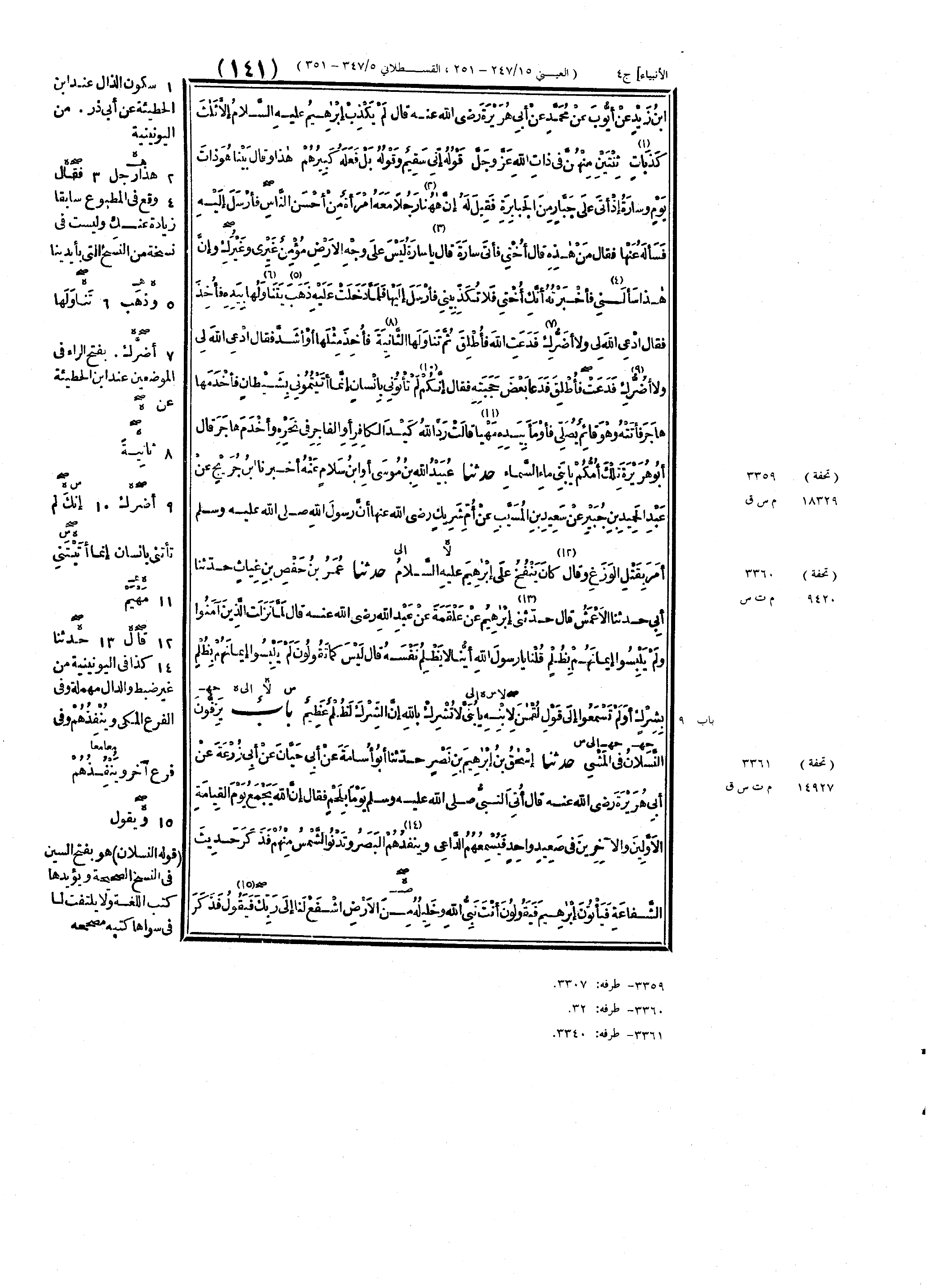
Context
The report stands in the Sahih's "Book of the Reports of the Prophets" and comes twice, consecutively. The short form is no. 3357: "Abraham lied only three times" (printed vol. 4 p. 140). The long form, which is the subject of this entry, is no. 3358; its isnad begins at the foot of 140 and its text runs on 141.
The long text enumerates the three lies and narrates the third: (1) "I am sick"; (2) "No, this, their chief, did it"; (3) presenting Sarah as "my sister" in the land of a tyrant. The third runs thus: Abraham goes to Sarah and says, "There is no believer on the face of the earth but you and I; this man asked me about you and I told him you are my sister — so do not contradict me." When the tyrant reaches out his hand to her he is seized, twice; twice Sarah prays and he is released; he says, "You have not brought me a human being, you have brought me a devil," and gives her Hagar as a servant. Abu Hurayra closes with, "That is your mother, O sons of the water of heaven."
The isnad: Muhammad b. Mahbub, from Hammad b. Zayd, from Ayyub [al-Sakhtiyani], from Muhammad [b. Sirin], from Abu Hurayra. The short form's isnad passes through the same link: Saʿid b. Talid, from Ibn Wahb, from Jarir b. Hazim, from Ayyub, from Muhammad, from Abu Hurayra. The two routes therefore meet at Ayyub. The same hadith is in Muslim (2371).
The classification matters here: the text is marfuʿ (attributed to the Prophet) and it names two sentences of the Quran and places them in the category of "lies". This does not merely offer an interpretation of the Quran; it assigns a moral category to two utterances the Quran contains.
The page's surroundings are worth noting too. Reports 3359, 3360 and 3361 on the same page concern Abraham and Ishmael; 3361 relates Abraham's meeting with his father Azar on the Day of Resurrection. The chapter is the section where the prophets' narratives are told through hadith.
End of the previous page
Start of the next page
How the tradition defends this
The tradition's defence is quite developed here, and rests largely on re-reading a single word.
(1) "Kadhabat" = maʿariḍ (equivocations), not lies. The main line of the commentators — al-Nawawi, Ibn Hajar, al-Qurtubi — glosses the word as "speech whose apparent sense differs from what is intended"; Ibn Hajar says so expressly in *Fath al-Bari* and uses the term maʿariḍ. The ground is the report's own qualifier: if these were outright lies, "for God's sake" would be a contradiction. The text therefore names the acts as lies in form while excusing them in substance.
(2) Each of the three has a truthful reading. "I am sick" — I am sick at heart, or I shall be sick; the page does not supply this, but the preceding verse, "then he cast a look at the stars" (37:88), offers a setting. "No, this, their chief, did it" — the verse's own continuation, "so ask them, if they can speak", builds an argument. "My sister" — in some reports and commentaries Abraham glosses it as "my sister in religion"; and on the page itself he tells Sarah, "there is no believer on the face of the earth but you and I", which intimates in what sense the kinship is meant.
(3) Necessity and the balance of harms. What is at stake in the third episode is protecting a woman from a tyrant; the permissibility of equivocation under necessity is well established in legal theory.
(4) Those who reject the report are inside the tradition too. Fakhr al-Din al-Razi rejects it outright on the ground of prophetic immunity. The tradition is not of one voice here, and rejection is itself an option within it.
(5) A methodological argument: the report stands in both Sahihs; to reject it is to bring down an authenticated text by criticism of content — a move that requires its own separate warrant.
Still held today?
What does the Quran say?
- 19:41 Text states it explicitly
"And mention in the Book Abraham; he was a man of truth, a prophet." The first epithet the Quran uses in introducing Abraham is siddiq: the intensive form of the root s-d-q, "one whose habit is truthfulness". The three acts the report enumerates are named with the opposing root, k-dh-b. Text and report use two opposite roots of the same man.
- 21:63 Text states it explicitly
"He said, 'No, this, their chief, did it; so ask them, if they can speak.'" The verse does not leave the sentence standing alone; it completes it with a condition: "if they can speak". The condition shows the sentence to be not a report of fact but an argument: the moment the hearers concede that the idols cannot speak, Abraham's reductio is complete. The sequel records exactly this: "so they returned to themselves" (21:64), and "you know very well that these do not speak" (21:65). The hearers were not deceived; they were persuaded. The definition of a lie is that it misleads the hearer; what happens here is the opposite.
- 37:88-90 Text states it explicitly
"Then he cast a look at the stars, and said, 'I am sick,' and they turned away from him." The three verses are one scene and contain their own outcome: the words are spoken, the people withdraw, and Abraham turns to the idols. The Quran neither praises nor blames the sentence; it relates it as part of an action. To classify the sentence as "a lie" is an operation the text does not perform — and the report performs it in the Prophet's name.
- 26:84 Implied by the text
"And grant me a tongue of truthfulness among later generations." Abraham's own prayer asks for a "tongue of truthfulness", and 19:50 records that the prayer was answered: "and We granted them a high tongue of truthfulness." Together the two verses constitute the Quran's judgement on Abraham's speech; the report passes the contrary judgement on that same speech three times.
- 9:114 Implied by the text
"Indeed Abraham was tender-hearted and forbearing." Even where the Quran takes up Abraham's asking forgiveness for his father, it explains it not as a fault but as a disposition — awwah, halim — and grounds it in a promise he had made. This kind of explanation is the only place where the Quran opens Abraham to comment at all; nowhere is there an imputation of moral fault.
The axis of this entry is a single operation: the report names two sentences that stand in the Quran and places them in the category of "lies". The operation differs from interpretation. To interpret a verse is to say what it means; to assign a verse to a moral category is to pass judgement on it. The report does the second, and does it in the Prophet's name.
What the Quran itself does with those same two sentences is this. At 21:63 the utterance is not left standing alone: "so ask them, if they can speak" — the conditional shows the utterance to be the construction of an argument, not a report of fact; and the sequel records that the hearers were persuaded ("they returned to themselves"; "you know very well that these do not speak"). The definition of a lie is that it misleads the hearer; what happens here is the reverse. At 37:89 the sentence stands in the middle of a scene and the Quran gives its outcome: the people withdraw. The text neither praises nor blames it.
The defence, meanwhile, must be given its due, and the due is not small. The main line of the commentators reads kadhabat as maʿariḍ and takes its ground from the report's own qualifier: "two of them for God's sake" would be meaningless of an outright lie. The reading is internal and coherent. But it has two limits. First: the qualifier covers only two; the third (Sarah) is left outside it — the report itself does not put the three acts on one footing. Second: if what is meant is equivocation, why enumerate at all? The structure "he did not lie — except three times" makes the number itself into a list of faults, and keeping a tally of equivocations is superfluous in a framework where equivocation is no fault.
The real loss appears in the third item. The Quran never tells the story of Abraham and Sarah — not the tyrant, not "my sister", not the giving of Hagar as a servant. What the Quran relates of Abraham is the idols, the fire, the migration, the sacrifice and the Kaʿba. The report's third lie comes wholly from a narrative outside the Quran and runs close to Genesis 12:11-20. That does not refute the report by itself — but bringing a moral verdict drawn from a scene the Quran does not tell back onto two sentences the Quran does tell reverses the direction of proof.
Finally, the measure of this entry is this: the first word 19:41 uses in introducing Abraham is siddiq, and 19:50 records that he was granted "a high tongue of truthfulness". The report uses the plural of the opposing root of that same tongue. The two texts can be harmonised — the maʿariḍ reading attempts it — but the price of harmonisation is to take the page's own word outside its own meaning. This site's work is to make that price visible.