Ibn Qudama: a father marries off his minor virgin daughter even against her aversion and resistance — and on this there is no disagreement
Arabic text
Full page
Translation
Word by word
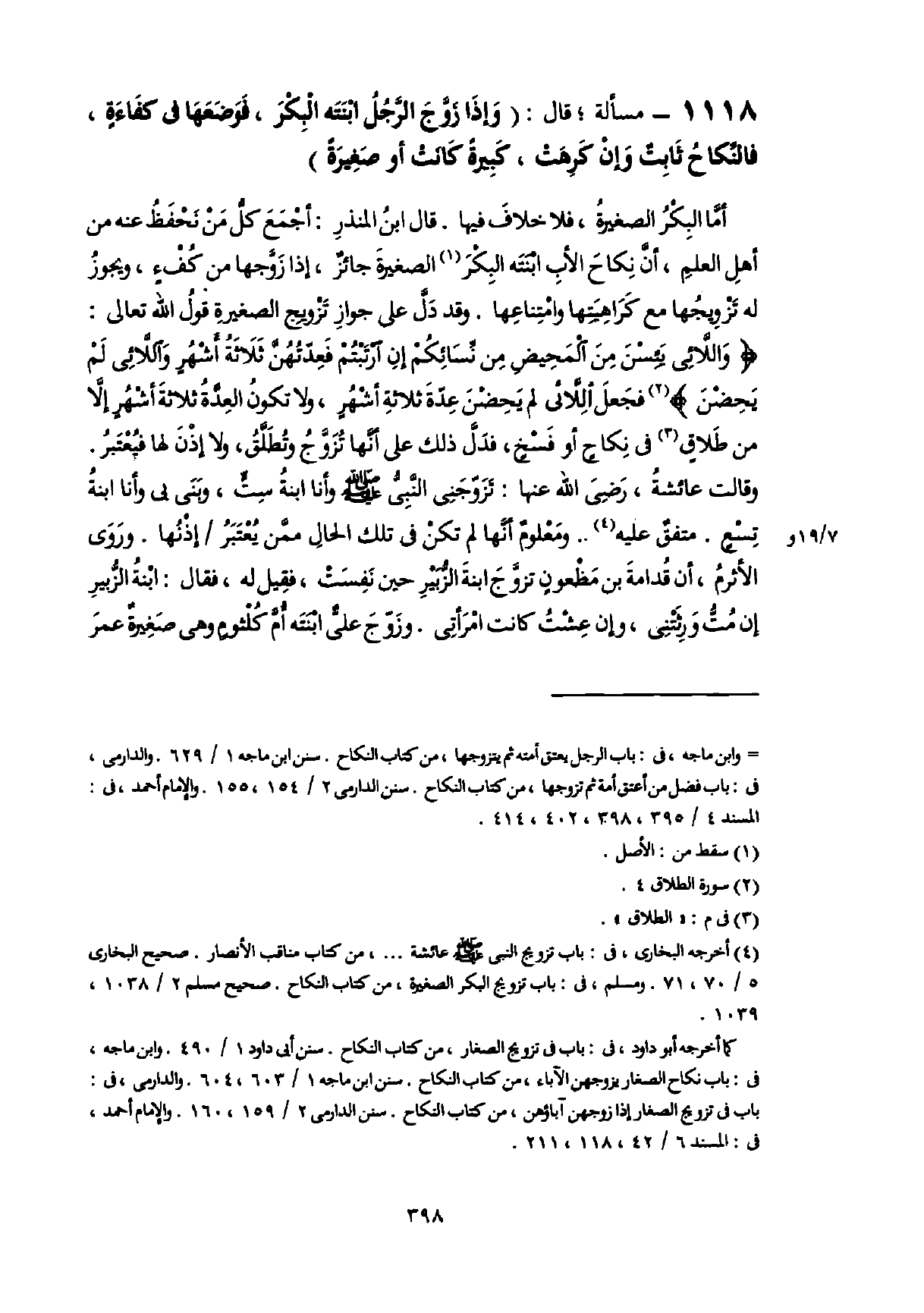
there is no disagreement concerning her فلا خلافَ فيها* everyone among the people of knowledge from whom we have preserved [a view] agrees أجْمَعَ كلُّ مَنْ نَحْفَظُ عنه من أهلِ العلمِ* virgin البِكْرَ (١)* if he marries her to an equal إذا زَوَّجها من كُفْءٍ* despite her aversion and her refusal مع كَرَاهِيَتِها وامْتِناعِها*
Interlinear view
- فلا خلافَ فيها: This is Ibn Qudama's own ruling and it comes **before** the report of consensus in the next sentence. On the same question al-Mabsut vol. 4 p. 212 records the dissent of Ibn Shubruma and Abu Bakr al-Asamm and their argument from 4:6 (see the entry 'Al-Sarakhsi: the Aisha proof and the marriage of minors').
- أجْمَعَ كلُّ مَنْ نَحْفَظُ عنه من أهلِ العلمِ: Ibn al-Mundhir's formula of consensus carries its own limit: 'those from whom we have preserved'. It is the sum of known views, not of all views — and Ibn Qudama turns it into 'there is no disagreement'.
- البِكْرَ (١): The page's own footnote: '(1) missing from: the base manuscript' — the word 'virgin' is **absent** from the editors' base copy and was supplied from other manuscripts. In the base copy the sentence of consensus says only 'a father's contracting the marriage of his minor daughter'.
- إذا زَوَّجها من كُفْءٍ: The power's only qualifier is kafa'a: the husband's parity with the girl in lineage, religion, trade and wealth. What the qualifier protects is not the girl's will but the family's standing.
- مع كَرَاهِيَتِها وامْتِناعِها: Karahiya is from the root k-r-h. The Quran uses the same root to forbid disposing over women: 'it is not lawful for you to inherit women against their will (karhan)' (4:19). Imtina' names not merely a feeling but active **refusal** — the page envisages the girl's objection and declares it without effect.
Source
Context
The passage opens the commentary on mas'ala 1118, taken from al-Khiraqi's Mukhtasar, in the book of marriage of al-Mughni (vol. 9 p. 398). The base text: 'When a man marries off his virgin daughter and places her with an equal, the marriage stands even if she is averse — whether she is grown or small.' Ibn Qudama begins by separating the two limbs of the text and takes up the minor virgin first; this is the quote.
The page supports the ruling with three proofs. (1) The verse: the phrase 'and those who have not menstruated' in 65:4 — Ibn Qudama's inference is that a three-month waiting period can only arise from divorce or annulment after a marriage, so a girl who has not yet menstruated can be married and divorced; and her permission is not sought 'because her permission is of no account'. (2) The report: Aisha's words 'the Prophet married me when I was six and consummated with me when I was nine' — the page's footnote grounds it in al-Bukhari and Muslim. (3) Companion practice: by al-Athram's report, Qudama b. Maz'un married al-Zubayr's daughter 'at the time she was born' (hina nufisat) — 'if I die she inherits from me, if I live she is my wife' — and Ali gave his small daughter Umm Kulthum to Umar.
The next page turns to the text's second limb, the grown virgin, and reports two narrations from Ahmad: one that the father may compel her too (the view of Malik, Ibn Abi Layla, al-Shafi'i and Ishaq), the other that he may not (the choice of Abu Bakr; the view of al-Awza'i, al-Thawri, Abu Ubayd, Abu Thawr, the people of opinion and Ibn al-Mundhir). The 'no disagreement' asserted of the minor does not hold for the grown girl even inside the school.
End of the previous page
Start of the next page
Positions of the schools
| Hanafi | A father (and grandfather) may marry off a minor boy or girl without seeking their consent; the proof is the report about Aisha and the practice of the Companions. The same page records the dissent of Ibn Shubruma and Abu Bakr al-Asamm. |
|---|---|
| Maliki | No one may compel anyone into marriage; the exceptions are enumerated: the father (over his virgin daughter and minor son), the master and the guardian. |
| Shafi'i | The father of a virgin has more right to give her in marriage than she has herself, on the ground that a girl of seven and of nine has no say over herself. |
| Hanbali | A father marries off his minor virgin daughter to an equal even if she is averse and resists; Ibn Qudama says there is no disagreement on this and reports consensus from Ibn al-Mundhir. On the grown virgin there are two narrations from Ahmad. This is the page that is the subject of this entry. |
How the tradition defends this
The tradition's defence runs along these lines.
(1) The power is qualified. The base text ties the father's power to kafa'a; a marriage to someone not the girl's equal falls outside this page's ruling. In classical legal theory the father's power rests on the presumption that he is the one most compassionate towards the child, and it is granted to no guardian other than the grandfather.
(2) Contract and consummation are separate. The Hanbali school separates the marriage contract from sexual union; consummation is tied to the girl's capacity to bear it (see the entry 'Ahmad: a girl who has completed nine is handed over for consummation' — the ifda' condition at Kashshaf 12/70). Defenders say the page regulates a contract, not an act.
(3) The proof is from the Quran. Ibn Qudama grounds the ruling first on a verse, 65:4; the inference is indirect but not arbitrary — a three-month waiting period presupposes divorce, and divorce a prior marriage.
(4) The tradition's own brake is on the record. On the next page Ahmad's second narration defends the view that the grown virgin may not be compelled, with the hadith 'the virgin is not married until her permission is sought', and assigns it to a majority running from al-Awza'i to Ibn al-Mundhir. The school recognises the principle of consent; the dispute is over its reach.
Still held today?
What does the Quran say?
- 4:19 Text states it explicitly
"It is not lawful for you to inherit women against their will (karhan)": the Quran bounds disposal over women with the root k-r-h — they may not be brought into a marital arrangement against their will. The page uses the same root the other way — 'despite her aversion (karahiyatiha)' — and turns the girl's unwillingness from an obstacle to the ruling into part of its scope.
- 4:21 Text states it explicitly
"And they have taken from you a solemn covenant": the party that takes the covenant is the women; the verb is predicated of them. A party 'whose permission is of no account' and who is bound to the contract despite her aversion cannot, by definition, be the one who takes a covenant.
- 4:6 Text states it explicitly
"And test the orphans until they reach [the age of] marriage; then if you perceive in them sound judgement": the Quran ties marriage to an age — 'until they reach marriage' — and names it together with the testing of sound judgement. In the text's own language marriage is a state that lies beyond a threshold; the page's example of a girl married 'at the time she was born' removes the threshold altogether.
- 2:232 Text states it explicitly
"Do not prevent them from marrying their husbands when they agree among themselves in a fair manner": the verse gives the guardian not a power but a prohibition: obstruction. The verb of marrying is predicated of the women and the condition is mutual consent (taradaw, form VI). Here the Quran sets out the relation between guardian and marriage, and that relation is not compulsion but refraining from obstruction.
- 65:4 Compatible with the text
"And those who have despaired of menstruation among your women — if you doubt, their waiting period is three months — and those who have not menstruated": the page's first proof. An honest assessment: the phrase states no age. The first limb is women past menstruation; the second is conjoined to it, and what joins them is not age but the absence of menstruation as a measure — there are causes of not menstruating other than childhood. The verse regulates the counting of a waiting period; it does not legitimise the making of a contract, and it carries no conclusion at all that the girl's permission is 'of no account'. The page's sentence that her permission counts for nothing comes not from the verse but from a premise added to it.
What puts this page in the register is not its recognition of a father's power to marry off his young daughter — that power stands in the canon of all four schools and is already recorded in the register by four entries — but that it envisages the girl's objection and declares it void. The base text says 'even if she is averse'; Ibn Qudama widens it to 'despite her aversion and her refusal'. The page speaks not of the marriage of someone whose consent is absent but of someone who shows her lack of it.
The Quran names this situation and forbids it. 4:19 does not allow women to be brought into a marital arrangement karhan, against their will; the page takes that will into the scope of the ruling with karahiya, a word from the same root. 4:21 defines the women as the party that takes the covenant; 2:232 commands the guardian only not to obstruct, and ties marriage to the mutual consent of the two parties. None of these verses sets an age limit, and this must be said honestly; but all three describe marriage as a relation formed by the will of its parties. A party whose will is declared void stands outside that description.
The page's own Quranic proof, 65:4, does not close the gap. The verse regulates a waiting period; the phrase 'those who have not yet menstruated' states a measure of menstruation, not an age. Ibn Qudama's sentence 'her permission is of no account' is not the verse's conclusion but a premise attached to it: not menstruating = a minor, a minor = one whose permission is void. The second equation is not in the verse.
The claim of consensus shows its limits on its own page as well. Ibn al-Mundhir's formula says 'those from whom we have preserved'; Ibn Qudama turns it into 'there is no disagreement'. Yet on the same question al-Mabsut (vol. 4 p. 212) records the dissent of Ibn Shubruma and Abu Bakr al-Asamm, and the proof of that dissent is precisely 4:6 — the verse that ties marriage to an age. The page's own footnote records, too, that the word 'virgin' in the sentence of consensus is absent from the base manuscript. The 'no disagreement' thus carries, in the tradition's own records, both a dissent and a textual hesitation.
Finally, the page's Companion proof shows the ruling's logical end by itself: Qudama b. Maz'un's marriage to al-Zubayr's daughter 'at the time she was born'. The reason is stated openly on the page and it is an inheritance: 'if I die, she inherits from me'. Where the Quran at 4:6 names marriage together with the testing of sound judgement, the page counts as proof an example that turns marriage into a transaction arranging a newborn's share of an estate.