The claim that it is 'only in al-Bukhari': the report of Aisha's age is in Muslim too, through two chains
Arabic text
Full page
Translation
Word by word
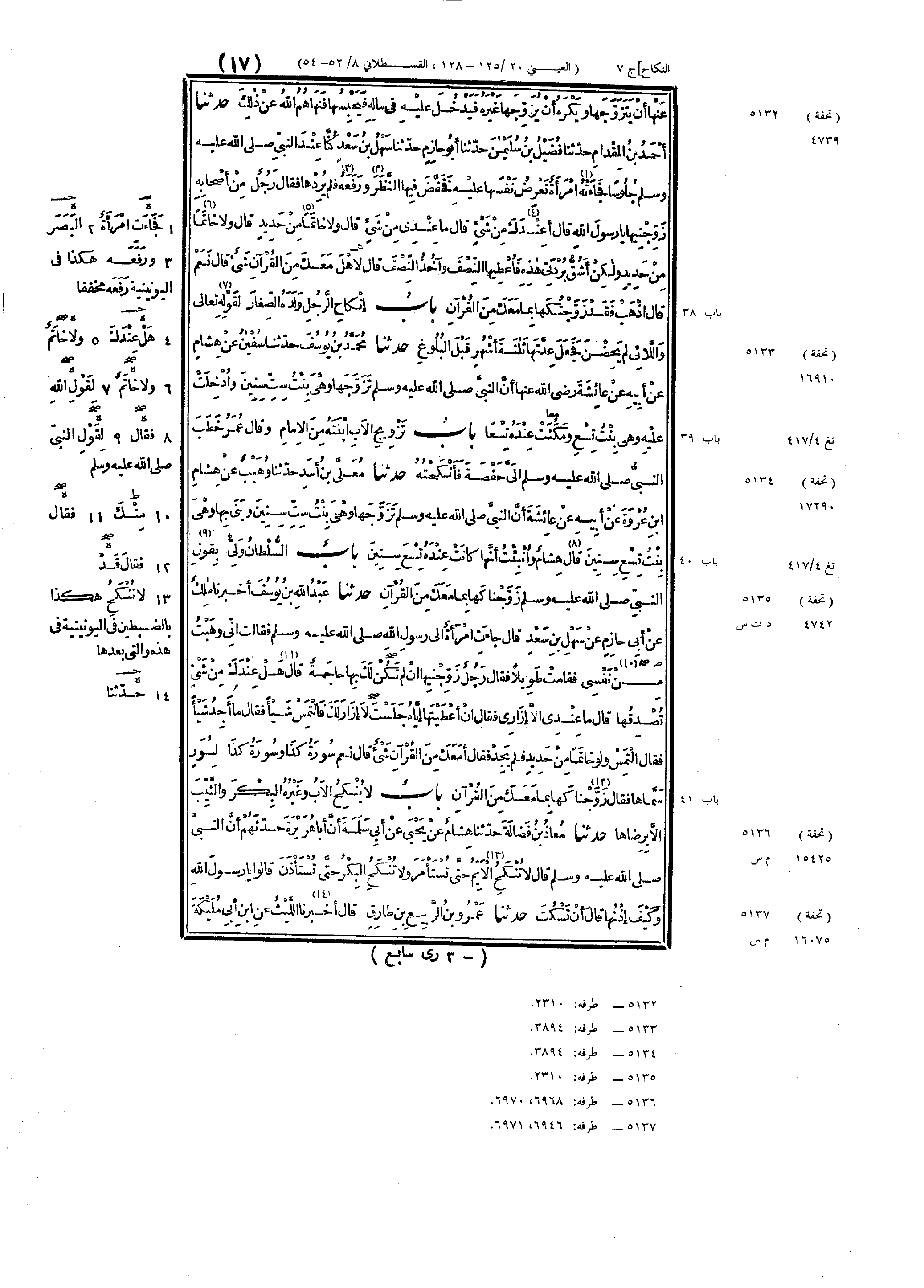
that أَنَّ the Prophet النَّبِيَّ married her تَزَوَّجَهَا* while she وَهِيَ a girl of بِنْتُ six سِتِّ years سِنِينَ and-she was brought in وَأُدْخِلَتْ* to him عَلَيْهِ while she وَهِيَ a girl of بِنْتُ nine تِسْعٍ
Interlinear view
- تَزَوَّجَهَا: Form V with a suffixed object pronoun; it denotes the marriage contract, not consummation — the report gives the two separately, at different ages.
- وَأُدْخِلَتْ: Form IV passive: 'she was brought in as a bride'; leaving the agent unnamed is the report's idiom.
Source
Context
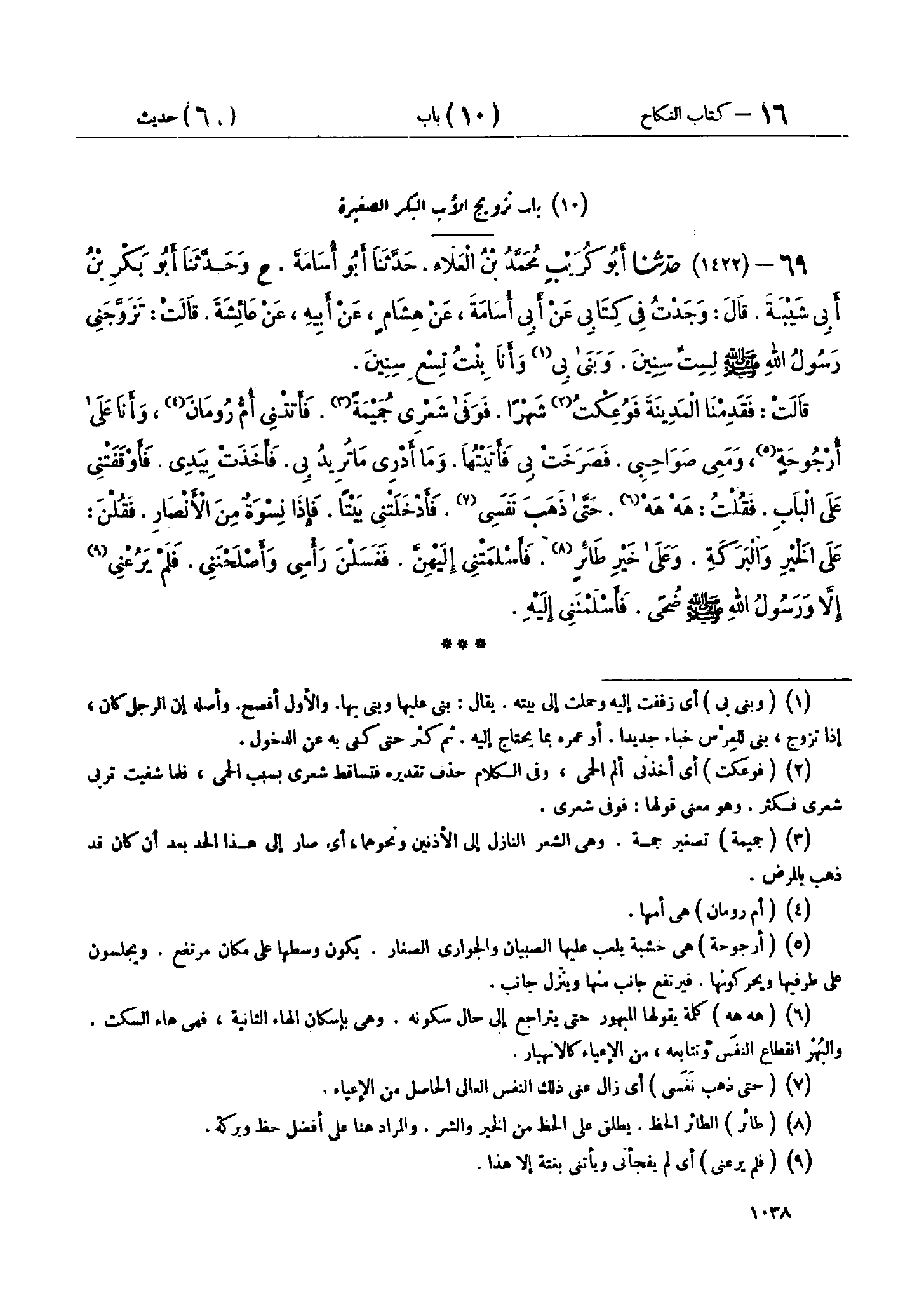
This is a viral verification entry: its subject is not the question of Aisha's age but the testing of a circulating claim about sources. The claim is: 'this report appears only in al-Bukhari, through a single channel.' The claim is false, and its falsity has been verified in two works from the local Shamela database. In al-Bukhari the report appears in the Book of Marriage, in the chapter 'a man marrying off his young children', through two separate isnads one after the other (vol. 7 p. 17, nos. 5133 and 5134), and again in the Virtues of the Ansar as a mursal report of Urwa (vol. 5 p. 56, no. 3896). In Muslim the same report is found in the Book of Marriage, chapter 'the father marrying off a young virgin', under no. 1422, through two separate chains (vol. 2 p. 1038: Abu Kurayb → Abu Usama, and Abu Bakr b. Abi Shayba; vol. 2 p. 1039: Ibn Numayr → Abda b. Sulayman). A second finding must be recorded, and it favours the side making the claim: both of al-Bukhari's chains and both of Muslim's converge on the same narrator, in the chain Hisham b. Urwa → his father Urwa → Aisha. The report is thus 'multi-channelled', but the channels branch from a single family isnad. The honest finding is this: the claim 'only in al-Bukhari' is false; the claim 'it rests on a single family isnad' is true and is a separate matter for examination.
End of the previous page
Start of the next page
How the tradition defends this
The position of the one making the claim can be stated as follows, and part of it is right. (1) What is meant may be 'a single isnad': in saying 'only in al-Bukhari' the claimant often means not a count of books but that the report comes from a single source (Hisham b. Urwa); on that reading what is said is true, and this entry confirms it. (2) There is a record about the narrator: the rijal works carry material about Hisham b. Urwa's transmissions after he moved to Iraq; that is a legitimate discussion about the quality of the isnad. (3) al-Bukhari's chapter heading: the report is placed by al-Bukhari under a legal chapter ('a man marrying off his young children'), so that it stands in the Sahih not as a historical note but as proof of a ruling — which makes the target of the objection legitimate. The wording of the claim, however, is false: the report is in Muslim, in the Sunan works and in the Musnad as well; the verdict this entry gives concerns that wording alone.
Still held today?
What does the Quran say?
- 4:6 Text is silent
«Test the orphans until they reach the age of marriage; then if you perceive in them sound judgment, hand over their property to them.» The Quran sets an order between 'reaching the age of marriage' and 'sound judgment'. The subject of this entry, however, is not the question of age but a claim about the number of sources; the Quran says nothing about the marriage age of any particular person, and that silence is recorded honestly. The question of age itself belongs in a separate entry, by way of 65:4 and 4:6.
- 17:36 Text states it explicitly
«Do not pursue that of which you have no knowledge.» This is the reason such an entry exists at all: a claim may not be repeated without verification at the source, whichever side it happens to serve.
- 49:6 Text states it explicitly
«If a transgressor brings you news, verify it.» The command to verify holds whatever the source; the same measure applied to the tradition's reports applies to the claims made against the tradition.
The measure this site applies is not one-directional. If the tradition's reports are verified at the source, then the claims made against the tradition must be verified by the same measure; otherwise the criticism repeats the method of what it criticises. The claim 'this report appears only in al-Bukhari' does not survive opening the relevant pages of two works: the report is in Muslim through two separate chains, and both scans are set side by side on this page. The observation underlying the claim, however — that all the chains converge on Hisham b. Urwa — is correct and has been recorded; that the wording of a claim is false does not make the observation behind it false. The methodological note that matters is this: al-Bukhari placed the report under a legal chapter and cited 65:4 in the chapter heading as its proof, so that in the Sahih it stands not as a historical note but as the ground of a ruling on marrying off minors. Turning to the Quran, 4:6 sets an order between marriage and sound judgment and says nothing about the age of any particular person; that silence is not a gap here but a finding that shows where the real argument lies.