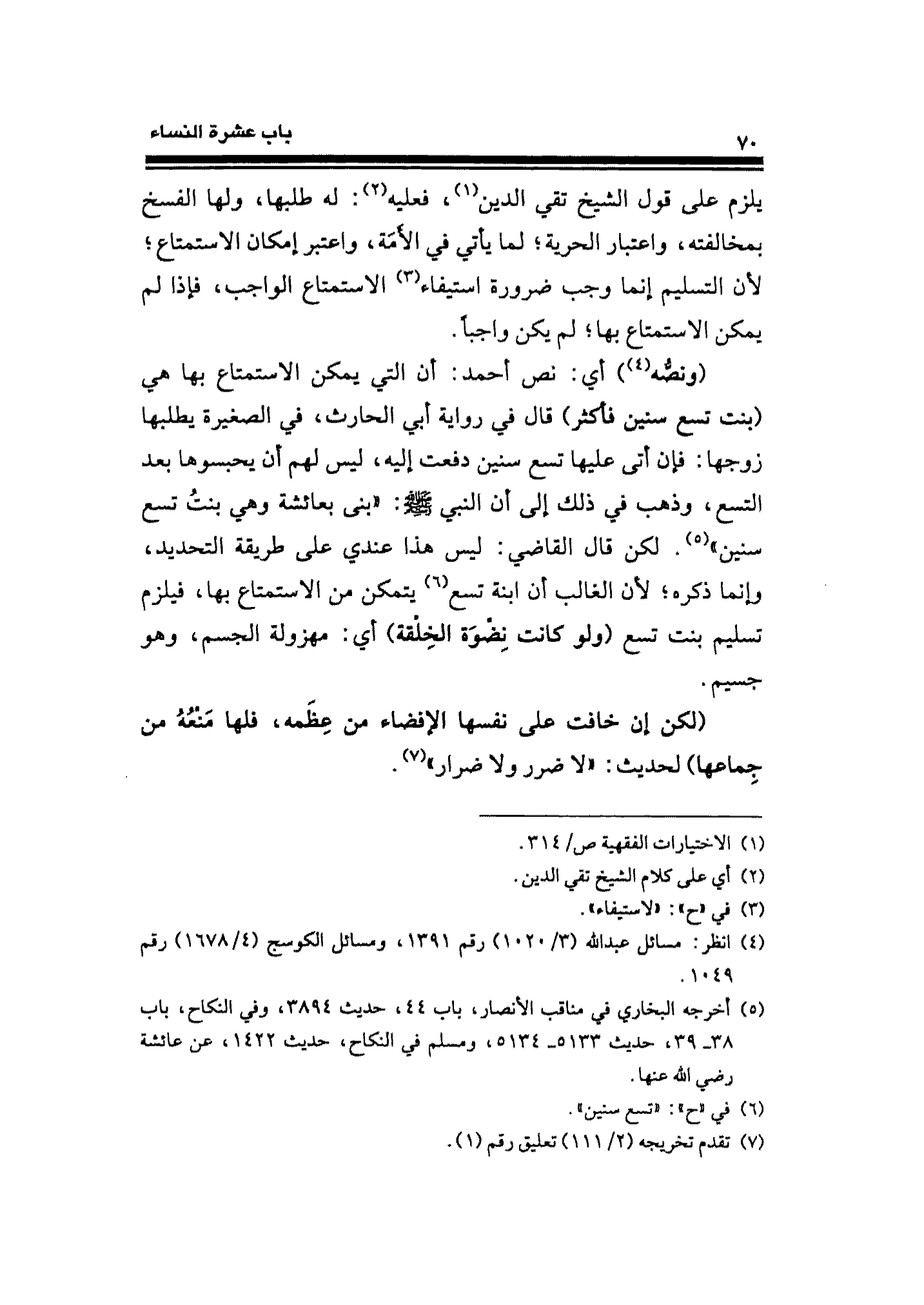
Ahmad ibn Hanbal's explicit ruling: a girl who has completed nine is handed over for consummation if her husband asks
Arabic text
Full page
Translation
Word by word
Ahmad's explicit ruling نص أحمد* with whom enjoyment is possible يمكن الاستمتاع بها* one who has completed nine years or more بنت تسع سنين فأكثر concerning the young girl whose husband demands her في الصغيرة يطلبها زوجها* she is handed over to him دفعت إليه* they have no right to withhold her ليس لهم أن يحبسوها*
Interlinear view
- نص أحمد: In Hanbali jurisprudence a nass is an answer given in the imam's own words and treated in the school as beyond dispute; al-Buhuti here transmits the imam's words, not his own preference.
- يمكن الاستمتاع بها: Form X of m-t-ʿ: in juristic usage, sexual enjoyment. The criterion is neither the girl's consent nor her maturity but the possibility of the act.
- في الصغيرة يطلبها زوجها: al-saghira = a girl who has not reached maturity. The demand is framed as the husband's act and the handing over as the family's; the girl performs no act.
- دفعت إليه: Passive of d-f-ʿ: the same verb is used in the Quran at 4:6 for handing over an orphan's **property** (fa-dfaʿu ilayhim amwalahum).
- ليس لهم أن يحبسوها: No power is created in the family's favour but a prohibition against it: withholding is unlawful.
Source
Context
The passage stands in Kashshaf al-Qina's chapter on the conduct of married life, the division of nights and marital discord, at the question of handing the wife over to the husband's house (vol. 12 p. 70). Al-Buhuti first glosses the base text's (al-Iqna') condition — handing over depends on the husband's demand and on the wife being 'capable of being enjoyed' — and then fixes the measure of that capability by Ahmad's explicit ruling.
The page carries three records together and all three belong in this entry. (1) The nass: a girl who has completed nine is handed over and her family may not withhold her; Ahmad grounds this in the Prophet consummating his marriage with Aisha at nine. (2) The Qadi's objection: 'this is not, to my mind, by way of fixing a limit; he said it because with a girl of nine enjoyment is usually possible' — the ground is capability rather than age, but the outcome is unchanged: a girl who has completed nine must be handed over. (3) A limit: she is handed over even if she is of slight build; but if she fears ifda (the tearing that joins the two passages) because of his size, she has the right to refuse intercourse, on the ground of the report 'no harm and no reciprocating harm'.
The following page sets out the consequences: maintenance remains the husband's obligation, no option of annulment arises for him, and he enjoys her as one enjoys a menstruating wife (that is, short of intercourse); if she denies his claim the burden of proof falls on her, and the testimony of a trustworthy woman is accepted as to the narrowness of her passage and the size of his member.
End of the previous page
Start of the next page
Positions of the schools
| Hanafi | A father may marry off his young daughter without seeking her consent; consummation is tied to her ability to bear intercourse, and no fixed age is given for it. |
|---|---|
| Maliki | The condition of consummation is not the girl's maturity but her physical fitness for intercourse; if the husband has reached maturity and intercourse is possible, she may be compelled to be handed over even though she has not. |
| Shafi'i | The father of a virgin has more right to give her in marriage than she has herself, on the ground that a girl of seven and of nine has no say over herself. |
| Hanbali | By Ahmad's explicit ruling a girl who has completed nine is handed over if her husband demands her, and her family may not withhold her; the Qadi holds this is not a fixing of an age but a statement about capability. This is the page that is the subject of this entry. |
How the tradition defends this
The tradition's defence runs along these lines. (1) Capability, not age: the Qadi's objection on this same page is the defence's strongest support — nine is not a limit but a description of what is usually the case; the measure is actual capability. (2) The harm proviso is real: the page recognises the girl's right to refuse intercourse for fear of ifda and grounds it in the principle of 'no harm'; the ruling is therefore not an unqualified order of surrender. (3) Historical setting: classical law regulates a society in which the threshold of maturity was understood differently and marriage was an economic security; the ruling should be read in that setting. (4) Present practice: most institutions following the Hanbali tradition today set a minimum age for marriage; the classical text is a record of juristic history, not a fatwa in force. (5) The scope of the nass: Ahmad's answer was given to a question (a family withholding the girl when the husband demands her) and speaks to the lawfulness of withholding; it is not a general command to marry off girls at nine. None of these defences disputes what stands on the page; all of them discuss the ruling's ground and its scope.
Still held today?
What does the Quran say?
- 4:6 Text states it explicitly
'Test the orphans until they reach [the age of] marriage; then if you discern in them sound judgement, hand over to them their property.' The same verb as on the page (dafaʿa) occurs here, but with a different object: what is handed over is property, not a person; and the handing over is tied to two thresholds — the age of marriage and the discernment of sound judgement. This is the measure the text builds.
- 4:21 Text states it explicitly
'And how could you take it back when you have gone in unto one another, and they have taken from you a solemn covenant?' The verse describes sexual union with 'you have gone in unto one another' — a reciprocal verb with two subjects — and immediately recalls the solemn covenant the woman has taken. The description on the page runs one way only: the demand is the husband's, the handing over the family's, and the girl performs no act. Note too that the term ifda used on the page shares the root of this verse's verb (f-d-w): in the Quran the word names the spouses' coming to one another, in the juristic text the prospect of an injury.
- 2:187 Implied by the text
'They are a garment for you and you are a garment for them.' The Quran describes sexual union through reciprocity; each party is the other's garment. A description in which one party demands and the other is handed over does not carry that symmetry.
- 30:21 Implied by the text
'He created for you from yourselves spouses, that you may find repose in them, and He set between you affection and mercy.' The purpose the text states for the contract is repose, affection and mercy. The measure on the page is 'the possibility of enjoyment'; the two are not the same, and nowhere does the text set the latter as the purpose.
- 65:4 Compatible with the text
'And [likewise] those who have not menstruated.' The verse adduced as proof for a minor's marriage. The honest assessment: the phrase states no age — the first member of the sentence is women whose menses have ceased, and what joins them is the unavailability of menstruation as a measure. Further, the verse regulates the counting of a waiting period; it licenses neither a contract nor a consummation. In any case the ruling on this page is grounded not in the verse but in a report given without a chain.
What this page discusses is not the validity of a contract but the handing over of a person; and the ruling is framed in the page's own words as 'they have no right to withhold her'. The measure is stated openly: the possibility of enjoyment. No description the Quran uses of marriage or of sexual union employs that measure.
The text's own measures are these. 4:6 sets a threshold, and it is two-layered — reaching the age of marriage and the discernment of sound judgement; and it asks this not for a person but for property. The same verb (dafaʿa) is used on the page of a girl and in the verse of an estate, and the verse requires, in order to release property, a maturity the page does not require in order to release a person. 4:21 describes sexual union with 'you have gone in unto one another', a verb of reciprocity; 2:187 makes each party the other's garment; 30:21 gives the purpose of the contract as repose, affection and mercy. None of these is compatible with a one-way relation of surrender.
The most-discussed part of the page is the Qadi's objection, and it is genuinely strong for the defence: 'this is not a fixing of a limit'. But the objection does not remove the ruling, it changes its ground — nine is not a boundary but the age at which capability is usually present; the outcome stays the same. And the objection makes the measure plainer still: the decisive question is not a judgement about the girl's own condition but whether the sexual act is possible.
The harm proviso the page itself records — the right to refuse for fear of ifda — does not weaken this reading but strengthens it. That a ruling anticipates a potentially fatal injury as a live possibility and legislates an exception against it, is the text's own statement about the nature of the act being regulated. That a word of the same root names, in the Quran (4:21), the spouses' coming to one another and here the prospect of a tearing, is that difference itself.
Honesty requires recording two things. First: the Quran gives no numeric age for marriage or for consummation; this is a silence and should be reported as one. What the text gives is not an age but capacity and consent. Second: the strongest text against this reading is 65:4, treated above; its traditional reading is not contrary to the text, but neither is it required by it, and in any case a rule for counting a waiting period cannot settle the law of consummation. The real ground of the ruling on this page is not a verse in any event: Ahmad's own stated reason is a report transmitted without its chain.